Juratyrant
"Jurassic tyrant"
- Lived
- 145 to 143 million years ago, Late Jurassic
- Diet
- Carnivore
- Group
- Theropods
- Found in
- United Kingdom
- Named by
- Brusatte and Benson 2013
Where its fossils were found
The evidence
Today

145 million years ago
Habitat
Juratyrant lived on land near the shallow sea that deposited the Kimmeridge Clay in southern England. Other dinosaurs recorded from these rocks include Dacentrurus, Cumnoria and Duriatitan.
Field notes
About Juratyrant
What it was like
Juratyrant was an early relative of the tyrannosaurs, a medium-sized, two-legged hunter. It is known from part of the hips, legs and backbone.
It was much smaller than the giant tyrannosaurs that came tens of millions of years later.
Its world
It lived at the end of the Jurassic in what is now southern England. Its bones come from the Kimmeridge Clay, rocks laid down in a shallow sea, which have also produced the stegosaur Dacentrurus and the plant eater Cumnoria.
How it was found
Its bones were first described as a species of Stokesosaurus. Brusatte and Benson gave them their own genus in 2013.
Field gallery
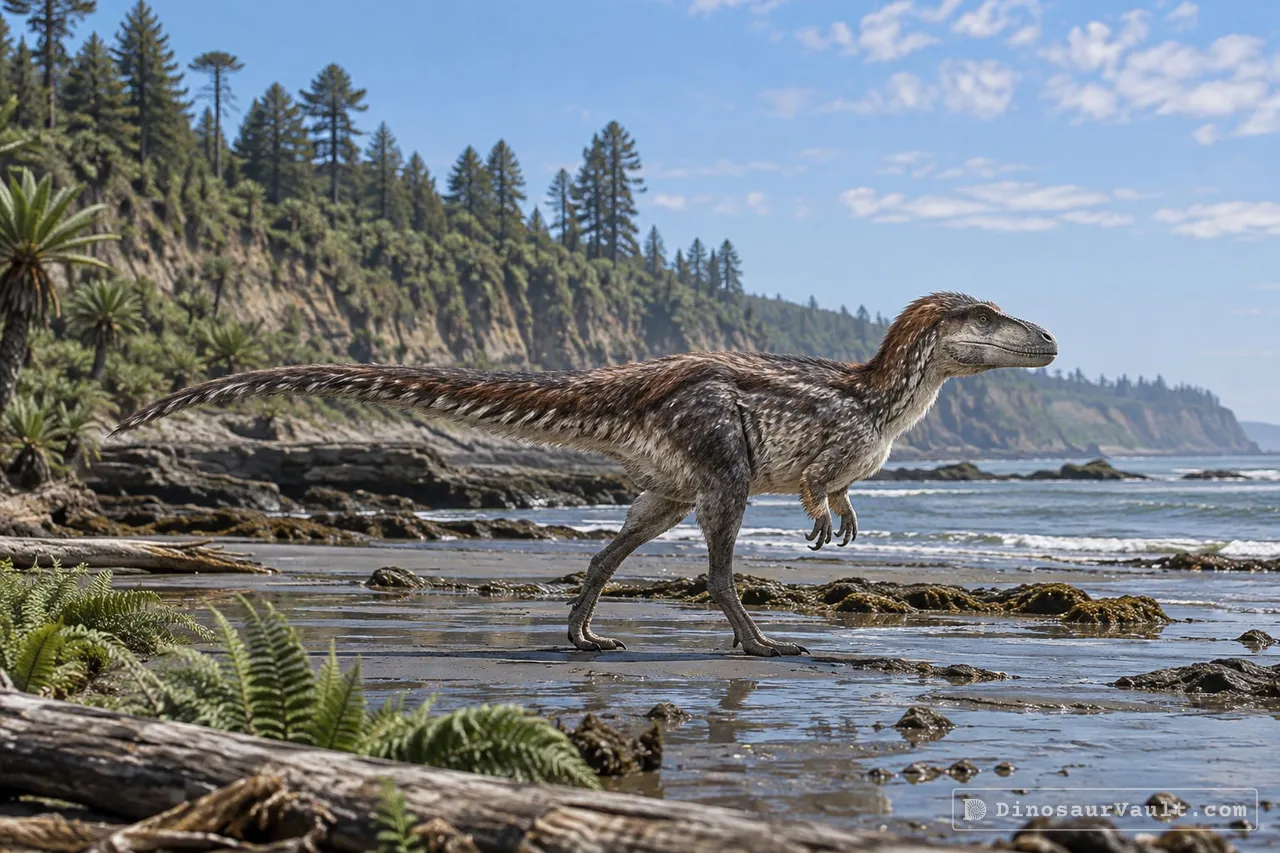
More views of Juratyrant
Scenes reconstructed from the available fossil evidence.
Lived alongside
Found in the same rock formations


A rock formation can hold fossils laid down millions of years apart, so not every animal here met Juratyrant.
The evidence
The science behind Juratyrant
Which parts of the picture come from its own bones, and which come from its relatives.
From its own fossils
- A partial adult skeleton preserves the complete hips, thigh and shin bones, and parts of the neck, back and tail.
- The hip bones have a deep hollow below the hip socket and a folded edge on the lower rear portion.
- Its shin bone is long compared with its thigh bone, and a low ridge for the calf bone runs all the way to the top of the shin.
Borrowed from relatives
- The missing skull and arms are restored by comparison with early tyrannosauroids such as Eotyrannus and Dilong.
Still unknown
- The shape of its skull, the proportions of its arms, and how it hunted.
- Its skin covering and color.
- Where it belongs in the family tree. Some studies place it among early tyrannosaur relatives close to Eotyrannus, while one recent analysis groups it instead with small early coelurosaurs such as Tanycolagreus under one of its methods.
Discovery timeline
- 2008Full descriptionBenson
- 2013Named itBrusatte & Benson
- 2016Family treeBrusatte & Carr
- 2022Close relativeNaish & Cau
- 2025Family treeDelcourt et al.
Key papers
The research behind what we know of Juratyrant
Full description
Described the partial skeleton later named Juratyrant, identifying features of an early tyrannosauroid in its hips and legs.
New information onStokesosaurus, a tyrannosauroid (Dinosauria: Theropoda) from North America and the United Kingdom. Journal of Vertebrate Paleontology 28: 732-750
Read the paper : New information onStokesosaurus, a tyrannosauroid (Dinosauria: Theropoda) from North America and the United Kingdom (opens in a new tab)Named it
Separated Juratyrant from Stokesosaurus after comparing their hip bones and testing their relationships.
The systematics of Late Jurassic tyrannosauroid theropods from Europe and North America. Acta Palaeontologica Polonica 58: 47-54
No link available
Family tree
Placed Juratyrant and Stokesosaurus outside the giant tyrannosaur family and compared their relationship with Eotyrannus using different methods.
The phylogeny and evolutionary history of tyrannosauroid dinosaurs. Scientific Reports 6
Read the paper : The phylogeny and evolutionary history of tyrannosauroid dinosaurs (opens in a new tab)Close relative
Described the skeleton of Eotyrannus in detail and found no close link between it and Juratyrant.
The osteology and affinities of Eotyrannus lengi , a tyrannosauroid theropod from the Wealden Supergroup of southern England. PeerJ 10: e12727
Read the paper : The osteology and affinities of Eotyrannus lengi , a tyrannosauroid theropod from the Wealden Supergroup of southern England (opens in a new tab)Family tree
Restudied Santanaraptor and Mirischia; under one weighting method its family tree put Juratyrant at the base of their group with Tanycolagreus, away from tyrannosaur relatives.
The coelurosaur theropods of the Romualdo formation, early Cretaceous (Aptian) of Brazil: Santanaraptor placidus meets Mirischia asymmetrica. The Anatomical Record 309: 2752-2789
Read the paper : The coelurosaur theropods of the Romualdo formation, early Cretaceous (Aptian) of Brazil: Santanaraptor placidus meets Mirischia asymmetrica (opens in a new tab)
Close relatives
Other members of Tyrannosauroidea


Sources: Wikidata