Jinbeisaurus
Type species Jinbeisaurus wangi
- Lived
- 101 to 72 million years ago, Late Cretaceous
- Diet
- Carnivore
- Group
- Theropods
- Found in
- China
- Named by
- Wu et al. 2020
Where its fossils were found
The evidence
Today

90 million years ago
Habitat
The Huiquanpu Formation in China records a landscape crossed by rivers. Other dinosaurs from these rocks include Huabeisaurus and Datonglong.
Field notes
About Jinbeisaurus
What it was like
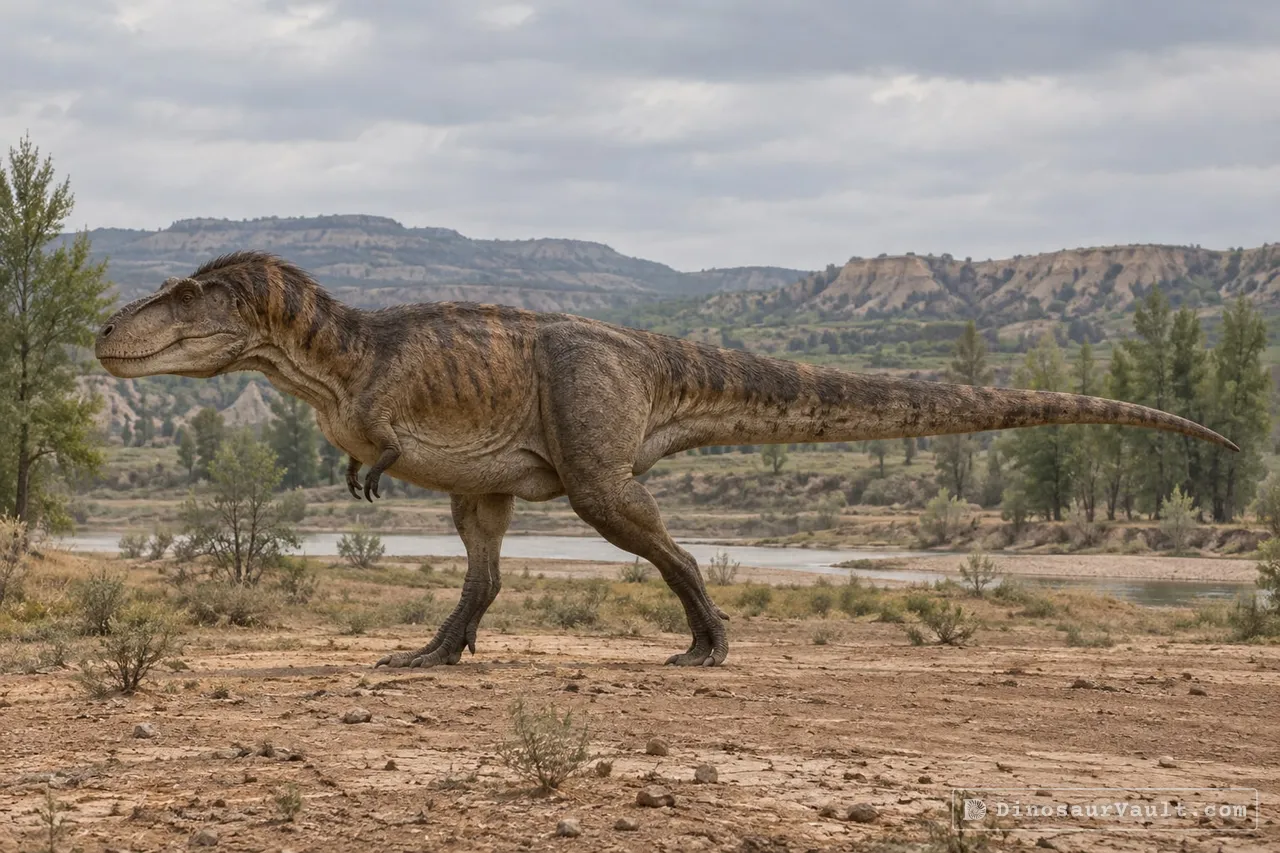
Jinbeisaurus was a tyrannosauroid, a mid-sized relative of Tyrannosaurus. It is known from part of a skull and skeleton.
Its world
It lived in the Late Cretaceous, in what is now China. It comes from the Huiquanpu Formation, where it shared the land with the armored Saichania and the sauropod Huabeisaurus.
How it was found
Wu and colleagues named Jinbeisaurus in 2020. The type species is Jinbeisaurus wangi.
Field gallery
More views of Jinbeisaurus
Scenes reconstructed from the available fossil evidence.
Lived alongside
Found in the same rock formations


A rock formation can hold fossils laid down millions of years apart, so not every animal here met Jinbeisaurus.
The evidence
The science behind Jinbeisaurus
Which parts of the picture come from its own bones, and which come from its relatives.
From its own fossils
- The known bones include paired upper jaw bones, an associated lower jaw bone and part of the hip.
- The upper jaw has a broad strut between its two openings, and the lower jaw has low nerve openings.
Borrowed from relatives
- Its limbs and tail are unknown.
Still unknown
- Its full body proportions and adult size.
- Whether its skin carried scales, feathers or both.
- Experts disagree about whether the known bones distinguish a separate genus or belong to a juvenile of another tyrannosaurid.
Discovery timeline
- 2013Same rocksD'Emic et al.
- 2020Named itWu et al.
- 2026Growing upRaun et al.
Key papers
The research behind what we know of Jinbeisaurus
Same rocks
Redescribed Huabeisaurus, a long-necked plant eater from the Huiquanpu Formation, and compared it with other Asian sauropods.
Osteology of Huabeisaurus allocotus (Sauropoda: Titanosauriformes) from the Upper Cretaceous of China. PLoS ONE 8: e69375
Read the paper : Osteology of Huabeisaurus allocotus (Sauropoda: Titanosauriformes) from the Upper Cretaceous of China (opens in a new tab)Named it
Named Jinbeisaurus from jaw bones and a partial skeleton, placing it among relatives of the giant tyrannosaurs.
A new tyrannosauroid from the Upper Cretaceous of Shanxi, China. Cretaceous Research 108: 104357
Read the paper : A new tyrannosauroid from the Upper Cretaceous of Shanxi, China (opens in a new tab)Growing up
Treats Jinbeisaurus as a juvenile tyrannosaur whose identity is unresolved while reassessing other young Asian tyrannosaurs.
Taxonomic reassessment of juvenile tyrannosaurine specimens from Asia reveal large biogeographic ranges in tyrannosaurids. Cretaceous Research 186: 106412
Read the paper : Taxonomic reassessment of juvenile tyrannosaurine specimens from Asia reveal large biogeographic ranges in tyrannosaurids (opens in a new tab)
Close relatives
Other members of Tyrannosauroidea


Sources: Wikidata