Huabeisaurus
"North China lizard"
- Lived
- 101 to 72 million years ago, Late Cretaceous
- Diet
- Herbivore
- Group
- Sauropods, Euhelopodidae
- Found in
- China
- Named by
- Pang and Cheng 2000
Where its fossils were found
The evidence
Today

90 million years ago
Habitat
Rivers laid down the silty mud in which its skeleton was buried. The Huiquanpu Formation also preserves Datonglong and Jinbeisaurus.
Field notes
About Huabeisaurus
What it was like
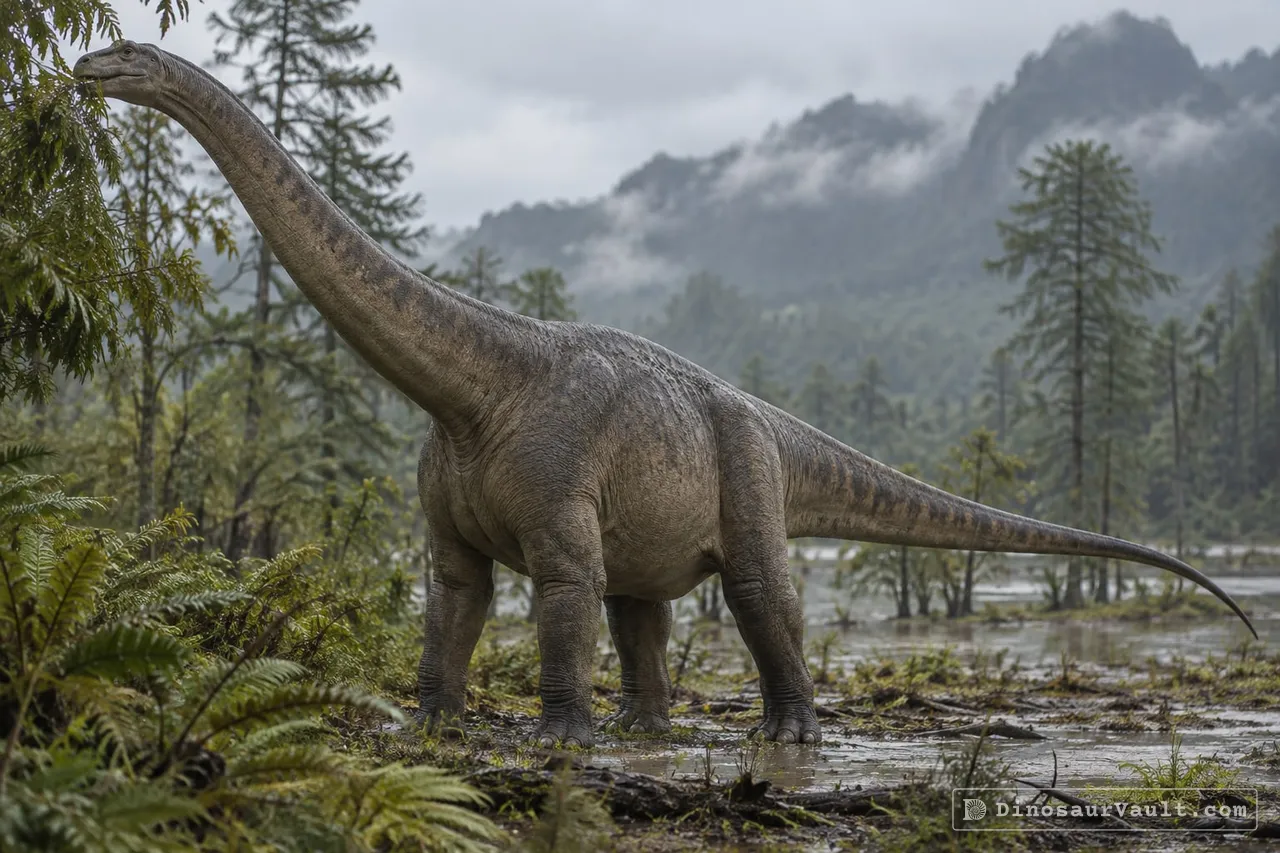
Huabeisaurus was a long-necked, four-legged plant eater, known from many bones of one animal, including limbs, backbones and teeth.
Its world
It lived in the Late Cretaceous in what is now northern China. Its bones come from the Huiquanpu Formation, where the early duckbill relative Datonglong has also been found.
How it was found
Pang and Cheng named Huabeisaurus in 2000, from a single find.
Field gallery
More views of Huabeisaurus
Scenes reconstructed from the available fossil evidence.
1 of 3
Lived alongside
Found in the same rock formations


A rock formation can hold fossils laid down millions of years apart, so not every animal here met Huabeisaurus.
The evidence
The science behind Huabeisaurus
Which parts of the picture come from its own bones, and which come from its relatives.
From its own fossils
- Much of a single, partly articulated skeleton preserves teeth, neck, back and tail vertebrae, ribs, shoulders, hips and limb bones. A separate upper arm bone once assigned to it was set aside in a later restudy.
- Its teeth have slender, rounded crowns with wrinkled enamel, and the spines on its rear neck vertebrae are relatively tall and split in two.
- The shin bones are relatively long compared with the thigh bones. The thigh bone is somewhat slender, and the forearm bone is slender with a widened lower end.
Borrowed from relatives
- Much of the body is known from its own bones. The missing skull is restored by comparison with Euhelopus, and the missing upper arm and elbow with Mnyamawamtuka.
Still unknown
- The complete shape of its skull.
- Its closest relatives. It was linked with Euhelopus and other Asian sauropods, but one recent study left its position unresolved.
- Its skin texture and color, and which plants it preferred to eat.
Discovery timeline
- 2000Named itPang & Cheng
- 2012Family treeD'EMIC
- 2013Full descriptionD'Emic et al.
- 2013Close relativePoropat & Kear
- 2026Family treeSethapanichsakul et al.
Key papers
The research behind what we know of Huabeisaurus
Named it
Named Huabeisaurus from a partial skeleton and proposed a new sauropod family for it.
A new family of sauropod dinosaur from the Upper Cretaceous of Tianzhen, Shanxi province, China. Acta Geologica Sinica 74: 117-125
No link available
Family tree
Rebuilt the early titanosauriform family tree and supported a group of related Cretaceous Asian sauropods called Euhelopodidae.
The early evolution of titanosauriform sauropod dinosaurs. Zoological Journal of the Linnean Society 166: 624-671
Read the paper : The early evolution of titanosauriform sauropod dinosaurs (opens in a new tab)Full description
Restudied the skeleton, identified distinctive features and linked Huabeisaurus with other Asian sauropods in Euhelopodidae.
Osteology of Huabeisaurus allocotus (Sauropoda: Titanosauriformes) from the Upper Cretaceous of China. PLoS ONE 8: e69375
Read the paper : Osteology of Huabeisaurus allocotus (Sauropoda: Titanosauriformes) from the Upper Cretaceous of China (opens in a new tab)Close relative
Photographed and digitally rebuilt the skull of Euhelopus, a related Asian sauropod whose head is better known.
Photographic Atlas and Three-Dimensional Reconstruction of the Holotype Skull of Euhelopus zdanskyi with Description of Additional Cranial Elements. PLoS ONE 8: e79932
Read the paper : Photographic Atlas and Three-Dimensional Reconstruction of the Holotype Skull of Euhelopus zdanskyi with Description of Additional Cranial Elements (opens in a new tab)Family tree
Named a new sauropod and, in one of its analyses, placed Huabeisaurus in an unresolved group with other sauropods such as Erketu.
The first sauropod dinosaur from the Lower Cretaceous Khok Kruat Formation of Thailand enriches the diversity of somphospondylan titanosauriforms in southeast Asia. Scientific Reports 16
Read the paper : The first sauropod dinosaur from the Lower Cretaceous Khok Kruat Formation of Thailand enriches the diversity of somphospondylan titanosauriforms in southeast Asia (opens in a new tab)
Close relatives
Other members of Euhelopodidae


Sources: Wikidata