Datonglong
- Lived
- 101 to 72 million years ago, Late Cretaceous
- Diet
- Herbivore
- Group
- Ornithopods
- Found in
- China
- Named by
- Xu et al. 2016
Where its fossils were found
The evidence
Today

90 million years ago
Habitat
River plains in what is now northern China. Huabeisaurus, Jinbeisaurus and Saichania are also recorded from the Huiquanpu Formation.
Field notes
About Datonglong
What it was like
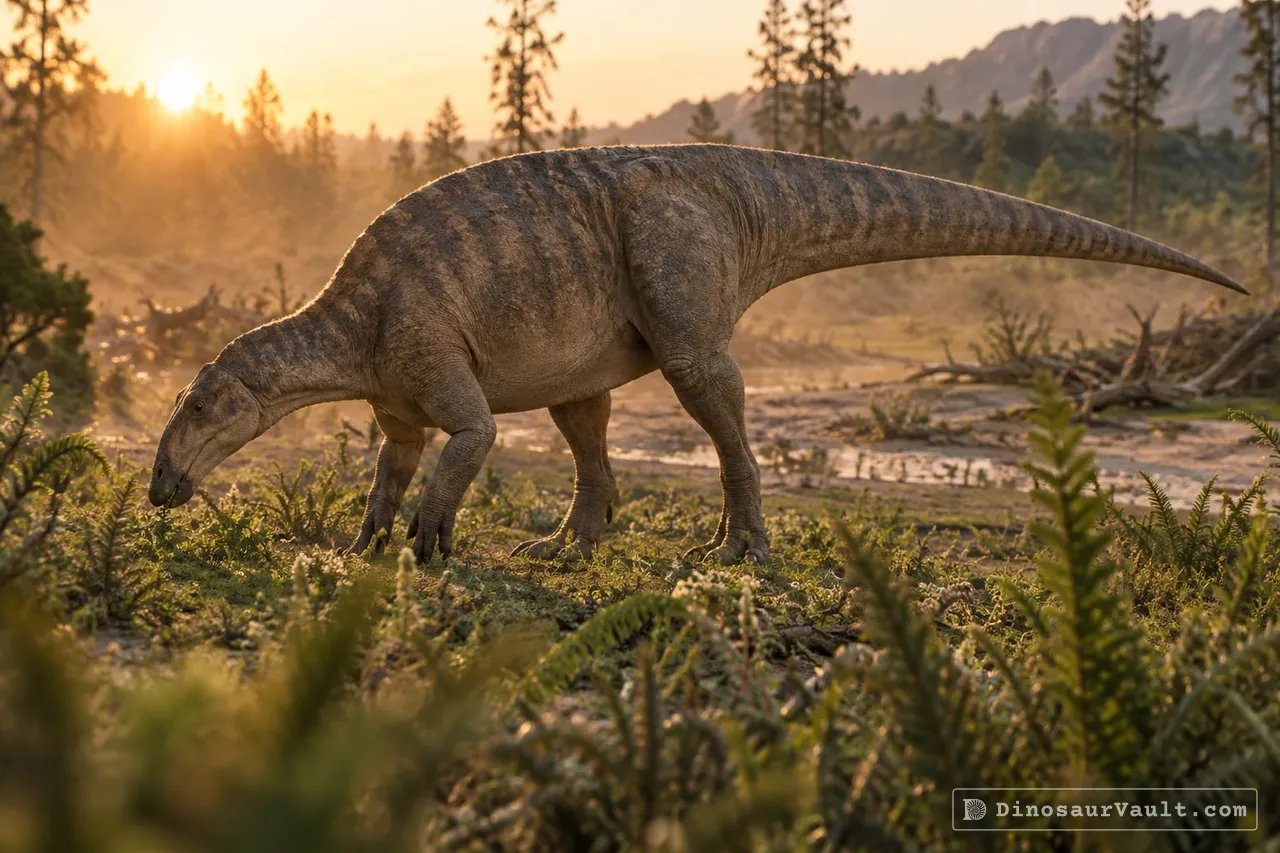
Datonglong was a relative of the duckbills, a plant eater known from a lower jaw with teeth.
Its world
It lived in the Late Cretaceous, in what is now China. It comes from the Huiquanpu Formation, where it shared the land with the armored Saichania, the tyrannosauroid Jinbeisaurus and the sauropod Huabeisaurus.
How it was found
Xu and colleagues named Datonglong in 2016.
Field gallery
More views of Datonglong
Scenes reconstructed from the available fossil evidence.
Lived alongside
Found in the same rock formations


A rock formation can hold fossils laid down millions of years apart, so not every animal here met Datonglong.
The evidence
The science behind Datonglong
Which parts of the picture come from its own bones, and which come from its relatives.
From its own fossils
- The type specimen is a right lower jaw with its teeth. The front end of the jaw, with its front teeth, and the top of the bony rise behind the tooth row are missing.
- The preserved jaw has nearly parallel upper and lower edges, and its rear part bends outward. At least in the middle and back of the jaw, each tooth position held two working teeth.
- The tooth crowns have a main ridge set toward the rear, a well-developed second ridge, no extra small ridges and slightly curved tips.
Borrowed from relatives
- The missing skull and body are restored by comparison with Eolambia, an early duckbill relative, while keeping the parallel edges of its own lower jaw.
Still unknown
- The shape of its snout and the rest of its skull.
- Its full body size and proportions.
- Its exact relationship to other early duckbill relatives. Bactrosaurus also has paired working teeth, but differs in the teeth toward the front of the jaw.
Discovery timeline
- 2012Close relativeMcDonald et al.
- 2013Same rocksD'Emic et al.
- 2016Named itXu et al.
- 2020Same rocksWu et al.
Key papers
The research behind what we know of Datonglong
Close relative
Described the skull and skeleton of Eolambia, an early duckbill relative, from bones of adults and young animals.
Osteology of the Basal Hadrosauroid Eolambia caroljonesa (Dinosauria: Ornithopoda) from the Cedar Mountain Formation of Utah. PLoS ONE 7: e45712
Read the paper : Osteology of the Basal Hadrosauroid Eolambia caroljonesa (Dinosauria: Ornithopoda) from the Cedar Mountain Formation of Utah (opens in a new tab)Same rocks
Redescribed Huabeisaurus, a sauropod from the Huiquanpu Formation, and confirmed its distinct anatomy.
Osteology of Huabeisaurus allocotus (Sauropoda: Titanosauriformes) from the Upper Cretaceous of China. PLoS ONE 8: e69375
Read the paper : Osteology of Huabeisaurus allocotus (Sauropoda: Titanosauriformes) from the Upper Cretaceous of China (opens in a new tab)Named it
Named a duckbill relative from a lower jaw with paired working teeth and a distinctive pattern of ridges on the tooth crowns.
A new hadrosauroid dinosaur from the Late Cretaceous of Tianzhen, Shanxi Province, China. Vertebrata PalAsiatica 54: 67-78
No link available
Same rocks
Named Jinbeisaurus, a tyrannosauroid predator from the Huiquanpu Formation.
A new tyrannosauroid from the Upper Cretaceous of Shanxi, China. Cretaceous Research 108: 104357
Read the paper : A new tyrannosauroid from the Upper Cretaceous of Shanxi, China (opens in a new tab)
Close relatives
Other members of Hadrosauroidea


Sources: Wikidata