Invictarx
"unconquerable fortress"
- Lived
- 84 to 72 million years ago, Late Cretaceous
- Diet
- Herbivore
- Group
- Ankylosaurs, Nodosauridae
- Found in
- United States
- Named by
- McDonald and Wolfe 2018
Where its fossils were found
The evidence
Today

80 million years ago
Habitat
It lived in the warm, swampy landscape of the Menefee Formation in New Mexico. Its neighbors included Dynamoterror, Menefeeceratops and Ornatops.
Field notes
About Invictarx
What it was like
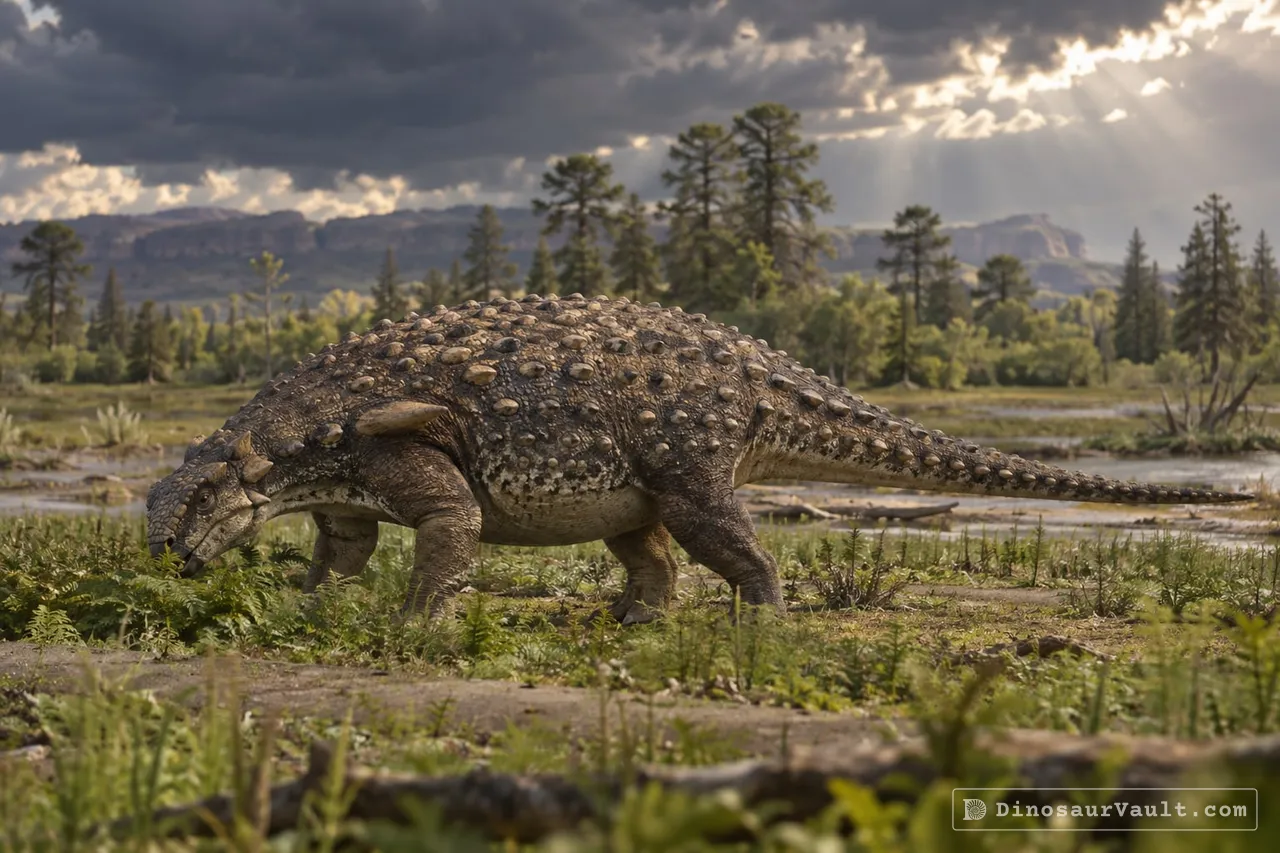
Invictarx was a nodosaur, an armored plant eater without a tail club. It is known from pieces of its armor, which show a pattern of plates unlike those of its relatives.
Its world
It lived in the Late Cretaceous in what is now New Mexico. Its bones come from the Menefee Formation, a warm, swampy land shared with the tyrannosaur Dynamoterror and the horned Menefeeceratops.
How it was found
McDonald and Wolfe named it in 2018 from armor and rib fragments, and assigned two more finds to it.
Field gallery
More views of Invictarx
Scenes reconstructed from the available fossil evidence.
1 of 2
Lived alongside
Found in the same rock formations


A rock formation can hold fossils laid down millions of years apart, so not every animal here met Invictarx.
The evidence
The science behind Invictarx
Which parts of the picture come from its own bones, and which come from its relatives.
From its own fossils
- The type specimen is mostly armor plates and pieces of ribs. Two more finds assigned to it add damaged vertebrae, front leg bones and more armor.
- The armor plates are fairly smooth, with scattered pits and a few grooves. Some carry a low, rounded ridge split by a groove along the top.
- Some plates probably joined into a shield of many-sided pieces over the hips.
Borrowed from relatives
- The head, neck, body, hips and hind legs are restored by comparison with the nodosaur Europelta.
- The arms, hands, feet and tail are restored by comparison with Sauropelta, whose proportions the published body outlines also borrow.
Still unknown
- The complete arrangement of its armor.
- Its skull shape and full body proportions.
- Whether newer nodosaur armor from the same rocks belongs to Invictarx. It shares its surface texture but differs in the shape of its ridges.
Discovery timeline
- 2013Close relativeKirkland et al.
- 2018Named itMcDonald & Wolfe
- 2018Same rocksMcDonald, Wolfe & Dooley
- 2021Same rocksMcDonald et al.
Key papers
The research behind what we know of Invictarx
Close relative
Named the early nodosaur Europelta from partial skeletons that include skull, backbone, shoulder, hip and hind leg bones.
The Basal Nodosaurid Ankylosaur Europelta carbonensis n. gen., n. sp. from the Lower Cretaceous (Lower Albian) Escucha Formation of Northeastern Spain. PLoS ONE 8: e80405
Read the paper : The Basal Nodosaurid Ankylosaur Europelta carbonensis n. gen., n. sp. from the Lower Cretaceous (Lower Albian) Escucha Formation of Northeastern Spain (opens in a new tab)Named it
Distinguished Invictarx by its armor plates and compared them with those of Glyptodontopelta.
A new nodosaurid ankylosaur (Dinosauria: Thyreophora) from the Upper Cretaceous Menefee Formation of New Mexico. PeerJ 6: e5435
Read the paper : A new nodosaurid ankylosaur (Dinosauria: Thyreophora) from the Upper Cretaceous Menefee Formation of New Mexico (opens in a new tab)Same rocks
Named Dynamoterror from a partial skeleton, documenting a tyrannosaur in the same formation as Invictarx.
A new tyrannosaurid (Dinosauria: Theropoda) from the Upper Cretaceous Menefee Formation of New Mexico. PeerJ 6: e5749
Read the paper : A new tyrannosaurid (Dinosauria: Theropoda) from the Upper Cretaceous Menefee Formation of New Mexico (opens in a new tab)Same rocks
Described Ornatops, a duck-billed plant eater from the same formation as Invictarx.
A new brachylophosaurin (Dinosauria: Hadrosauridae) from the Upper Cretaceous Menefee Formation of New Mexico. PeerJ 9: e11084
Read the paper : A new brachylophosaurin (Dinosauria: Hadrosauridae) from the Upper Cretaceous Menefee Formation of New Mexico (opens in a new tab)
Close relatives
Other members of Nodosauridae


Sources: Wikidata