Borealopelta
bor-ee-AL-oh-PEL-tuh
"northern shield"
Type species Borealopelta markmitchelli
- Lived
- 121 to 113 million years ago, Early Cretaceous
- Diet
- Herbivore
- Length
- about 5.5 m (18 ft)
- Group
- Ankylosaurs, Nodosauridae
- Found in
- Canada
- Named by
- Brown et al. 2017
Size comparison
To scale
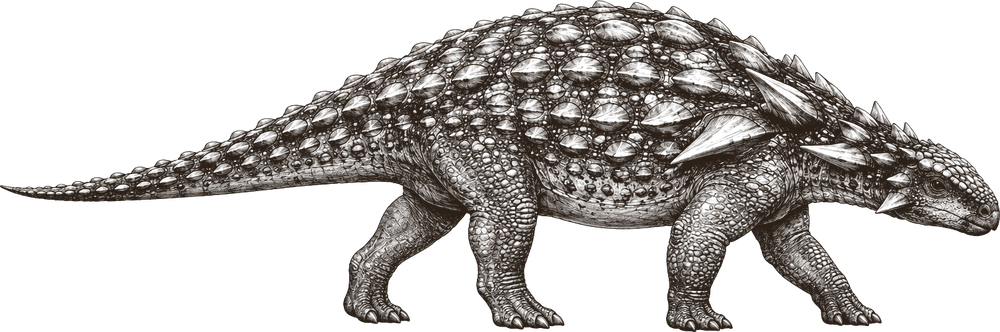


Scale in meters
Where its fossils were found
The evidence
Today

115 million years ago
Habitat
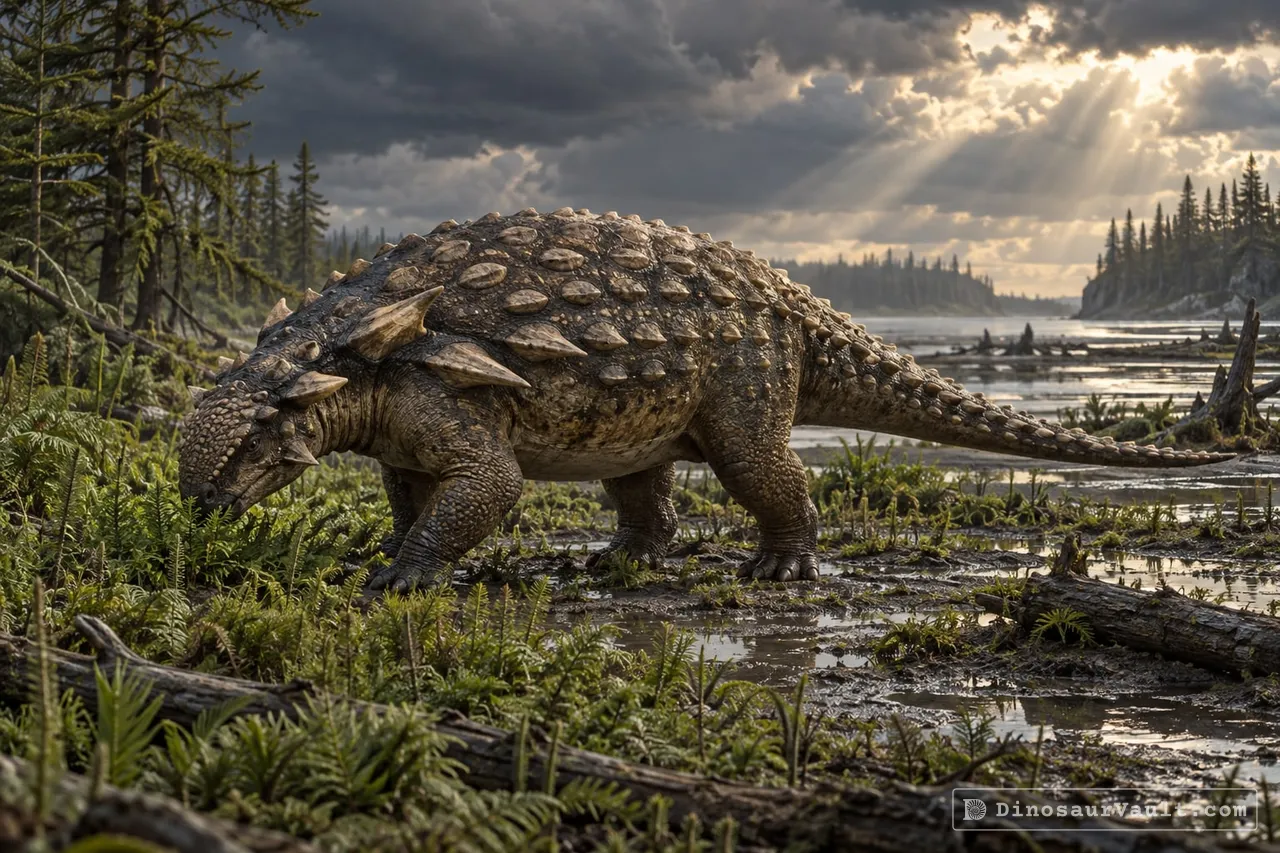
It lived on land near the coast, among ferns, cycads and conifers. Charcoal in its stomach suggests it may have fed where vegetation was growing back after a fire.
A Dinosaur Vault film
The Dinosaur That Turned to Stone in Its Own Skin
An armored dinosaur found by accident in an Alberta mine, its skin and scales turned to stone, its last meal still in its stomach and traces of its reddish-brown color intact.
Subscribe on YouTubeField notes
About Borealopelta
What it was like
Borealopelta was a heavily armored plant eater that grew to about 5.5 meters (18 feet) long. Rows of bony plates called osteoderms covered its neck, back, and tail, with larger spikes along its shoulders.
One fossil of Borealopelta is so well preserved that it still shows the actual armor, skin, and even the pattern of coloring from the animal's life. Traces of pigment suggest it was reddish brown on top and paler underneath, a pattern that may have helped it blend into its surroundings.
Its world
Borealopelta lived from about 121 to 113 million years ago, during the Early Cretaceous, in what is now Alberta, Canada. Its only known fossil comes from the Clearwater Formation.
The remains also preserved contents from the animal's last meal, giving researchers a rare direct look at what this plant eater had been feeding on shortly before it died.
How it was found
Brown and colleagues named Borealopelta in 2017, based on a single remarkably complete specimen. It is one of the best preserved armored dinosaurs ever found, and its closest relatives include Edmontonia, Nodosaurus, and Sauropelta, all members of the nodosaur family.
Field gallery
More views of Borealopelta
Scenes reconstructed from the available fossil evidence.
1 of 7
The evidence
The science behind Borealopelta
Which parts of the picture come from its own bones, and which come from its relatives.
From its own fossils
- The head and front of the body preserve rows of keeled armor in place, with long spines projecting from the shoulders.
- Skin and the horny coverings of the armor survive; pigment traces suggest a reddish-brown back and a paler underside.
- Its last meal contained mostly fern leaves, with smaller amounts of cycad and conifer foliage and pieces of charcoal.
Borrowed from relatives
- The missing hindquarters and tail are restored by comparison with nodosaurs such as Sauropelta and Edmontonia.
Still unknown
- The exact shade of its skin.
- The shape and armor of its young.
- Which land animals lived alongside it.
Often drawn wrong
- A tail club belongs to other armored dinosaurs; Borealopelta was a nodosaur with a tapering tail.
- Its shoulder spines formed a single pair, rather than several matching pairs along the body.
Discovery timeline
- 2017Named itBrown et al.
- 2017SkinBrown
- 2020How it fedBrown et al.
Key papers
The research behind what we know of Borealopelta
Named it
Named the armored dinosaur from a fossil preserving skin and armor, and inferred a reddish-brown back with a paler underside.
An Exceptionally Preserved Three-Dimensional Armored Dinosaur Reveals Insights into Coloration and Cretaceous Predator-Prey Dynamics. Current Biology 27: 2514-2521.e3
Read the paper : An Exceptionally Preserved Three-Dimensional Armored Dinosaur Reveals Insights into Coloration and Cretaceous Predator-Prey Dynamics (opens in a new tab)Skin
The horny coverings made the shoulder spines much longer than their bony cores, emphasizing their possible role in display.
An exceptionally preserved armored dinosaur reveals the morphology and allometry of osteoderms and their horny epidermal coverings. PeerJ 5: e4066
Read the paper : An exceptionally preserved armored dinosaur reveals the morphology and allometry of osteoderms and their horny epidermal coverings (opens in a new tab)How it fed
Its stomach contents show selective feeding on ferns, with a little cycad and conifer foliage and charcoal from burned vegetation.
Dietary palaeoecology of an Early Cretaceous armoured dinosaur (Ornithischia; Nodosauridae) based on floral analysis of stomach contents. Royal Society Open Science 7: 200305
Read the paper : Dietary palaeoecology of an Early Cretaceous armoured dinosaur (Ornithischia; Nodosauridae) based on floral analysis of stomach contents (opens in a new tab)
Close relatives
Other members of Nodosauridae


Sources: Wikidata