Nodosaurus
NOH-doh-SORE-us
"knobbed lizard"
Type species Nodosaurus textilis
- Lived
- 101 to 90 million years ago, Late Cretaceous
- Diet
- Herbivore
- Length
- estimates range from 5 to 6 m (16 to 20 ft)
- Group
- Ankylosaurs, Nodosauridae
- Found in
- United States
- Named by
- Marsh 1889
Where its fossils were found
The evidence
Today

95 million years ago
Habitat
Its original skeleton comes from the Frontier Formation, deposited along the Western Interior Seaway, where Stegopelta is also found. Later rocks with remains referred to Nodosaurus contain Tyrannosaurus and Triceratops.
Field notes
About Nodosaurus
What it was like
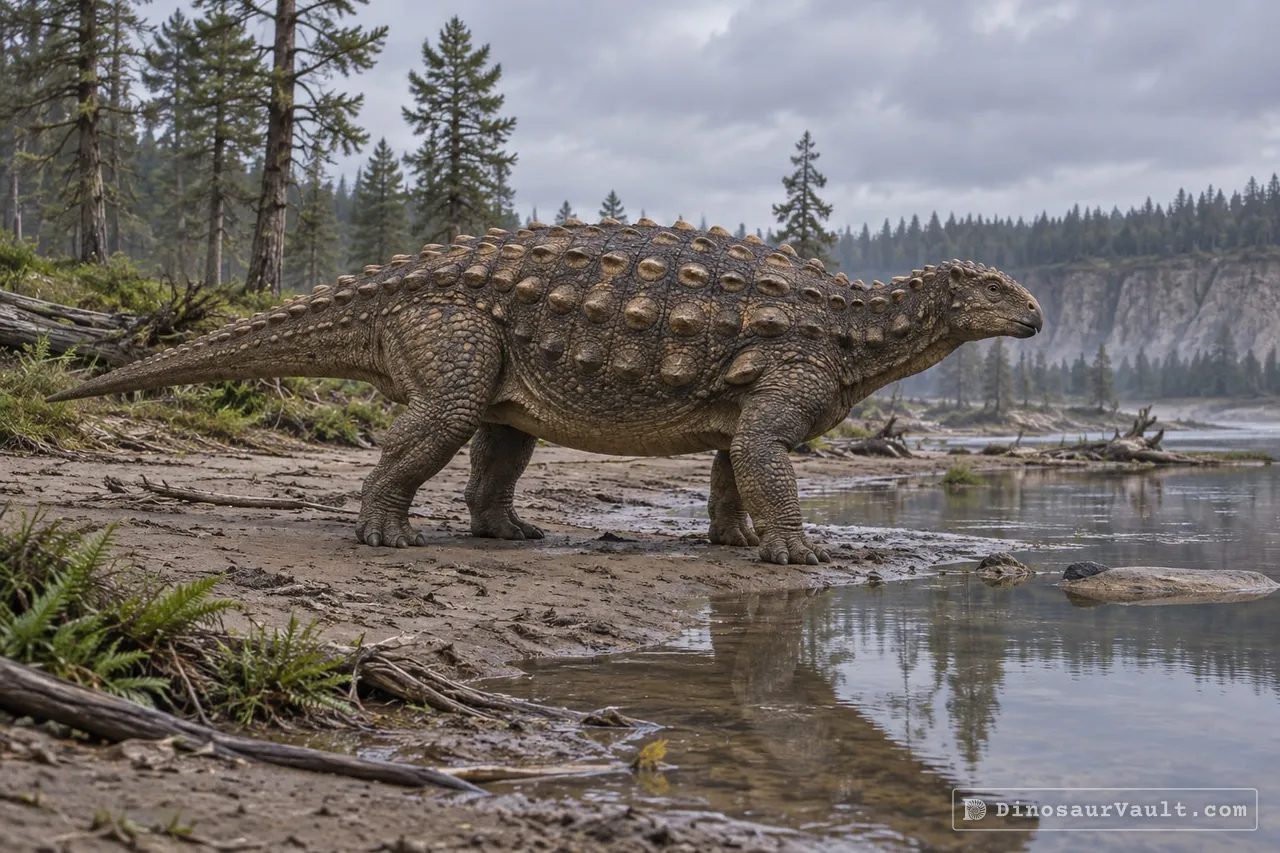
Nodosaurus was an armored plant eater between 5 and 6 meters (16 to 20 feet) long. Rows of bony knobs and plates covered its back, giving it a texture like woven cloth, which inspired the type species name, Nodosaurus textilis.
It had no tail club. It walked on four legs and probably ate low-growing plants. Its skull is not known.
Its world
It lived in the Late Cretaceous of western North America. The first and best remains come from the Frontier Formation of Wyoming, and some other bones have been linked to it.
How it was found
Marsh named Nodosaurus in 1889, and the family of armored dinosaurs called nodosaurids is named after it. Three finds are known.
Field gallery
More views of Nodosaurus
Scenes reconstructed from the available fossil evidence.
1 of 3
Lived alongside
Found in the same rock formations

A rock formation can hold fossils laid down millions of years apart, so not every animal here met Nodosaurus.
The evidence
The science behind Nodosaurus
Which parts of the picture come from its own bones, and which come from its relatives.
From its own fossils
- An incomplete skeleton preserves strong forelimbs, ribs and tail vertebrae.
- Some armor remains in place. On the trunk, plates bearing knobs are separated by smaller plates, and there are also oval keeled plates, spined plates and tiny bony nodules.
- Tightly joined armor plates covered part of the hips.
Borrowed from relatives
- The missing head and neck are restored by comparison with Europelta, a nodosaurid whose skull is preserved.
- The missing parts of the forelimbs are restored by comparison with Sauropelta.
Still unknown
- The shape of its skull.
- How far the hip armor spread. The full description placed it over the middle of the hips only, while a later study described plates joined over the hip bones themselves.
- Its exact place among armored dinosaurs. One study found that its position shifts between analyses because so little of it is known. Whether the name Nodosaurus, and the family named after it, rest on enough distinctive anatomy has been questioned but not settled.
Discovery timeline
- 1889Named itMarsh
- 1921Full descriptionLull
- 2013Close relativeKirkland et al.
- 2023Family treeRaven et al.
Key papers
The research behind what we know of Nodosaurus
Named it
Named the animal from an incomplete skeleton with rows of bony knobs and armor whose surface resembled woven cloth.
Notice of gigantic horned Dinosauria from the Cretaceous. American Journal of Science s3-38: 173-176
Read the paper : Notice of gigantic horned Dinosauria from the Cretaceous (opens in a new tab)Full description
Gave a detailed account of the original skeleton, sorting its armor into knobbed plates, smaller plates, keeled and spined plates and tiny nodules.
The Cretaceous armored dinosaur, Nodosaurus textilis Marsh. American Journal of Science s5-1: 97-126
Read the paper : The Cretaceous armored dinosaur, Nodosaurus textilis Marsh (opens in a new tab)Close relative
Named Europelta, a nodosaurid with a preserved skull, and compared it with the original Nodosaurus skeleton, including its tightly joined hip armor.
The Basal Nodosaurid Ankylosaur Europelta carbonensis n. gen., n. sp. from the Lower Cretaceous (Lower Albian) Escucha Formation of Northeastern Spain. PLoS ONE 8: e80405
Read the paper : The Basal Nodosaurid Ankylosaur Europelta carbonensis n. gen., n. sp. from the Lower Cretaceous (Lower Albian) Escucha Formation of Northeastern Spain (opens in a new tab)Family tree
A family tree of armored dinosaurs that included Nodosaurus found its position unstable between analyses, because so little of its skeleton is known.
The phylogenetic relationships and evolutionary history of the armoured dinosaurs (Ornithischia: Thyreophora). Journal of Systematic Palaeontology 21
Read the paper : The phylogenetic relationships and evolutionary history of the armoured dinosaurs (Ornithischia: Thyreophora) (opens in a new tab)
Close relatives
Other members of Nodosauridae


Sources: Wikidata