Ornatops
"ornate face"
Type species Ornatops incantatus
- Lived
- 84 to 72 million years ago, Late Cretaceous
- Diet
- Herbivore
- Group
- Ornithopods, Hadrosauridae
- Found in
- United States
- Named by
- McDonald et al. 2021
Where its fossils were found
The evidence
Today

80 million years ago
Habitat
A warm, swampy landscape in what is now New Mexico produced the Menefee Formation. Dynamoterror, Menefeeceratops and Invictarx are also recorded from these rocks.
Field notes
About Ornatops
What it was like
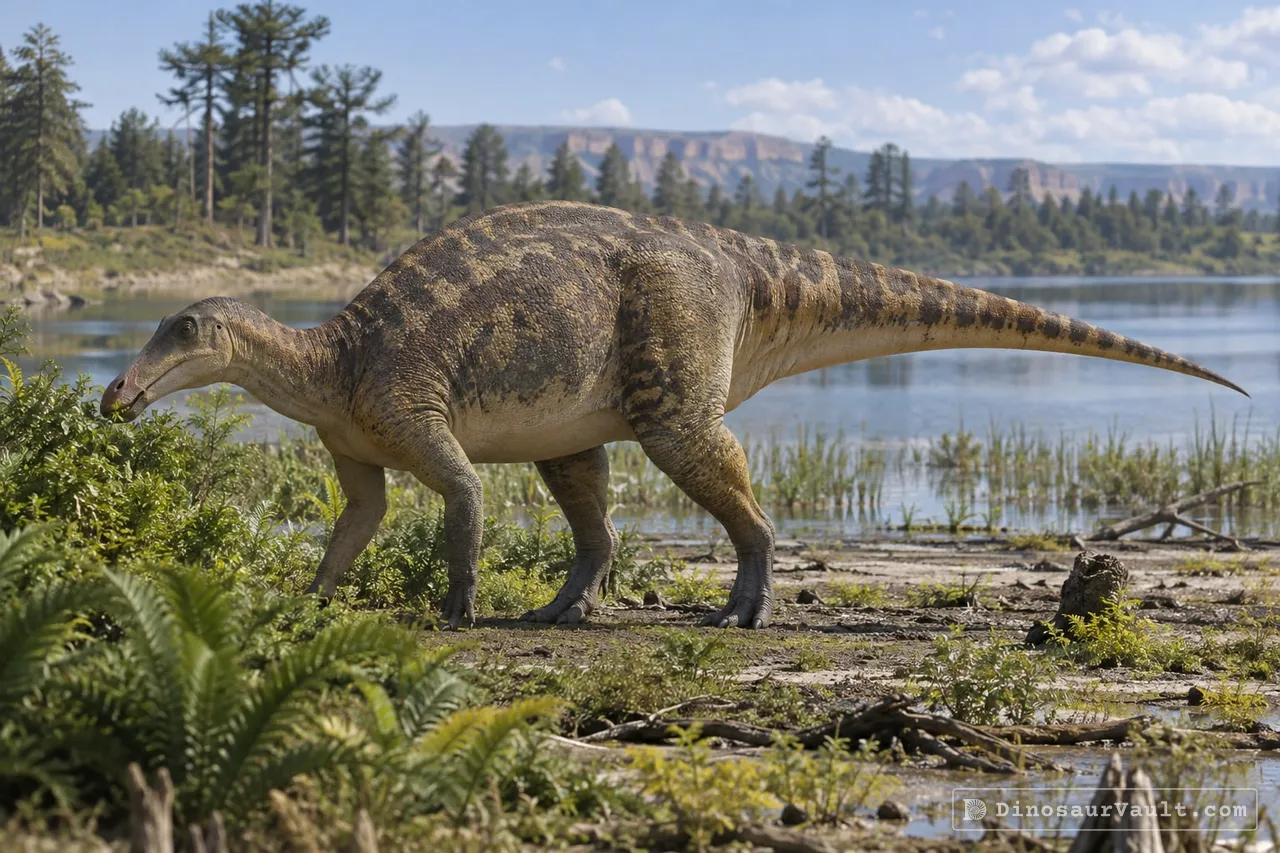
Ornatops was a duck-billed plant eater related to Brachylophosaurus. Its skull bones preserve an attachment area from which its describers inferred a broad, solid crest. The crest itself is missing.
Its world
It lived in the Late Cretaceous in what is now New Mexico. Its bones come from the Menefee Formation, a warm, swampy land shared with the tyrannosaur Dynamoterror, the horned Menefeeceratops and the armored Invictarx.
How it was found
McDonald and colleagues named it in 2021. The type species is Ornatops incantatus.
Field gallery
More views of Ornatops
Scenes reconstructed from the available fossil evidence.
1 of 3
Lived alongside
Found in the same rock formations


A rock formation can hold fossils laid down millions of years apart, so not every animal here met Ornatops.
The evidence
The science behind Ornatops
Which parts of the picture come from its own bones, and which come from its relatives.
From its own fossils
- One skeleton includes the front of the upper beak, bones from the back of the skull and the braincase, and parts of the back, shoulder, forearm, hand and hips.
- Where the missing nose bones joined the skull roof, the contact is level at the front and rises at the back into paired bumps. From this, its describers think it had a broad, solid crest lying close against the skull roof.
- The edge of the upper beak slopes gently and does not flare outward.
Borrowed from relatives
- Its missing upper jaw, cheek and lower jaw are restored after Brachylophosaurus and Probrachylophosaurus, without copying either one's crest.
- Its neck, body, limbs, feet and tail are restored after Eolambia, a more distant relative known from many bones.
Still unknown
- The exact size and outline of its crest, and how the crest changed as it grew.
- Its color and skin pattern.
- Its exact relationships within its group, which the family tree in its naming paper left unresolved.
Discovery timeline
- 2015Close relativeFreedman Fowler & Horner
- 2018Same rocksMcDonald & Wolfe
- 2021Named itMcDonald et al.
Key papers
The research behind what we know of Ornatops
Close relative
Described Probrachylophosaurus with a small nasal crest and compared crest growth in its relative Brachylophosaurus.
A New Brachylophosaurin Hadrosaur (Dinosauria: Ornithischia) with an Intermediate Nasal Crest from the Campanian Judith River Formation of Northcentral Montana. PLOS ONE 10: e0141304
Read the paper : A New Brachylophosaurin Hadrosaur (Dinosauria: Ornithischia) with an Intermediate Nasal Crest from the Campanian Judith River Formation of Northcentral Montana (opens in a new tab)Same rocks
Described Invictarx, an armored plant eater from the same formation, using partial skeletons and distinctive armor plates.
A new nodosaurid ankylosaur (Dinosauria: Thyreophora) from the Upper Cretaceous Menefee Formation of New Mexico. PeerJ 6: e5435
Read the paper : A new nodosaurid ankylosaur (Dinosauria: Thyreophora) from the Upper Cretaceous Menefee Formation of New Mexico (opens in a new tab)Named it
Named Ornatops from a partial skeleton with a distinctive crest attachment on the skull roof, and inferred a broad, solid nasal crest.
A new brachylophosaurin (Dinosauria: Hadrosauridae) from the Upper Cretaceous Menefee Formation of New Mexico. PeerJ 9: e11084
Read the paper : A new brachylophosaurin (Dinosauria: Hadrosauridae) from the Upper Cretaceous Menefee Formation of New Mexico (opens in a new tab)
Close relatives
Other members of Hadrosauridae


Sources: Wikidata