Dynamoterror
"powerful terror"
Type species Dynamoterror dynastes
- Lived
- 84 to 72 million years ago, Late Cretaceous
- Diet
- Carnivore
- Group
- Theropods, Tyrannosauridae
- Found in
- United States
- Named by
- McDonald et al. 2018
Where its fossils were found
The evidence
Today

80 million years ago
Habitat
Rivers crossed a warm coastal plain with swamps, palms and conifers. Dinosaurs from the Menefee Formation include Invictarx, Menefeeceratops and Ornatops.
Field notes
About Dynamoterror
What it was like
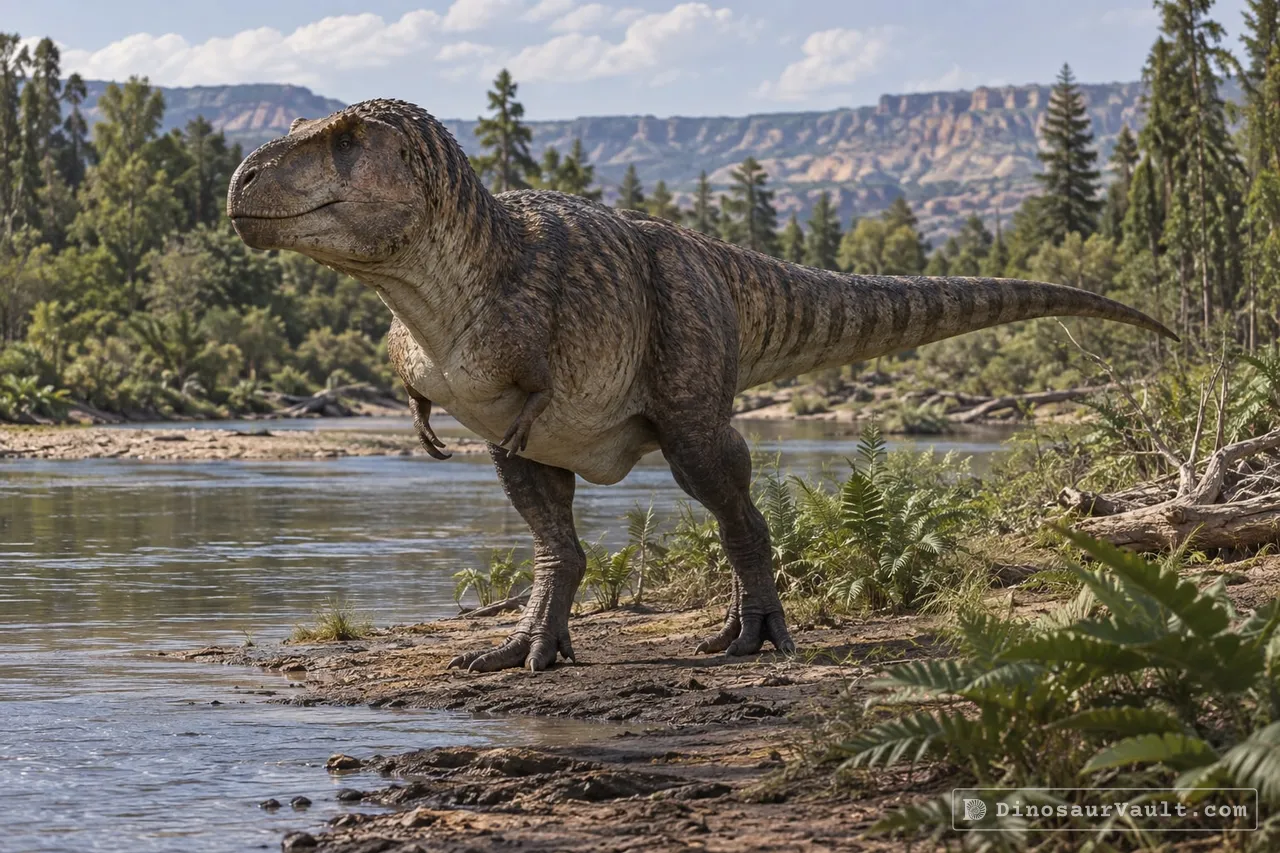
Dynamoterror was a tyrannosaur, a large two-legged predator with a big head and strong jaws. It is known from parts of the skull and skeleton, so its exact size is uncertain. Its closest relatives include Teratophoneus and Lythronax.
Its world
It lived in the Late Cretaceous in what is now New Mexico. Its bones come from the Menefee Formation, a warm, swampy coastal land where it shared the landscape with the horned Menefeeceratops and the armored Invictarx.
How it was found
McDonald and colleagues named it in 2018 from one find. The type species is Dynamoterror dynastes.
Field gallery
More views of Dynamoterror
Scenes reconstructed from the available fossil evidence.
Lived alongside
Found in the same rock formations


A rock formation can hold fossils laid down millions of years apart, so not every animal here met Dynamoterror.
The evidence
The science behind Dynamoterror
Which parts of the picture come from its own bones, and which come from its relatives.
From its own fossils
- The type specimen includes paired skull-roof bones, a hand bone and toe bones, with fragments of the backbone, ribs and pelvis, associated from pieces found together.
- The skull roof has broad hollows and a tall central ridge for the muscles that closed the jaws.
Borrowed from relatives
- Its missing skull bones are restored by comparison with Teratophoneus.
Still unknown
- Experts disagree about whether its skull-roof features distinguish it from other tyrannosaurs or whether the name rests on bones too incomplete to identify.
- Its exact adult size and complete skull shape.
- Its skin covering and color.
Discovery timeline
- 2018Named itMcDonald, Wolfe & Dooley
- 2018Same rocksMcDonald & Wolfe
- 2020Family treeChan-gyu
Key papers
The research behind what we know of Dynamoterror
Named it
Named Dynamoterror from an incomplete tyrannosaur skeleton and rebuilt its skull roof by combining digital models of the preserved bones.
A new tyrannosaurid (Dinosauria: Theropoda) from the Upper Cretaceous Menefee Formation of New Mexico. PeerJ 6: e5749
Read the paper : A new tyrannosaurid (Dinosauria: Theropoda) from the Upper Cretaceous Menefee Formation of New Mexico (opens in a new tab)Same rocks
Named Invictarx from bones and armor plates, documenting an armored plant eater from the same formation.
A new nodosaurid ankylosaur (Dinosauria: Thyreophora) from the Upper Cretaceous Menefee Formation of New Mexico. PeerJ 6: e5435
Read the paper : A new nodosaurid ankylosaur (Dinosauria: Thyreophora) from the Upper Cretaceous Menefee Formation of New Mexico (opens in a new tab)Family tree
Argued that the skull-roof features used to name Dynamoterror overlap with other tyrannosaurs or reflect variation and breakage, and proposed a doubtful name.
A Reassessment of the Taxonomic Validity of Dynamoterror dynastes (Theropoda, Tyrannosauridae). Zoodiversity 54: 259-264
Read the paper : A Reassessment of the Taxonomic Validity of Dynamoterror dynastes (Theropoda, Tyrannosauridae) (opens in a new tab)
Close relatives
Other members of Tyrannosauridae


Sources: Wikidata