Menefeeceratops
Type species Menefeeceratops sealeyi
- Lived
- 84 to 72 million years ago, Late Cretaceous
- Diet
- Herbivore
- Group
- Ceratopsians, Ceratopsidae
- Found in
- United States
- Named by
- Dalman et al. 2021
Where its fossils were found
The evidence
Today

80 million years ago
Habitat
Rivers and swamps spread across a low coastal plain in what is now New Mexico. Other dinosaurs from the Menefee Formation include Dynamoterror, Invictarx and Ornatops.
Field notes
About Menefeeceratops
What it was like
Menefeeceratops was a centrosaurine, a horned dinosaur related to Centrosaurus. It is known from part of the skeleton and frill.
Its world
It lived in the Late Cretaceous, in what is now New Mexico. It comes from the Menefee Formation, where it shared the land with the tyrannosaur Dynamoterror and the armored Invictarx. It is one of the oldest known centrosaurines.
How it was found
Dalman and colleagues named Menefeeceratops in 2021. The type species is Menefeeceratops sealeyi.
Field gallery
More views of Menefeeceratops
Scenes reconstructed from the available fossil evidence.
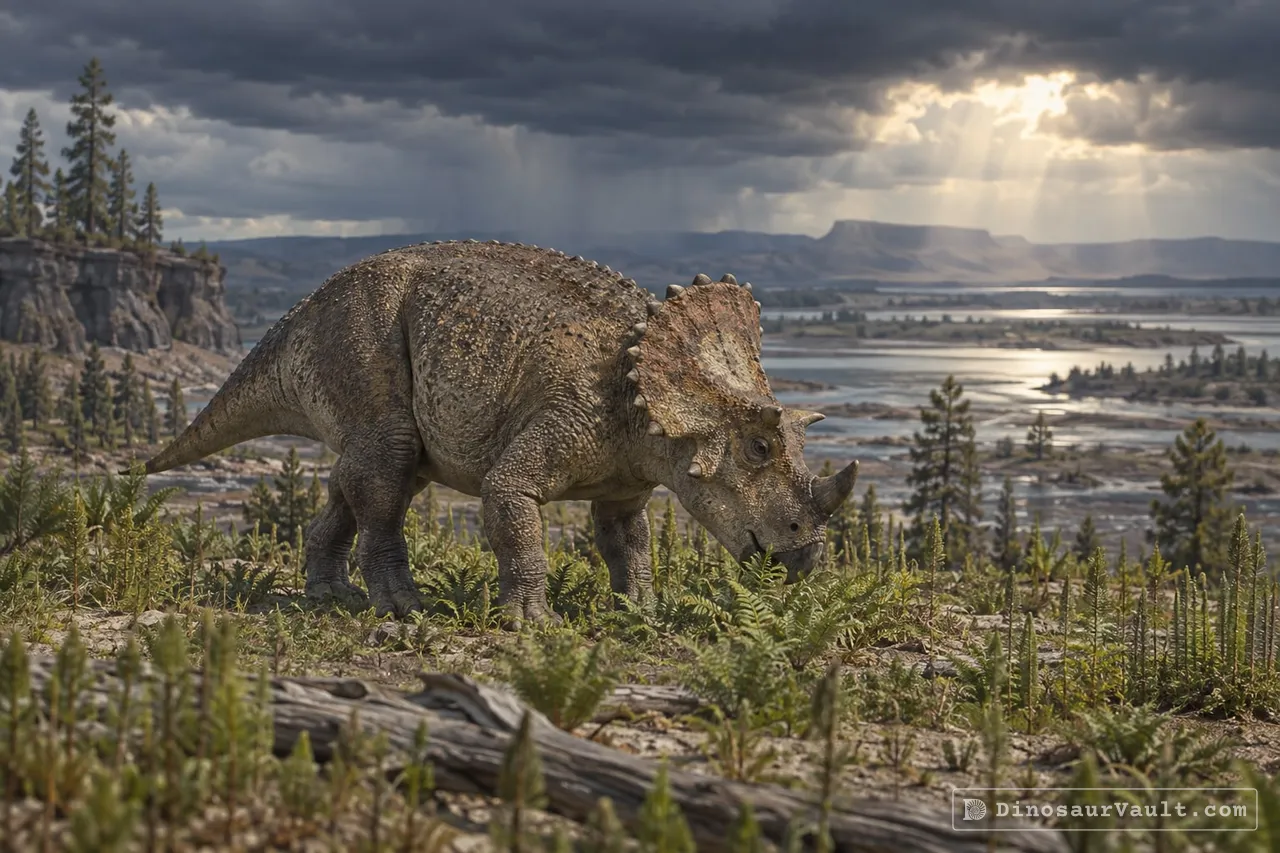
Lived alongside
Found in the same rock formations


A rock formation can hold fossils laid down millions of years apart, so not every animal here met Menefeeceratops.
The evidence
The science behind Menefeeceratops
Which parts of the picture come from its own bones, and which come from its relatives.
From its own fossils
- A single partial skeleton includes skull and jaw bones, a brow horn, parts of the frill, vertebrae, ribs and limb bones, among them a sturdy thigh bone.
- The preserved brow horn core is long and curves forward and downward. Its tip is missing.
- The side bones of the frill are flat and triangular, with ridges and an edge scalloped into shallow, broad lobes.
Borrowed from relatives
- The beak, snout and frill are restored by comparison with Nasutoceratops, another early centrosaurine.
- The hands are restored from Triceratops. The broad, hoof-like toes follow a lower leg of an unnamed horned dinosaur from Canada, which was compared with Triceratops and Chasmosaurus.
Still unknown
- The ornament of the frill's back edge, and whether the frill had openings. Its rounded outline is inferred from a flat fragment.
- Whether it had a horn or ridge over the nose.
- Its closest relatives. The naming study's family tree changed depending on how missing data were handled, so no single closest relative is settled.
Discovery timeline
- 2013Close relativeSampson et al.
- 2018Same rocksMcDonald, Wolfe & Dooley
- 2021Named itDalman et al.
- 2021Same rocksMcDonald et al.
- 2026Close relativesTheurer et al.
Key papers
The research behind what we know of Menefeeceratops
Close relative
Described Nasutoceratops, an early centrosaurine with a short snout, long brow horns and a short, broad frill.
A remarkable short-snouted horned dinosaur from the Late Cretaceous (late Campanian) of southern Laramidia. Proceedings of the Royal Society B: Biological Sciences 280: 20131186
Read the paper : A remarkable short-snouted horned dinosaur from the Late Cretaceous (late Campanian) of southern Laramidia (opens in a new tab)Same rocks
Described Dynamoterror, a tyrannosaur from the same formation that adds a large predator to this dinosaur community.
A new tyrannosaurid (Dinosauria: Theropoda) from the Upper Cretaceous Menefee Formation of New Mexico. PeerJ 6: e5749
Read the paper : A new tyrannosaurid (Dinosauria: Theropoda) from the Upper Cretaceous Menefee Formation of New Mexico (opens in a new tab)Named it
Named an early centrosaurine from a partial skeleton, identifying distinctive frill bones and forward-curving brow horns.
The oldest centrosaurine: a new ceratopsid dinosaur (Dinosauria: Ceratopsidae) from the Allison Member of the Menefee Formation (Upper Cretaceous, early Campanian), northwestern New Mexico, USA. PalZ 95: 291-335
Read the paper : The oldest centrosaurine: a new ceratopsid dinosaur (Dinosauria: Ceratopsidae) from the Allison Member of the Menefee Formation (Upper Cretaceous, early Campanian), northwestern New Mexico, USA (opens in a new tab)Same rocks
Named Ornatops from a partial skeleton, adding a duck-billed plant eater to the dinosaurs known from the same formation.
A new brachylophosaurin (Dinosauria: Hadrosauridae) from the Upper Cretaceous Menefee Formation of New Mexico. PeerJ 9: e11084
Read the paper : A new brachylophosaurin (Dinosauria: Hadrosauridae) from the Upper Cretaceous Menefee Formation of New Mexico (opens in a new tab)Close relatives
Described a horned dinosaur's lower leg and foot from Alberta, with broad, spade-shaped toe bones, and compared them with Triceratops and Chasmosaurus.
Morphology and articular configuration of the ceratopsid (Dinosauria: Ornithischia) lower hindlimb as revealed by a specimen from the Upper Cretaceous Dinosaur Park Formation of southern Alberta, Canada. PLOS One 21: e0353362
Read the paper : Morphology and articular configuration of the ceratopsid (Dinosauria: Ornithischia) lower hindlimb as revealed by a specimen from the Upper Cretaceous Dinosaur Park Formation of southern Alberta, Canada (opens in a new tab)
Close relatives
Other members of Ceratopsidae


Sources: Wikidata