Gryphoceratops
"griffin horned face"
Type species Gryphoceratops morrisoni
- Lived
- 86 to 84 million years ago, Late Cretaceous
- Diet
- Herbivore
- Group
- Ceratopsians, Leptoceratopsidae
- Found in
- Canada
- Named by
- Ryan et al. 2012
Where its fossils were found
The evidence
Today

80 million years ago
Habitat
Rivers crossed muddy floodplains in what is now Alberta, Canada. Other dinosaurs recorded from the Milk River Formation include Acrotholus, Richardoestesia and Paronychodon.
Field notes
About Gryphoceratops
What it was like
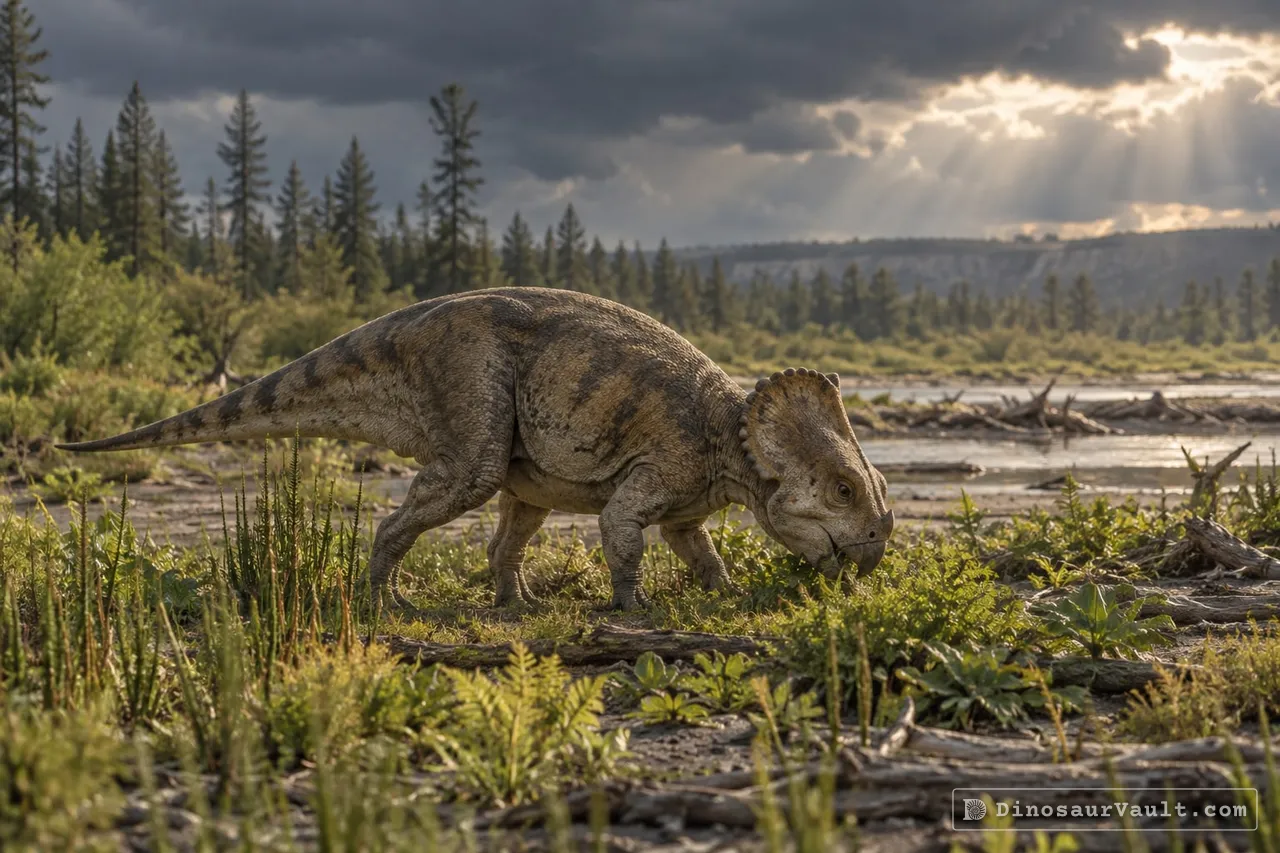
Gryphoceratops was a very small horned dinosaur, known only from part of a lower jaw. It belonged to the leptoceratopsids, simple horned dinosaurs with no real horns.
Its world
It lived about 86 to 84 million years ago, in the Late Cretaceous, in what is now Alberta, Canada. It comes from the Milk River Formation, where the small dome-headed Acrotholus also lived.
How it was found
Ryan and colleagues named Gryphoceratops in 2012. The type species is Gryphoceratops morrisoni.
Field gallery
More views of Gryphoceratops
Scenes reconstructed from the available fossil evidence.
Lived alongside
Found in the same rock formations


A rock formation can hold fossils laid down millions of years apart, so not every animal here met Gryphoceratops.
The evidence
The science behind Gryphoceratops
Which parts of the picture come from its own bones, and which come from its relatives.
From its own fossils
- Only part of a lower jaw is known.
- Its tiny jaw was interpreted as belonging to an adult, making it an unusually small horned dinosaur.
Borrowed from relatives
- The body and limbs are modeled on better-known leptoceratopsids such as Leptoceratops and Ferrisaurus.
- A short frill and hornless head follow the anatomy of other leptoceratopsids.
Still unknown
- Its full body proportions.
- The shape of the rest of its skull.
- Its skin covering and color.
Discovery timeline
- 2012Named itRyan et al.
- 2013Same rocksEvans et al.
- 2019Close relativeArbour & Evans
Key papers
The research behind what we know of Gryphoceratops
Named it
Named Gryphoceratops from a partial jaw and identified it as an exceptionally small adult-sized ceratopsian.
New leptoceratopsids from the Upper Cretaceous of Alberta, Canada. Cretaceous Research 35: 69-80
Read the paper : New leptoceratopsids from the Upper Cretaceous of Alberta, Canada (opens in a new tab)Same rocks
Named the dome-headed Acrotholus and showed that small plant-eating dinosaurs were more diverse than their scattered fossils suggest.
The oldest North American pachycephalosaurid and the hidden diversity of small-bodied ornithischian dinosaurs. Nature Communications 4
Read the paper : The oldest North American pachycephalosaurid and the hidden diversity of small-bodied ornithischian dinosaurs (opens in a new tab)Close relative
Described the limbs of Ferrisaurus, providing a body comparison for leptoceratopsids known mainly from jaws.
A new leptoceratopsid dinosaur from Maastrichtian-aged deposits of the Sustut Basin, northern British Columbia, Canada. PeerJ 7: e7926
Read the paper : A new leptoceratopsid dinosaur from Maastrichtian-aged deposits of the Sustut Basin, northern British Columbia, Canada (opens in a new tab)
Close relatives
Other members of Leptoceratopsidae


Sources: Wikidata