Acrotholus
"high dome"
- Lived
- 86 to 84 million years ago, Late Cretaceous
- Diet
- Herbivore
- Group
- Pachycephalosaurs, Pachycephalosauridae
- Found in
- Canada
- Named by
- Evans et al. 2013
Where its fossils were found
The evidence
Today

80 million years ago
Habitat
It lived on land near the coast in what is now Alberta, Canada. The Milk River Formation also records Richardoestesia, Paronychodon and Gryphoceratops.
Field notes
About Acrotholus
What it was like
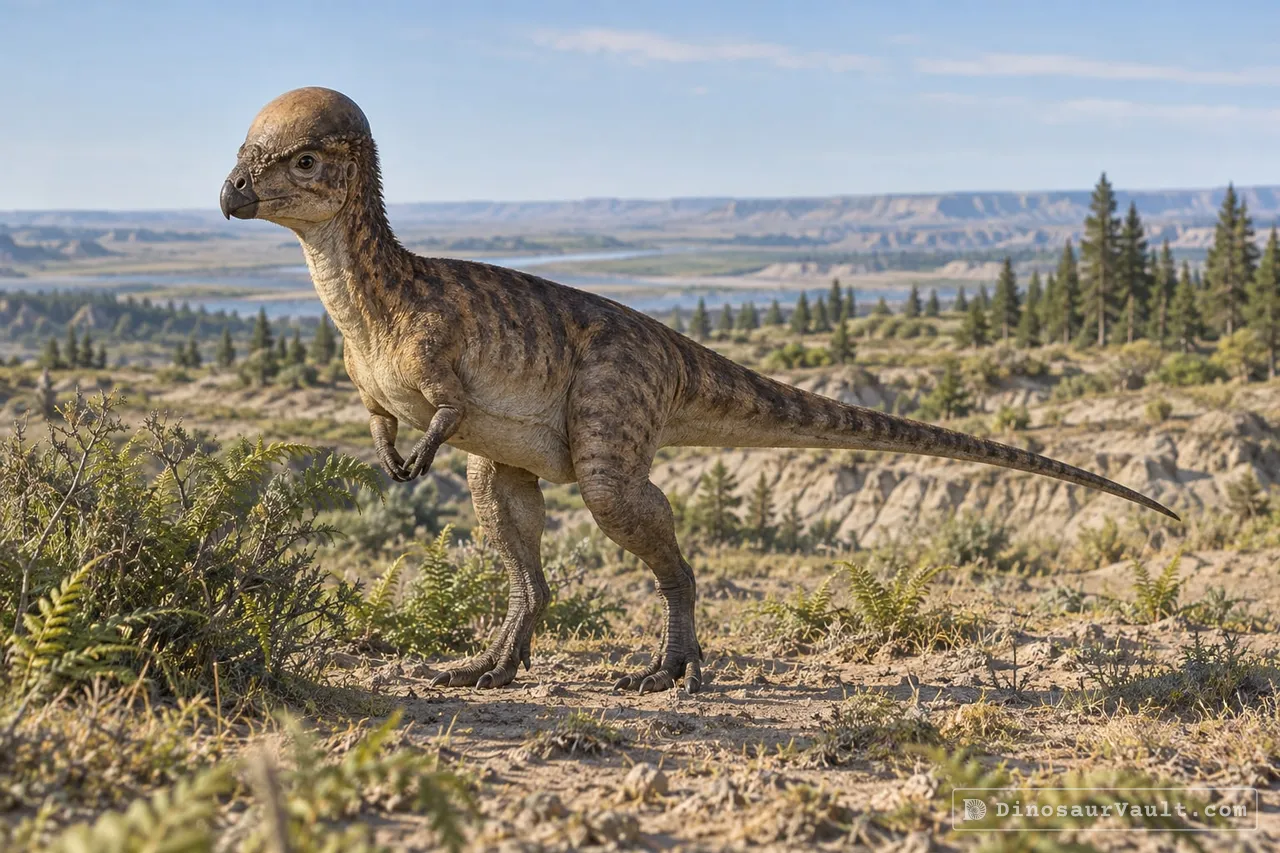
Acrotholus was a small dome-headed dinosaur. Its skull carried a tall, thick dome of bone.
It is one of the oldest dome-headed dinosaurs known from North America.
Its world
It lived about 86 to 84 million years ago, in the Late Cretaceous, in what is now Alberta, Canada. Its fossil comes from the Milk River Formation.
How it was found
Evans and colleagues named Acrotholus in 2013, from a single skull dome. Its species name honors a rancher on whose land it was found.
Field gallery
More views of Acrotholus
Scenes reconstructed from the available fossil evidence.
1 of 3
Lived alongside
Found in the same rock formations


A rock formation can hold fossils laid down millions of years apart, so not every animal here met Acrotholus.
The evidence
The science behind Acrotholus
Which parts of the picture come from its own bones, and which come from its relatives.
From its own fossils
- The skull roof carries a high, smooth dome, oval when seen from above.
- A rounded bump at the front blends into the dome, while a low ridge runs along its rear extension.
Borrowed from relatives
- The missing snout and eye region are restored using Prenocephale.
- The broad body, short arms, strong hind legs and long tail follow Stegoceras.
Still unknown
- The full shape of its face and any ornaments behind the dome.
- Whether it used its dome to strike other animals.
- Its skin covering and color.
Discovery timeline
- 2013Named itEvans et al.
- 2014RedescriptionEvans et al.
- 2022Close relativeMoore et al.
Key papers
The research behind what we know of Acrotholus
Named it
Named a small dinosaur with a tall skull dome and argued that small plant eaters were more diverse than their scattered bones suggest.
The oldest North American pachycephalosaurid and the hidden diversity of small-bodied ornithischian dinosaurs. Nature Communications 4
Read the paper : The oldest North American pachycephalosaurid and the hidden diversity of small-bodied ornithischian dinosaurs (opens in a new tab)Redescription
Corrected the specimen numbers for the additional skull domes listed in the original description.
Correction: Corrigendum: The oldest North American pachycephalosaurid and the hidden diversity of small-bodied ornithischian dinosaurs. Nature Communications 5
Read the paper : Correction: Corrigendum: The oldest North American pachycephalosaurid and the hidden diversity of small-bodied ornithischian dinosaurs (opens in a new tab)Close relative
Reconstructed the limb muscles of Stegoceras, providing a comparison for the missing body of Acrotholus and testing ideas about head-butting.
The appendicular myology of Stegoceras validum (Ornithischia: Pachycephalosauridae) and implications for the head-butting hypothesis. PLOS ONE 17: e0268144
Read the paper : The appendicular myology of Stegoceras validum (Ornithischia: Pachycephalosauridae) and implications for the head-butting hypothesis (opens in a new tab)
Close relatives
Other members of Pachycephalosauridae


Sources: Wikidata