Helioceratops
"sun horned face"
- Lived
- 121 to 101 million years ago, Early Cretaceous
- Diet
- Herbivore
- Group
- Ceratopsians, Leptoceratopsidae
- Found in
- China
- Named by
- Jin et al. 2009
Where its fossils were found
The evidence
Today

110 million years ago
Habitat
It lived among rivers and lakes in what is now China. Changchunsaurus, a small plant eater, lived in the same landscape.
Field notes
About Helioceratops
What it was like
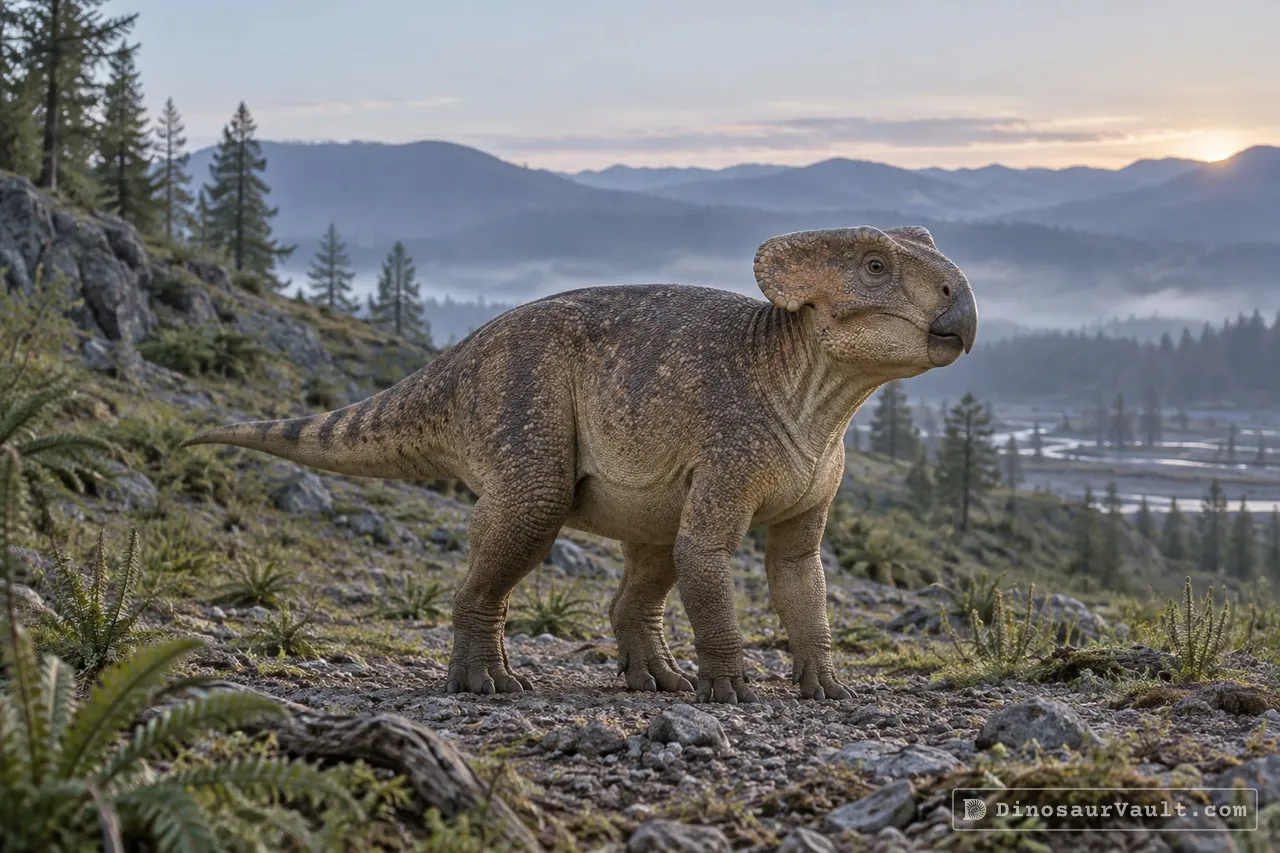
Helioceratops was a small horned dinosaur known from its jaws. It belonged to the leptoceratopsids, simple horned dinosaurs with short frills.
Its world
It lived in the Cretaceous, in what is now China. It comes from the Quantou Formation.
How it was found
Jin and colleagues named Helioceratops in 2009.
Field gallery
More views of Helioceratops
Scenes reconstructed from the available fossil evidence.
1 of 3
The evidence
The science behind Helioceratops
Which parts of the picture come from its own bones, and which come from its relatives.
From its own fossils
- The lower jaw is deep, with a steep surface at its front where the toothless beak bone attached.
- The lower teeth differ in shape, with unevenly arranged ridges and small points along their edges.
- A later study confirmed that its lower jaw is deeper, and the beak joint steeper, than in Aquilops.
Borrowed from relatives
- The missing upper skull, eyes and cheeks are restored from Auroraceratops, an early horned dinosaur from China. The deeper lower jaw of Helioceratops is kept.
Still unknown
- The rest of its skull, including the shape and size of its frill.
- Its body proportions and usual walking posture.
- Its exact place among early horned dinosaurs. One later family-tree study left it out, along with other species whose type specimens were hard to diagnose or too incomplete to compare.
Discovery timeline
- 2009Named itJIN et al.
- 2014Close relativeFarke et al.
- 2018Family treeMorschhauser et al.
- 2021Family treeMadzia et al.
Key papers
The research behind what we know of Helioceratops
Named it
Named Helioceratops from distinctive jaws and teeth, including a deep lower jaw and uneven tooth ridges.
A New Basal Neoceratopsian Dinosaur from the Middle Cretaceous of Jilin Province, China. Acta Geologica Sinica - English Edition 83: 200-206
Read the paper : A New Basal Neoceratopsian Dinosaur from the Middle Cretaceous of Jilin Province, China (opens in a new tab)Close relative
Named Aquilops and compared it with Helioceratops, noting the deeper lower jaw and steeper beak joint of Helioceratops, then added it to a new family tree.
A Ceratopsian Dinosaur from the Lower Cretaceous of Western North America, and the Biogeography of Neoceratopsia. PLoS ONE 9: e112055
Read the paper : A Ceratopsian Dinosaur from the Lower Cretaceous of Western North America, and the Biogeography of Neoceratopsia (opens in a new tab)Family tree
Placed Helioceratops on the earliest branch of the leptoceratopsid family tree.
Phylogenetic history ofAuroraceratops rugosus(Ceratopsia: Ornithischia) from the Lower Cretaceous of Gansu Province, China. Journal of Vertebrate Paleontology 38: 117-147
Read the paper : Phylogenetic history ofAuroraceratops rugosus(Ceratopsia: Ornithischia) from the Lower Cretaceous of Gansu Province, China (opens in a new tab)Family tree
Defined the major plant-eating dinosaur groups and included Helioceratops among leptoceratopsids in its reference family tree.
The phylogenetic nomenclature of ornithischian dinosaurs. PeerJ 9: e12362
Read the paper : The phylogenetic nomenclature of ornithischian dinosaurs (opens in a new tab)
Close relatives
Other members of Leptoceratopsidae


Sources: Wikidata