Koreaceratops
"Korean horned face"
- Lived
- 113 to 101 million years ago, Early Cretaceous
- Diet
- Herbivore
- Group
- Ceratopsians, Leptoceratopsidae
- Found in
- South Korea
- Named by
- Lee et al. 2010
Where its fossils were found
The evidence
Today

105 million years ago
Habitat
It lived in what is now South Korea, in a landscape with alternating wet and dry seasons. Damage left by microbes inside its bones supports a partly dry climate.
Field notes
About Koreaceratops
What it was like
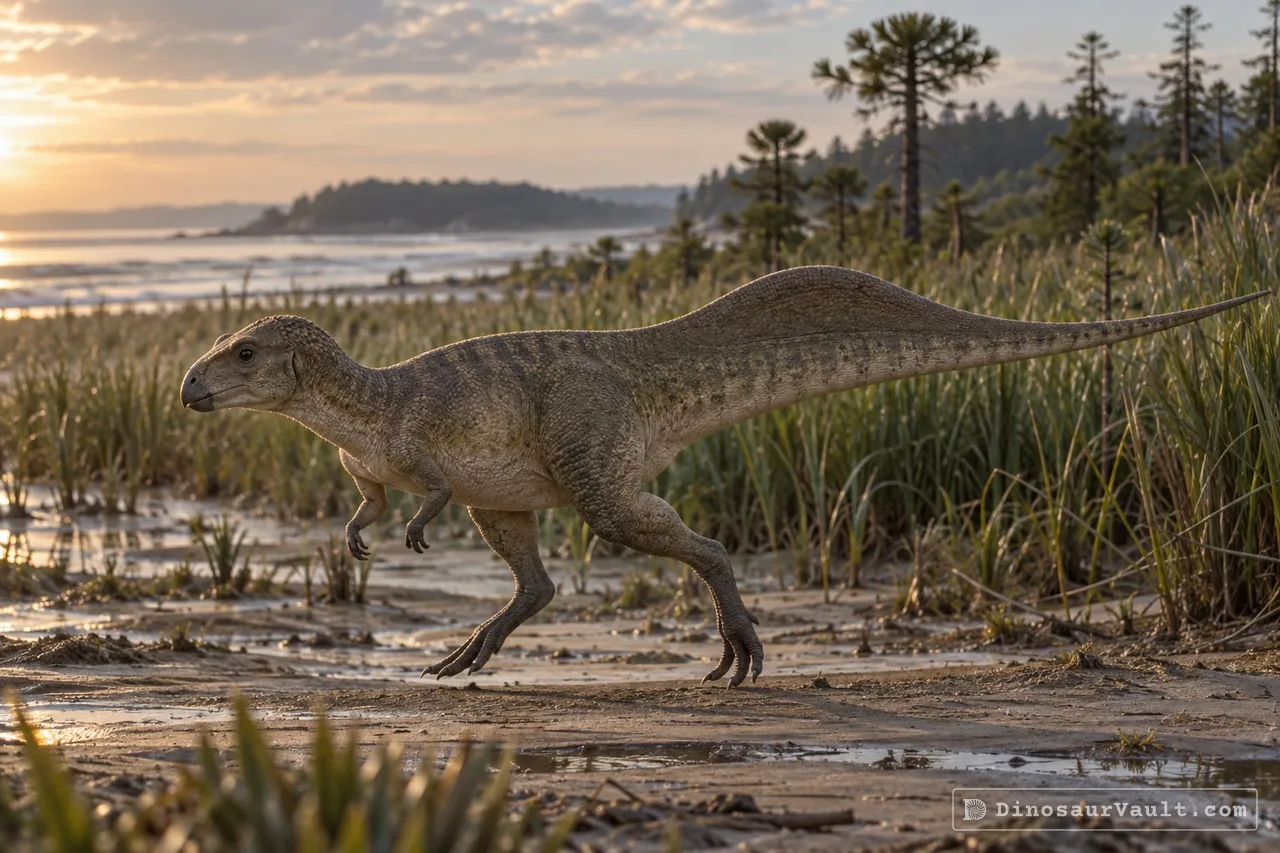
Koreaceratops was a small, early horned dinosaur, known from the back half of a skeleton, with legs and a long tail. It had no real horns or large frill.
Its tail had very tall spines on top, which made it deep and flat from side to side. Some scientists think it may have helped it swim, but that idea is uncertain.
Its world
It lived in the Early Cretaceous in what is now South Korea.
How it was found
Lee and colleagues named Koreaceratops in 2010, from a single find. It was the first horned dinosaur named from Korea.
Field gallery
More views of Koreaceratops
Scenes reconstructed from the available fossil evidence.
The evidence
The science behind Koreaceratops
Which parts of the picture come from its own bones, and which come from its relatives.
From its own fossils
- The known skeleton preserves the rear part of the body, including hind legs and a long tail.
- Very tall spines rise above the tail vertebrae, giving the tail a deep profile.
- Its ankle bone has a prominent ridge dividing the upper surface into separate hollows.
Borrowed from relatives
- The missing head and front of the body are restored from small horned dinosaurs such as Archaeoceratops and Protoceratops.
Still unknown
- The precise shape of its skull and short frill.
- Whether its deep tail helped it swim.
- Its skin color and markings.
Discovery timeline
- 2010Named itLee, Ryan & Kobayashi
- 2022Growing upBaag & Lee
- 2024Family treeFonseca et al.
Key papers
The research behind what we know of Koreaceratops
Named it
Named Koreaceratops from a partial skeleton and proposed that its unusually deep tail may have helped it swim.
The first ceratopsian dinosaur from South Korea. Naturwissenschaften 98: 39-49
Read the paper : The first ceratopsian dinosaur from South Korea (opens in a new tab)Growing up
Studied microscopic growth marks and microbial damage in the leg bones, finding a growth pattern resembling that of Protoceratops.
Bone histology on Koreaceratops hwaseongensis (Dinosauria: Ceratopsia) from the Lower Cretaceous of South Korea. Cretaceous Research 134: 105150
Read the paper : Bone histology on Koreaceratops hwaseongensis (Dinosauria: Ceratopsia) from the Lower Cretaceous of South Korea (opens in a new tab)Family tree
Combined and revised anatomical comparisons to test relationships among early branches of plant-eating dinosaurs.
A comprehensive phylogenetic analysis on early ornithischian evolution. Journal of Systematic Palaeontology 22
Read the paper : A comprehensive phylogenetic analysis on early ornithischian evolution (opens in a new tab)
Close relatives
Other members of Leptoceratopsidae


Sources: Wikidata