Brachytrachelopan
"short-necked shepherd"
- Lived
- 155 to 145 million years ago, Late Jurassic
- Diet
- Herbivore
- Length
- about 10 m (33 ft)
- Group
- Sauropods, Dicraeosauridae
- Found in
- Argentina
- Named by
- Rauhut et al. 2005
Size comparison
To scale


Scale in metersOutline: typical sauropod shape
Where its fossils were found
The evidence
Today

150 million years ago
Habitat
Rivers crossed floodplains in what is now Argentina, with lakes elsewhere in the same landscape. Tehuelchesaurus and Pandoravenator also lived in this region.
Field notes
About Brachytrachelopan
What it was like
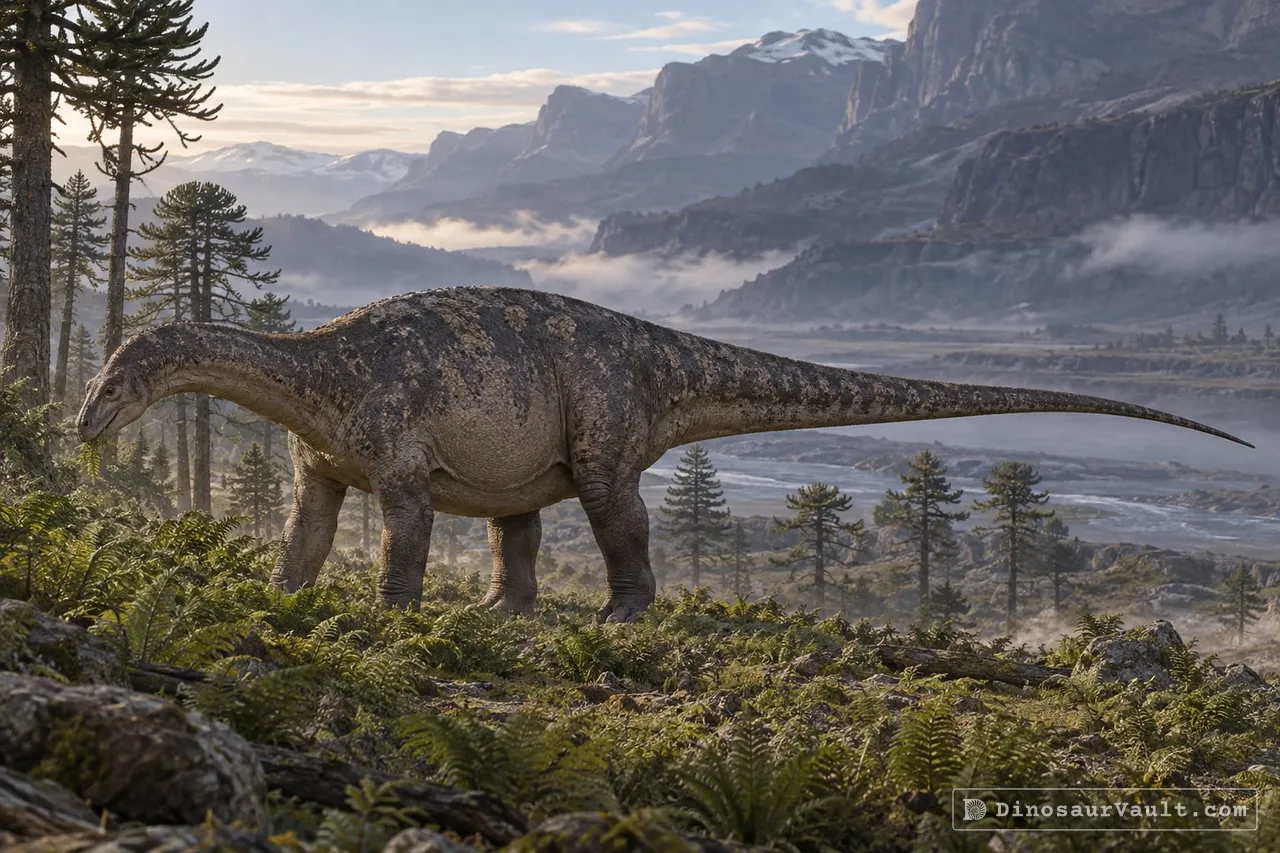
Brachytrachelopan was a sauropod with a surprisingly short neck. Most sauropods had very long necks, but this one's neck was shorter than its back, so it probably fed close to the ground, on low plants, rather than reaching high into trees.
It was about 10 meters (33 feet) long and belonged to the dicraeosaurs, a family of smaller sauropods that includes Amargasaurus and Dicraeosaurus.
Its world
It lived about 155 to 145 million years ago, in the Late Jurassic, in what is now Argentina. Its bones come from the Cañadón Calcáreo Formation, where it shared the land with the larger sauropod Tehuelchesaurus.
How it was found
Rauhut and colleagues named Brachytrachelopan in 2005, from a single partial skeleton. The first bones were spotted by a shepherd looking for lost sheep, which is where the name comes from.
Field gallery
More views of Brachytrachelopan
Scenes reconstructed from the available fossil evidence.
1 of 2
Lived alongside
Found in the same rock formations


A rock formation can hold fossils laid down millions of years apart, so not every animal here met Brachytrachelopan.
The evidence
The science behind Brachytrachelopan
Which parts of the picture come from its own bones, and which come from its relatives.
From its own fossils
- An incomplete skeleton preserves connected neck and back bones, ribs, part of the pelvis and pieces of a hind leg.
- Its neck bones are unusually short, making the neck shorter than the trunk.
- Paired bony spines along the neck and front of the back lean forward.
Borrowed from relatives
- The missing skull is restored using the small, low head of Bajadasaurus as a guide.
- Dicraeosaurus helps fill in the missing limbs, feet and tail.
- Ligaments between the spines of Amargasaurus suggest that soft tissue may have joined its paired neck ridges.
Still unknown
- The shape of its skull and the full length of its tail.
- The thickness and outline of the tissue covering its neck spines.
- Its color and how its body changed as it grew.
Often drawn wrong
- A long neck like that of Diplodocus misses its most distinctive feature: a neck shorter than its trunk.
- The huge forward-pointing spikes of Bajadasaurus should not be copied onto it.
Discovery timeline
- 2005Named itRauhut et al.
- 2019Close relativeGallina et al.
- 2022Close relativeCerda et al.
Key papers
The research behind what we know of Brachytrachelopan
Named it
Described a partial skeleton with an exceptionally short neck and placed it among the relatives of Dicraeosaurus.
Discovery of a short-necked sauropod dinosaur from the Late Jurassic period of Patagonia. Nature 435: 670-672
Read the paper : Discovery of a short-necked sauropod dinosaur from the Late Jurassic period of Patagonia (opens in a new tab)Close relative
Described Bajadasaurus, whose preserved skull helps guide the reconstruction of the missing head of Brachytrachelopan.
A new long-spined dinosaur from Patagonia sheds light on sauropod defense system. Scientific Reports 9
Read the paper : A new long-spined dinosaur from Patagonia sheds light on sauropod defense system (opens in a new tab)Close relative
Microscopic study of Amargasaurus neck spines supported connecting ligaments rather than horn sheaths, offering a soft-tissue comparison for Brachytrachelopan.
Osteohistology of the hyperelongate hemispinous processes of Amargasaurus cazaui (Dinosauria: Sauropoda): Implications for soft tissue reconstruction and functional significance. Journal of Anatomy 240: 1005-1019
Read the paper : Osteohistology of the hyperelongate hemispinous processes of Amargasaurus cazaui (Dinosauria: Sauropoda): Implications for soft tissue reconstruction and functional significance (opens in a new tab)
Close relatives
Other members of Dicraeosauridae


Sources: Wikidata