Tehuelchesaurus
"Tehuelche lizard"
Type species Tehuelchesaurus benitezii
- Lived
- 158 to 143 million years ago, Late Jurassic
- Diet
- Herbivore
- Group
- Sauropods
- Found in
- Argentina
- Named by
- Rich et al. 1999
Where its fossils were found
The evidence
Today

150 million years ago
Habitat
Lakes, rivers and floodplains formed its fossil-bearing rocks in Argentina. Other dinosaurs from these rocks include Brachytrachelopan, Bicharracosaurus and Pandoravenator.
Field notes
About Tehuelchesaurus
What it was like
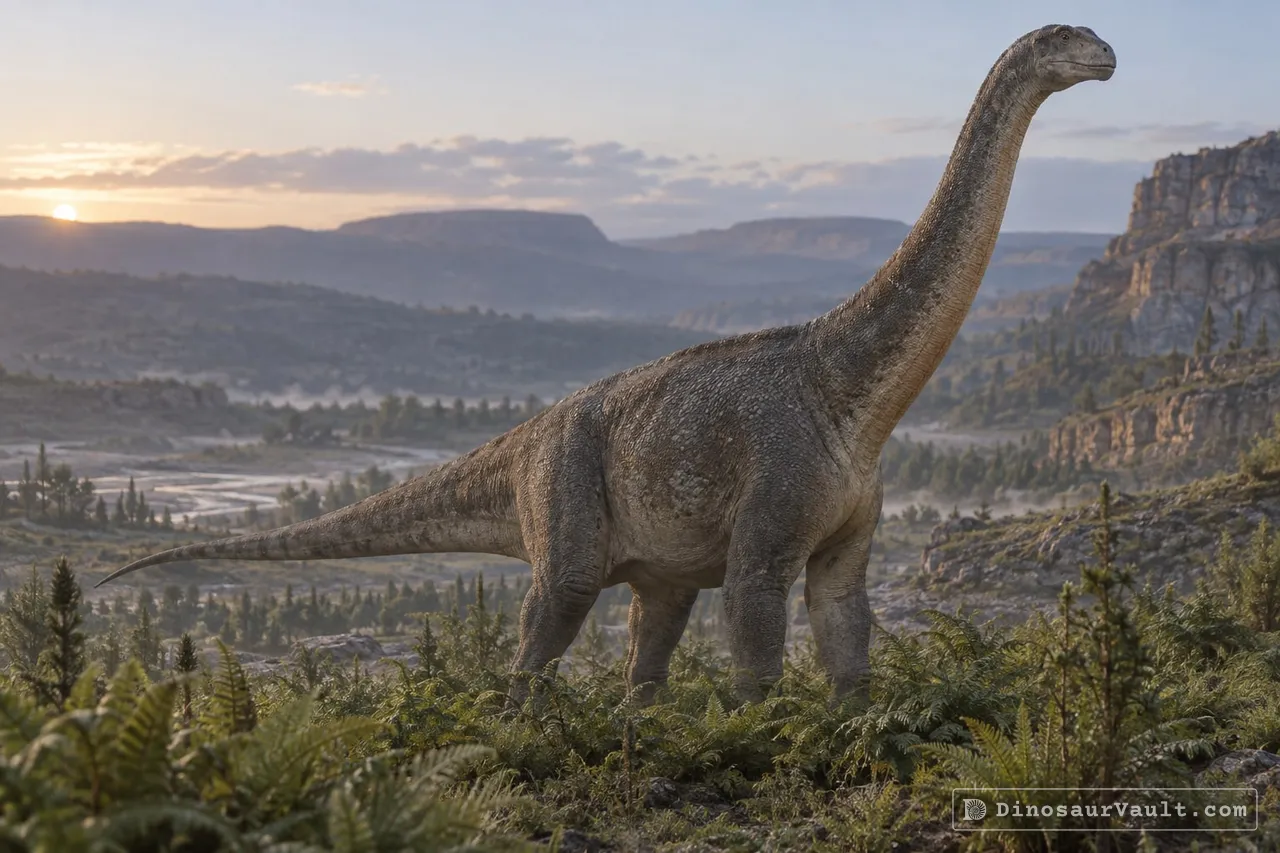
Tehuelchesaurus was a large, long-necked, four-legged plant eater, known from a partial skeleton. Skin impressions found with it show many-sided scales arranged in rosette patterns, with smaller diamond-shaped scales in some patches.
Its place among the sauropods is still debated.
Its world
It lived in the Late Jurassic in what is now Argentina. Its bones come from the Cañadón Calcáreo Formation, where it shared the land with the short-necked Brachytrachelopan.
How it was found
Rich and colleagues named Tehuelchesaurus in 1999, from a single find. It honors a native people of the region.
Field gallery
More views of Tehuelchesaurus
Scenes reconstructed from the available fossil evidence.
Lived alongside
Found in the same rock formations


A rock formation can hold fossils laid down millions of years apart, so not every animal here met Tehuelchesaurus.
The evidence
The science behind Tehuelchesaurus
Which parts of the picture come from its own bones, and which come from its relatives.
From its own fossils
- A single partial skeleton preserves linked back and hip vertebrae, the shoulder and hip bones, an upper arm and both forearm bones, both thigh bones, and patches of skin. Most of the neck and tail had been lost to erosion, and no skull was found with it.
- Its back vertebrae contain large internal chambers and a complex framework of bony ridges, and its upper arm bone and ulna are short and stocky, with expanded ends.
- Skin impressions from the shoulder, chest and forelimb show non-overlapping, many-sided scales arranged in rosette patterns, with smaller diamond-shaped scales in some patches from the arm and chest.
Borrowed from relatives
- The missing head, neck and tail are restored by comparison with Euhelopus.
- The hands and feet, which are unknown, are restored by comparison with Camarasaurus and Apatosaurus.
Still unknown
- The exact shape of its skull and length of its neck.
- Its skin color.
- Its place in the sauropod family tree. The full redescription placed it among the neosauropods, outside the group that includes Brachiosaurus and the titanosaurs, while a later analysis found weak support for a place among early somphospondylans, on the line leading to titanosaurs.
Discovery timeline
- 1999Named itRich et al.
- 2005Same rocksRauhut et al.
- 2011Full descriptionCARBALLIDO et al.
- 2024Family treeGomez et al.
Key papers
The research behind what we know of Tehuelchesaurus
Named it
Named Tehuelchesaurus from a partial sauropod skeleton found in Argentina.
A new sauropod dinosaur from Chubut province, Argentina. Proceedings of the Second Gondwanan Dinosaur Symposium, National Science Museum Monographs 15: 61-84
No link available
Same rocks
Described Brachytrachelopan, a short-necked sauropod from the same formation, showing how different neighboring sauropods could be.
Discovery of a short-necked sauropod dinosaur from the Late Jurassic period of Patagonia. Nature 435: 670-672
Read the paper : Discovery of a short-necked sauropod dinosaur from the Late Jurassic period of Patagonia (opens in a new tab)Full description
Restudied the skeleton after further preparation, gave it a new diagnosis based on its vertebrae and upper arm, and placed it among the neosauropods rather than the more primitive sauropods proposed earlier.
Osteology and phylogenetic relationships of Tehuelchesaurus benitezii (Dinosauria, Sauropoda) from the Upper Jurassic of Patagonia. Zoological Journal of the Linnean Society 163: 605-662
Read the paper : Osteology and phylogenetic relationships of Tehuelchesaurus benitezii (Dinosauria, Sauropoda) from the Upper Jurassic of Patagonia (opens in a new tab)Family tree
A broad sauropod analysis that recovered Tehuelchesaurus among early somphospondylans, with weak support for that part of the tree.
Unraveling sauropod diversity in the Portezuelo Formation of Patagonia through a comprehensive analysis of new and existing material. BMC Ecology and Evolution 24
Read the paper : Unraveling sauropod diversity in the Portezuelo Formation of Patagonia through a comprehensive analysis of new and existing material (opens in a new tab)
Close relatives
Other members of Camarasauromorpha

Sources: Wikidata