Pandoravenator
"Pandora hunter"
Type species Pandoravenator fernandezorum
- Lived
- 158 to 149 million years ago, Late Jurassic
- Diet
- Carnivore
- Group
- Theropods
- Found in
- Argentina
- Named by
- Rauhut and Pol 2017
Where its fossils were found
The evidence
Today

155 million years ago
Habitat
Lakes and rivers occupied the landscape recorded in the Cañadón Calcáreo Formation of Argentina. Brachytrachelopan and Tehuelchesaurus were plant eaters from the same formation.
Field notes
About Pandoravenator
What it was like
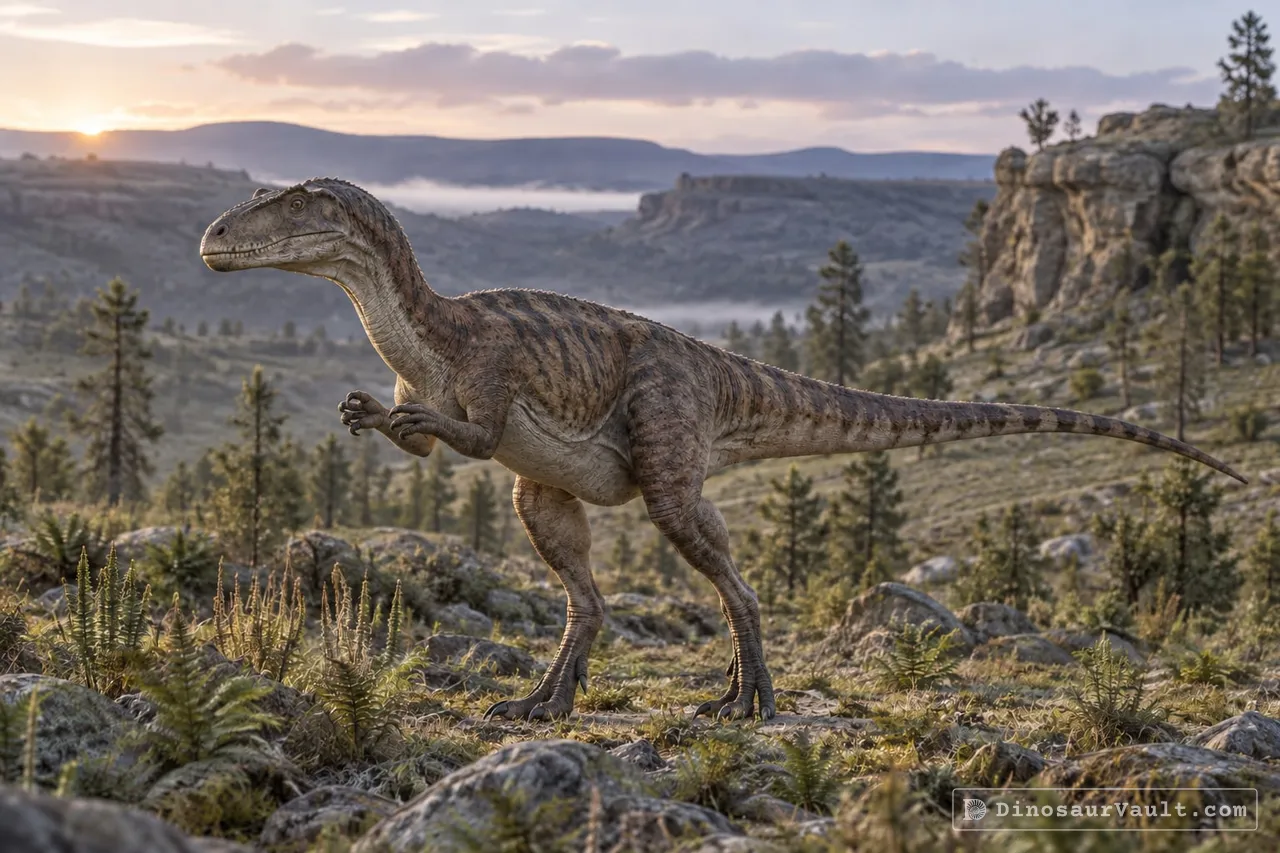
Pandoravenator was a medium-sized, two-legged meat eater. It is known from part of the legs and tail.
Its world
It lived in the Late Jurassic, in what is now Argentina. It comes from the Cañadón Calcáreo Formation, where it shared the land with the sauropods Brachytrachelopan and Tehuelchesaurus.
How it was found
Rauhut and Pol named Pandoravenator in 2017. The type species is Pandoravenator fernandezorum. Its name comes from the nickname of the dig site.
Field gallery
More views of Pandoravenator
Scenes reconstructed from the available fossil evidence.
1 of 2
Lived alongside
Found in the same rock formations


A rock formation can hold fossils laid down millions of years apart, so not every animal here met Pandoravenator.
The evidence
The science behind Pandoravenator
Which parts of the picture come from its own bones, and which come from its relatives.
From its own fossils
- The type specimen consists of hind-leg, ankle and foot bones. A foot claw is moderately curved and stout.
- An ankle bone has unusual rounded bumps and a low, sideways-leaning projection.
Borrowed from relatives
- Zuolong provides a comparison for the missing head, trunk and arms. Guanlong provides further comparisons for missing jaw and hand bones.
Still unknown
- The shape of its skull and teeth. A conference report mentions a second specimen with skull remains but gives no anatomical description.
- Its skin covering and color.
- Whether the nearby shoulder, arm and tail fragments belong to the same animal as the hind legs, and where it sits in the theropod family tree.
Discovery timeline
- 2005Same rocksRauhut et al.
- 2011Same rocksCARBALLIDO et al.
- 2017Named itRauhut & Pol
Key papers
The research behind what we know of Pandoravenator
Same rocks
Described Brachytrachelopan, a sauropod with an unusually short neck from the same formation as Pandoravenator.
Discovery of a short-necked sauropod dinosaur from the Late Jurassic period of Patagonia. Nature 435: 670-672
Read the paper : Discovery of a short-necked sauropod dinosaur from the Late Jurassic period of Patagonia (opens in a new tab)Same rocks
Restudied Tehuelchesaurus, a long-necked plant eater from the same formation, and revised its place in the sauropod family tree.
Osteology and phylogenetic relationships of Tehuelchesaurus benitezii (Dinosauria, Sauropoda) from the Upper Jurassic of Patagonia. Zoological Journal of the Linnean Society 163: 605-662
Read the paper : Osteology and phylogenetic relationships of Tehuelchesaurus benitezii (Dinosauria, Sauropoda) from the Upper Jurassic of Patagonia (opens in a new tab)Named it
Described the fragmentary skeleton and its unusual ankle, linking it to the early evolution of theropod ankle joints.
A Theropod Dinosaur from the Late Jurassic Cañadón Calcáreo Formation of Central Patagonia, and the Evolution of the Theropod Tarsus. Ameghiniana 54: 539-566
Read the paper : A Theropod Dinosaur from the Late Jurassic Cañadón Calcáreo Formation of Central Patagonia, and the Evolution of the Theropod Tarsus (opens in a new tab)
Close relatives
Other members of Tetanurae


Sources: Wikidata