Outline: a typical sauropod
Bajadasaurus
"Bajada lizard"
- Lived
- 139 to 133 million years ago, Early Cretaceous
- Diet
- Herbivore
- Group
- Sauropods, Dicraeosauridae
- Found in
- Argentina
- Named by
- Gallina et al. 2019
Where its fossils were found
The evidence
Today

135 million years ago
Field notes
About Bajadasaurus
What it was like
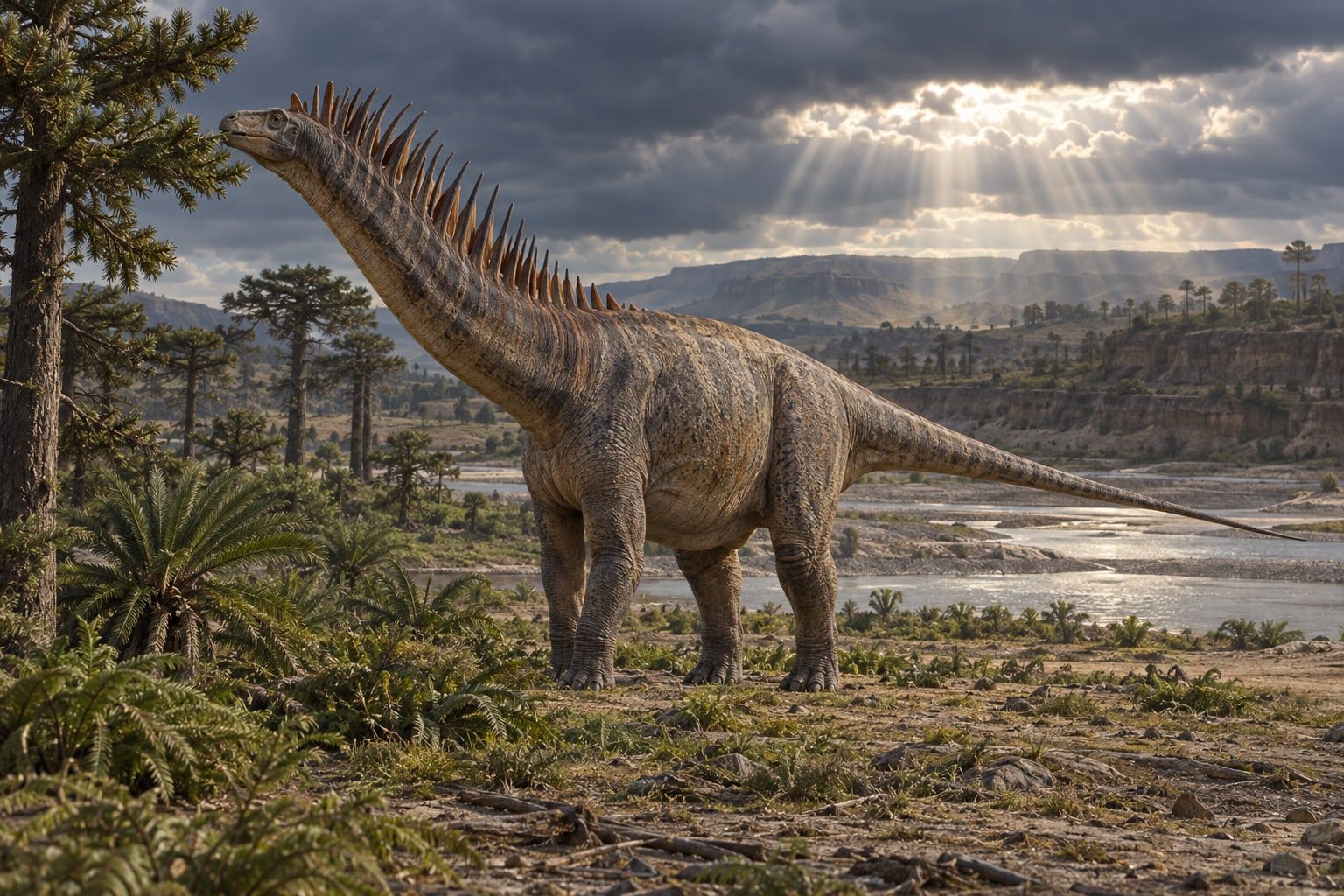
Bajadasaurus was a long-necked plant eater from the dicraeosaurid family, a group of sauropods with fairly short necks for their kind. Its most striking feature was a row of very long, paired spines rising from the bones of its neck and curving forward over the head.
Nobody knows for sure what the spines were for. They may have carried a covering of horn, helped with display, or made the neck harder for a predator to bite. Its slender skull held thin, pencil-like teeth at the front of the jaws.
Its world
It lived about 139 to 133 million years ago, in the Early Cretaceous, in what is now Argentina. Its bones come from the Bajada Colorada Formation, laid down by rivers, where it shared the land with the sauropods Leinkupal and Ninjatitan.
How it was found
Gallina and colleagues named Bajadasaurus in 2019 from a single find: a skull and part of the neck. Its closest well-known relative is Amargasaurus, which had similar spines.
Lived alongside
Found in the same rock formations
Close relatives
Other members of Dicraeosauridae
Sources: WikidataNamed in: P. A. Gallina, S. Apesteguía, and J. I. Canale, A. Haluza. 2019. A new long-spined dinosaur from Patagonia sheds light on sauropod defense system. Scientific Reports 9:1392:1-10