Wintonotitan
"Winton titan"
Type species Wintonotitan wattsi
- Lived
- 101 to 90 million years ago, Late Cretaceous
- Diet
- Herbivore
- Group
- Sauropods
- Found in
- Australia
- Named by
- Hocknull et al. 2009
Where its fossils were found
The evidence
Today

95 million years ago
Habitat
Rivers crossed the lowlands of the Winton Formation, where conifers, ferns and flowering plants grew. Its neighbors included Diamantinasaurus, Savannasaurus and Australovenator.
Field notes
About Wintonotitan
What it was like
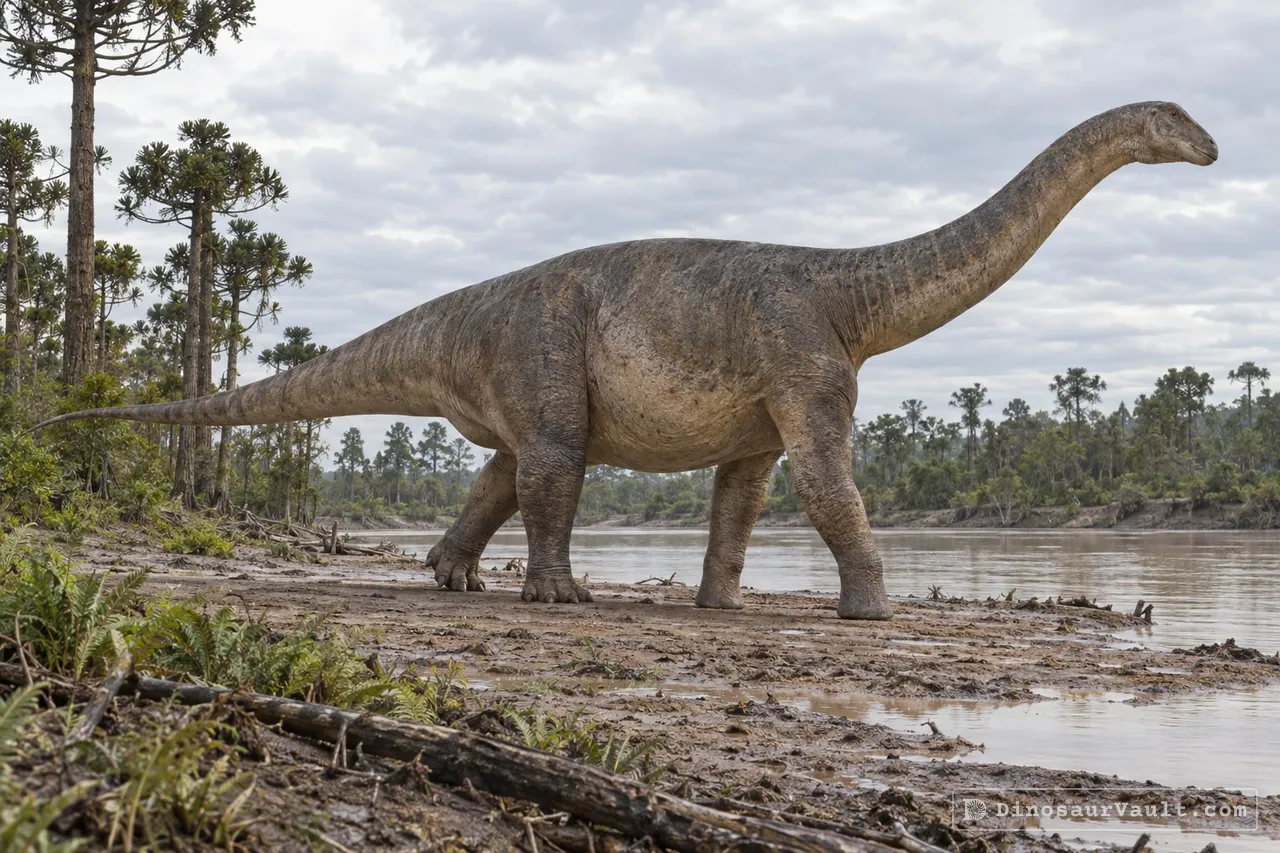
Wintonotitan was a long-necked plant eater, a relative of the titanosaurs. It is known from parts of the skeleton, including bones of the back, tail, shoulders and legs.
Its world
It lived in the Late Cretaceous in Australia. Its bones come from the Winton Formation, a land of rivers where it shared the land with the titanosaurs Diamantinasaurus and Savannasaurus and the predator Australovenator.
How it was found
Hocknull and colleagues named it in 2009. The type species is Wintonotitan wattsi. There are 7 recorded finds.
Field gallery
More views of Wintonotitan
Scenes reconstructed from the available fossil evidence.
1 of 2
Lived alongside
Found in the same rock formations


A rock formation can hold fossils laid down millions of years apart, so not every animal here met Wintonotitan.
The evidence
The science behind Wintonotitan
Which parts of the picture come from its own bones, and which come from its relatives.
From its own fossils
- A partial skeleton preserves bones of the back, tail, ribs, shoulders, arms and hips.
- Long bones from the palm show how its weight-bearing hand was built.
Borrowed from relatives
- The missing head is restored using Diamantinasaurus, a relative with a rounded snout and teeth at the front of its jaws.
- A small thumb claw is a possibility borrowed from Diamantinasaurus.
Still unknown
- The shape of its skull and the length of its neck.
- Whether its hands carried claws.
- Its skin covering and color.
Discovery timeline
- 2009Named itHocknull et al.
- 2023Close relativePoropat et al.
- 2024Family treeBeeston et al.
Key papers
The research behind what we know of Wintonotitan
Named it
Named Wintonotitan from a partial skeleton and described other dinosaurs from the Winton Formation.
New Mid-Cretaceous (Latest Albian) Dinosaurs from Winton, Queensland, Australia. PLoS ONE 4: e6190
Read the paper : New Mid-Cretaceous (Latest Albian) Dinosaurs from Winton, Queensland, Australia (opens in a new tab)Close relative
Described a nearly complete Diamantinasaurus skull, a useful comparison for restoring the missing head of Wintonotitan.
A nearly complete skull of the sauropod dinosaurDiamantinasaurus matildaefrom the Upper Cretaceous Winton Formation of Australia and implications for the early evolution of titanosaurs. Royal Society Open Science 10
Read the paper : A nearly complete skull of the sauropod dinosaurDiamantinasaurus matildaefrom the Upper Cretaceous Winton Formation of Australia and implications for the early evolution of titanosaurs (opens in a new tab)Family tree
Reexamined the bones and placed Wintonotitan in the same branch of the sauropod family tree as Diamantinasaurus and Savannasaurus.
Reappraisal of sauropod dinosaur diversity in the Upper Cretaceous Winton Formation of Queensland, Australia, through 3D digitisation and description of new specimens. PeerJ 12: e17180
Read the paper : Reappraisal of sauropod dinosaur diversity in the Upper Cretaceous Winton Formation of Queensland, Australia, through 3D digitisation and description of new specimens (opens in a new tab)
Close relatives
Other members of Diamantinasauria


Sources: Wikidata