Diamantinasaurus
"Diamantina lizard"
Type species Diamantinasaurus matildae
- Lived
- 101 to 90 million years ago, Late Cretaceous
- Diet
- Herbivore
- Group
- Sauropods
- Found in
- Australia
- Named by
- Hocknull et al. 2009
Where its fossils were found
The evidence
Today

95 million years ago
Habitat
Rivers and forests in what is now Australia, with conifers, seed ferns and flowering plants. The Winton Formation also held Wintonotitan, Savannasaurus and Australovenator.
Field notes
About Diamantinasaurus
What it was like
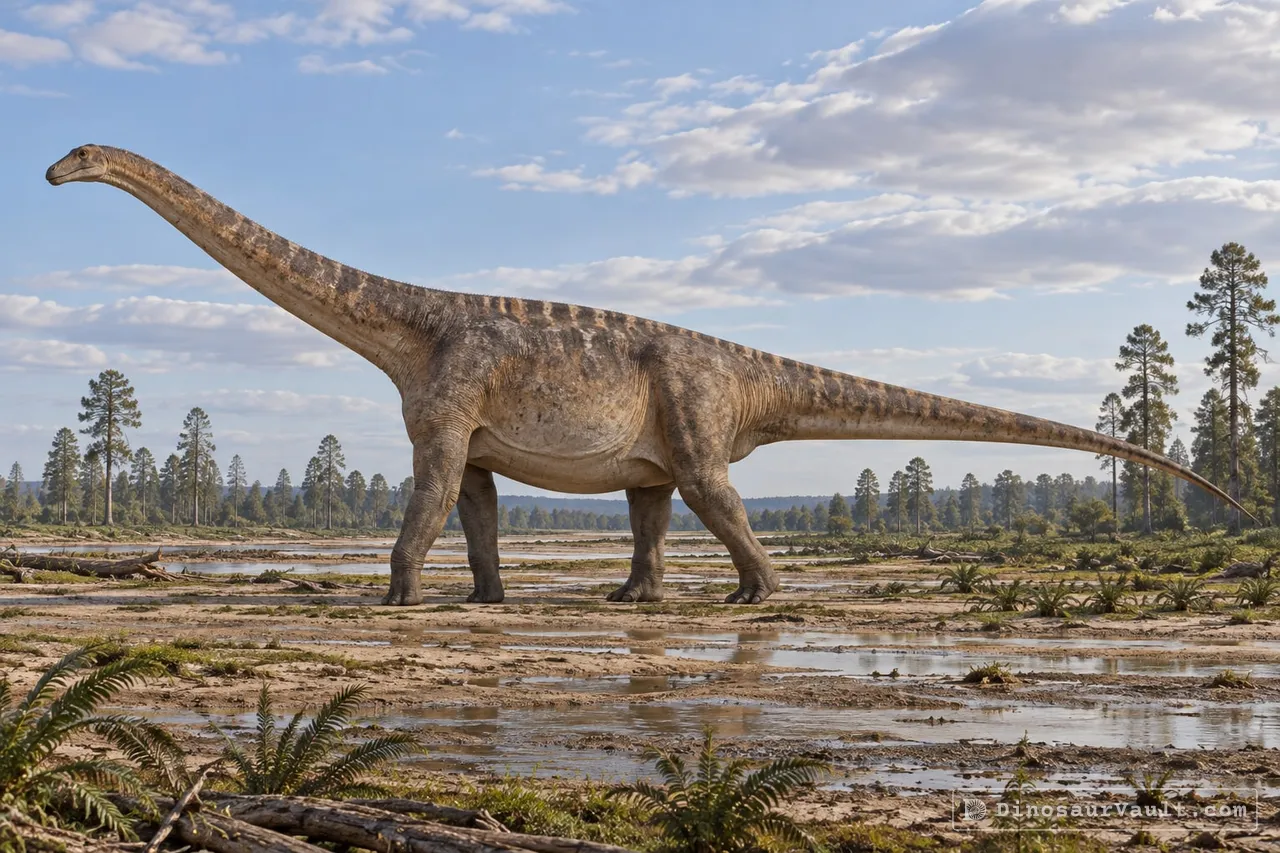
Diamantinasaurus was a titanosaur, a long-necked plant eater with a sturdy body and thick legs. Its skull is known, which is rare for titanosaurs, and its close relatives include Savannasaurus.
Its world
It lived in the Late Cretaceous, in what is now Australia. It comes from the Winton Formation, a land of rivers and forests shared with the sauropods Wintonotitan and Savannasaurus and the predator Australovenator. Parts of Diamantinasaurus and Australovenator were found in the same place.
How it was found
Hocknull and colleagues named Diamantinasaurus in 2009. The type species is Diamantinasaurus matildae.
Field gallery
More views of Diamantinasaurus
Scenes reconstructed from the available fossil evidence.
1 of 3
Lived alongside
Found in the same rock formations


A rock formation can hold fossils laid down millions of years apart, so not every animal here met Diamantinasaurus.
The evidence
The science behind Diamantinasaurus
Which parts of the picture come from its own bones, and which come from its relatives.
From its own fossils
- Several partial skeletons preserve the sturdy limbs, parts of the backbone and a nearly complete skull.
- The hand retained finger bones and a thumb claw.
- Fossilized gut contents contain conifer foliage, flowering-plant leaves and seed-fern reproductive parts.
Borrowed from relatives
- Its own fossils supply much of the body; missing parts can be compared with Savannasaurus and Sarmientosaurus.
- Its skull and teeth share distinctive features with Sarmientosaurus from South America.
Still unknown
- Its color.
- Whether it cared for its young.
- How its diet changed as it grew.
Discovery timeline
- 2009Named itHocknull et al.
- 2021Growing upRigby et al.
- 2023SkullPoropat et al.
- 2025How it fedPoropat et al.
Key papers
The research behind what we know of Diamantinasaurus
Named it
Named Diamantinasaurus from a sturdy partial skeleton that retained finger bones and a thumb claw.
New Mid-Cretaceous (Latest Albian) Dinosaurs from Winton, Queensland, Australia. PLoS ONE 4: e6190
Read the paper : New Mid-Cretaceous (Latest Albian) Dinosaurs from Winton, Queensland, Australia (opens in a new tab)Growing up
Described a juvenile skeleton and found that its limb bones grew proportionally faster than other skeletal parts.
A juvenile Diamantinasaurus matildae (Dinosauria: Titanosauria) from the Upper Cretaceous Winton Formation of Queensland, Australia, with implications for sauropod ontogeny. Journal of Vertebrate Paleontology 41
Read the paper : A juvenile Diamantinasaurus matildae (Dinosauria: Titanosauria) from the Upper Cretaceous Winton Formation of Queensland, Australia, with implications for sauropod ontogeny (opens in a new tab)Skull
Described a nearly complete skull with features shared by Sarmientosaurus, strengthening the link between these Australian and South American sauropods.
A nearly complete skull of the sauropod dinosaurDiamantinasaurus matildaefrom the Upper Cretaceous Winton Formation of Australia and implications for the early evolution of titanosaurs. Royal Society Open Science 10
Read the paper : A nearly complete skull of the sauropod dinosaurDiamantinasaurus matildaefrom the Upper Cretaceous Winton Formation of Australia and implications for the early evolution of titanosaurs (opens in a new tab)How it fed
Identified conifers, flowering plants and seed ferns in fossilized gut contents, showing a varied plant diet with little chewing.
Fossilized gut contents elucidate the feeding habits of sauropod dinosaurs. Current Biology 35: 2597-2613.e7
Read the paper : Fossilized gut contents elucidate the feeding habits of sauropod dinosaurs (opens in a new tab)
Close relatives
Other members of Diamantinasauria


Sources: Wikidata