Savannasaurus
"savanna lizard"
Type species Savannasaurus elliottorum
- Lived
- 101 to 90 million years ago, Late Cretaceous
- Diet
- Herbivore
- Group
- Sauropods
- Found in
- Australia
- Named by
- Poropat et al. 2016
Where its fossils were found
The evidence
Today

95 million years ago
Habitat
A warm, heavily vegetated floodplain crossed by slow rivers, with lakes and swamps in the Winton Formation. Diamantinasaurus, Wintonotitan and Australovenator lived in the same landscape.
Field notes
About Savannasaurus
What it was like
Savannasaurus was a titanosaur, a long-necked, four-legged plant eater with a very wide body. Its broad hips and chest suggest it had a huge gut for digesting plants.
It is the most complete long-necked dinosaur found in Australia.
Its world
It lived in the Late Cretaceous in what is now Australia. Its bones come from the Winton Formation, where it shared the land with the titanosaurs Diamantinasaurus and Wintonotitan and the hunter Australovenator.
How it was found
Poropat and colleagues named Savannasaurus in 2016. The first bone was found by a sheep farmer, and the skeleton took years to dig out and prepare.
Field gallery
More views of Savannasaurus
Scenes reconstructed from the available fossil evidence.
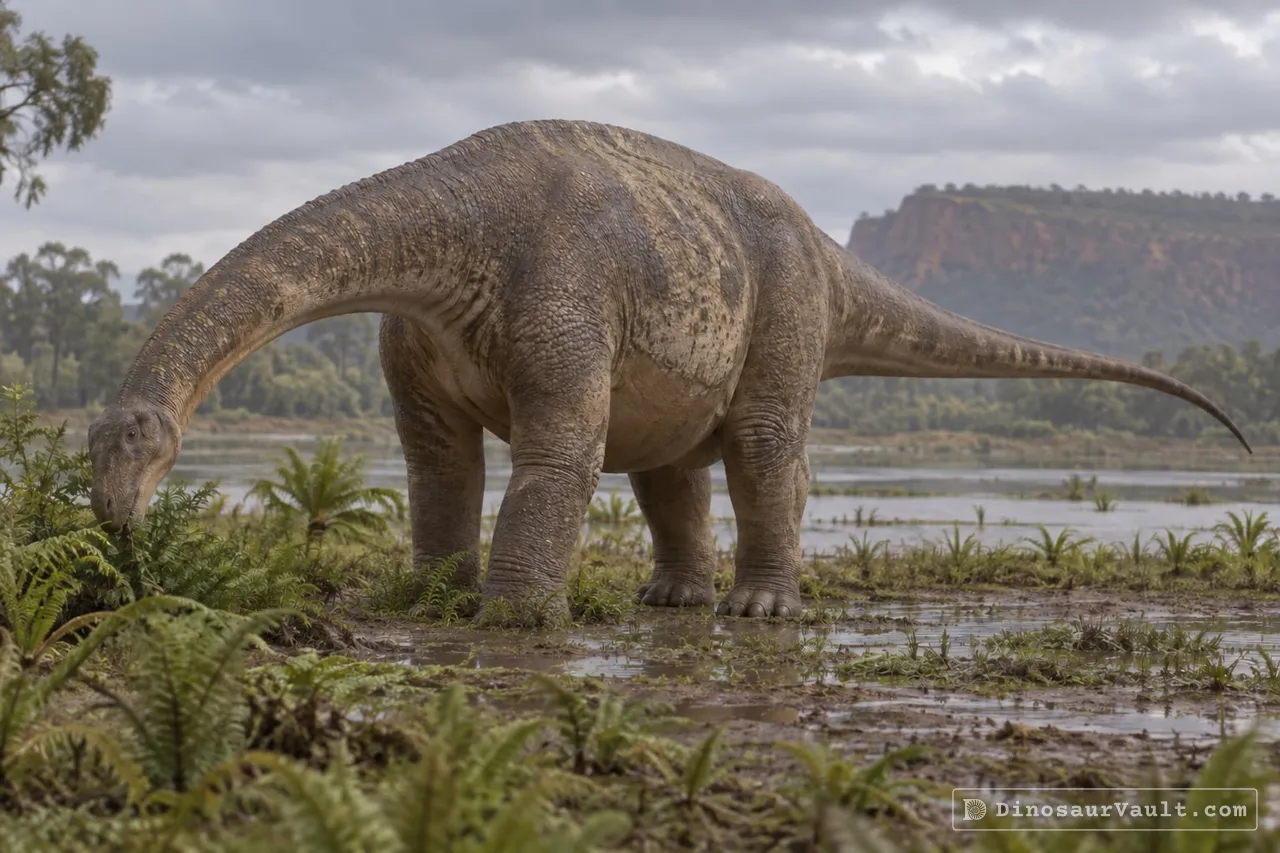
1 of 2
Lived alongside
Found in the same rock formations


A rock formation can hold fossils laid down millions of years apart, so not every animal here met Savannasaurus.
The evidence
The science behind Savannasaurus
Which parts of the picture come from its own bones, and which come from its relatives.
From its own fossils
- A partial skeleton preserves much of the backbone, ribs, shoulder region, hips and parts of the limbs.
- Its chest and hips were unusually broad, giving the trunk a barrel shape.
- The ankle bone is taller than it is wide or long.
Borrowed from relatives
- Its missing skull and much of the neck are restored by comparison with related sauropods, especially Diamantinasaurus.
Still unknown
- The shape of its skull.
- Its skin color and markings.
- What hatchlings looked like.
Discovery timeline
- 2016Named itPoropat et al.
- 2018Its worldFletcher, Moss & Salisbury
- 2020Full descriptionPoropat et al.
Key papers
The research behind what we know of Savannasaurus
Named it
Named Savannasaurus from a broad-bodied skeleton and examined how sauropods reached Australia.
New Australian sauropods shed light on Cretaceous dinosaur palaeobiogeography. Scientific Reports 6
Read the paper : New Australian sauropods shed light on Cretaceous dinosaur palaeobiogeography (opens in a new tab)Its world
Reconstructed a warm floodplain with meandering rivers, lakes, swamps and seasonal rainfall.
The palaeoenvironment of the Upper Cretaceous (Cenomanian–Turonian) portion of the Winton Formation, Queensland, Australia. PeerJ 6: e5513
Read the paper : The palaeoenvironment of the Upper Cretaceous (Cenomanian–Turonian) portion of the Winton Formation, Queensland, Australia (opens in a new tab)Full description
Described the skeleton in detail and proposed that its broad trunk and stable stance helped it move across muddy floodplains.
Osteology of the Wide-Hipped Titanosaurian Sauropod Dinosaur Savannasaurus Elliottorum from the Upper Cretaceous Winton Formation of Queensland, Australia. Journal of Vertebrate Paleontology 40
Read the paper : Osteology of the Wide-Hipped Titanosaurian Sauropod Dinosaur Savannasaurus Elliottorum from the Upper Cretaceous Winton Formation of Queensland, Australia (opens in a new tab)
Close relatives
Other members of Diamantinasauria


Sources: Wikidata