Albinykus
"Albin claw"
- Lived
- 86 to 72 million years ago, Late Cretaceous
- Diet
- Carnivore
- Group
- Theropods, Alvarezsauridae
- Found in
- Mongolia
- Named by
- Nesbitt et al. 2011
Where its fossils were found
The evidence
Today

80 million years ago
Habitat
A plain in Mongolia with seasonal dry weather and occasional floods. Yamaceratops and Haya lived in the same formation.
Field notes
About Albinykus
What it was like
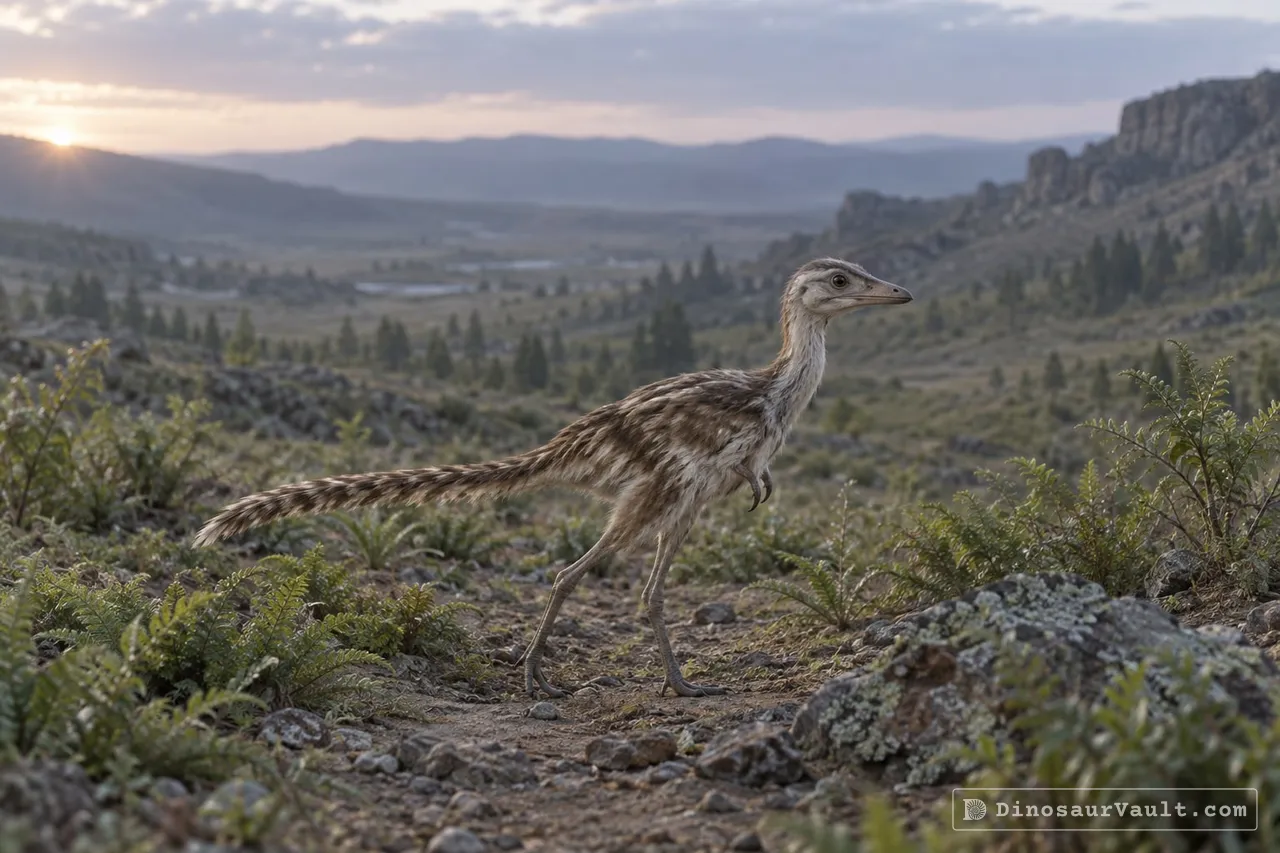
Albinykus was a tiny alvarezsaur, a bird-like dinosaur with long legs and short, strong arms. It is known from the legs and hips of one animal, which was found crouched as if sitting on a nest.
Its world
It lived in the Late Cretaceous in what is now Mongolia. Its bones come from the Javkhlant Formation, where the small horned Yamaceratops and the plant eater Haya also lived.
How it was found
Nesbitt and colleagues named it in 2011. Its name comes from a Mongolian word for a light of legend.
Field gallery
More views of Albinykus
Scenes reconstructed from the available fossil evidence.
Lived alongside
Found in the same rock formations


A rock formation can hold fossils laid down millions of years apart, so not every animal here met Albinykus.
The evidence
The science behind Albinykus
Which parts of the picture come from its own bones, and which come from its relatives.
From its own fossils
- A partial skeleton preserves the hips and hind legs, with the feet folded under the body.
- Ankle bones are fused to the shin, and other ankle bones are fused to the upper foot bones.
Borrowed from relatives
- The missing head and short, strong arms are restored from relatives such as Shuvuuia and Mononykus.
Still unknown
- Its head shape.
- Its color and the details of its body covering.
- Whether it was resting when it died.
Discovery timeline
- 2011Named itNesbitt et al.
- 2021Growing upQin et al.
- 2023PostureKubo et al.
Key papers
The research behind what we know of Albinykus
Named it
Named a tiny alvarezsaur with unusually fused ankle bones and a crouched posture; bone structure showed that it was still growing.
A small alvarezsaurid from the eastern Gobi Desert offers insight into evolutionary patterns in the Alvarezsauroidea. Journal of Vertebrate Paleontology 31: 144-153
Read the paper : A small alvarezsaurid from the eastern Gobi Desert offers insight into evolutionary patterns in the Alvarezsauroidea (opens in a new tab)Growing up
Compared growth and body size across alvarezsaurs and linked their shift toward tiny bodies to possible specialization in eating ants and termites.
Growth and miniaturization among alvarezsauroid dinosaurs. Current Biology 31: 3687-3693.e5
Read the paper : Growth and miniaturization among alvarezsauroid dinosaurs (opens in a new tab)Posture
Described Jaculinykus in a bird-like sleeping posture and compared it with the folded hind legs of Albinykus.
A new alvarezsaurid dinosaur (Theropoda, Alvarezsauria) from the Upper Cretaceous Baruungoyot Formation of Mongolia provides insights for bird-like sleeping behavior in non-avian dinosaurs. PLOS ONE 18: e0293801
Read the paper : A new alvarezsaurid dinosaur (Theropoda, Alvarezsauria) from the Upper Cretaceous Baruungoyot Formation of Mongolia provides insights for bird-like sleeping behavior in non-avian dinosaurs (opens in a new tab)
Close relatives
Other members of Alvarezsauridae


Sources: Wikidata