Yamaceratops
Type species Yamaceratops dorngobiensis
- Lived
- 86 to 72 million years ago, Late Cretaceous
- Diet
- Herbivore
- Group
- Ceratopsians
- Found in
- Mongolia
- Named by
- Makovicky and Norell 2006
Where its fossils were found
The evidence
Today

80 million years ago
Habitat
It lived on river floodplains in a seasonally dry landscape in what is now Mongolia. Haya and Albinykus also lived in the Javkhlant Formation landscape.
Field notes
About Yamaceratops
What it was like
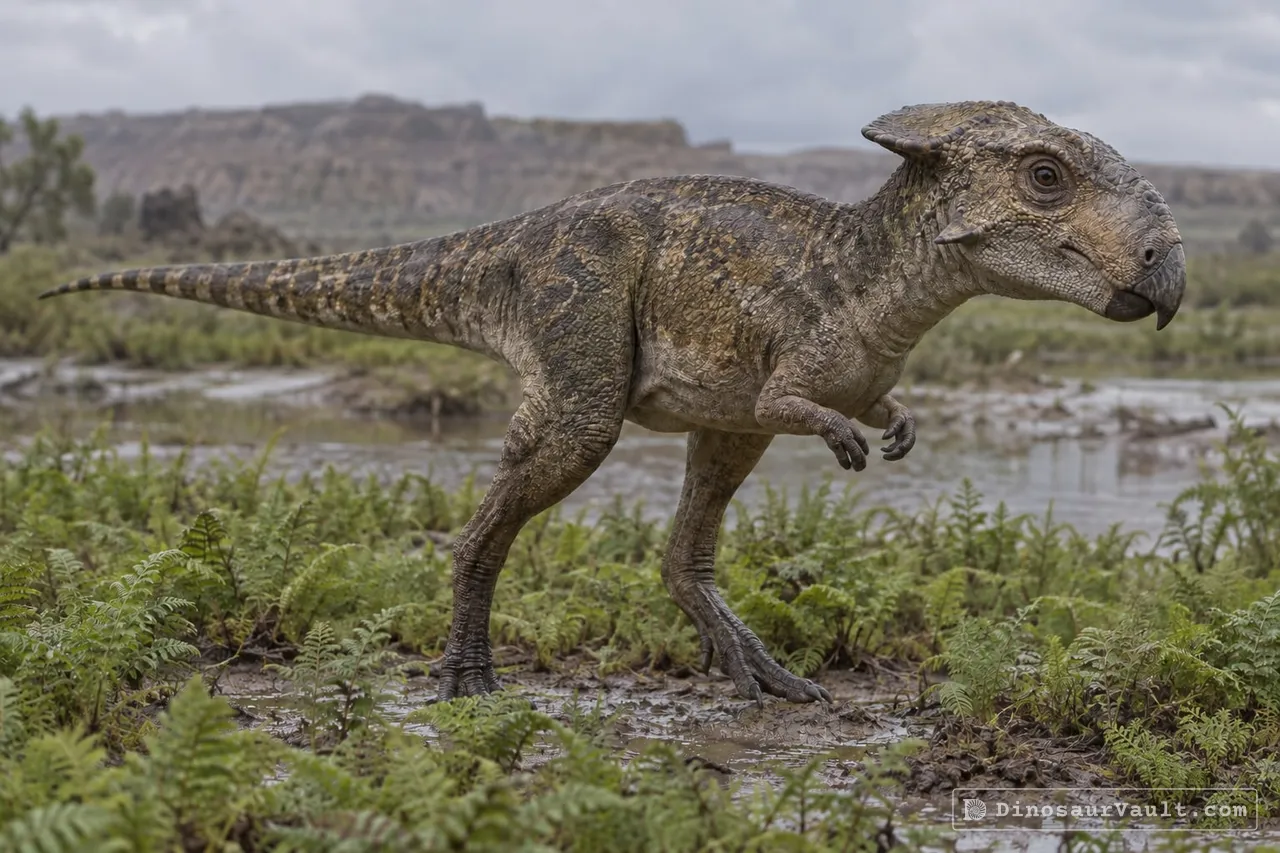
Yamaceratops was a small, early horned dinosaur with a short frill. It had no horns and probably walked on two legs.
Its world
It lived in the Late Cretaceous, in what is now Mongolia. It comes from the Javkhlant Formation, where it shared the land with the small plant eater Haya and the alvarezsaur Albinykus.
How it was found
Makovicky and Norell named Yamaceratops in 2006. The type species is Yamaceratops dorngobiensis. Its name refers to a deity.
Field gallery
More views of Yamaceratops
Scenes reconstructed from the available fossil evidence.
1 of 3
Lived alongside
Found in the same rock formations


A rock formation can hold fossils laid down millions of years apart, so not every animal here met Yamaceratops.
The evidence
The science behind Yamaceratops
Which parts of the picture come from its own bones, and which come from its relatives.
From its own fossils
- Skulls show a hooked beak and broad, thin frill behind the head.
- A young skeleton preserves much of the backbone and limbs, including long hind legs.
- Tall spines on the middle tail bones gave the tail a deep profile.
Borrowed from relatives
- The fleshy outline of the tail follows comparisons with Protoceratops and other early ceratopsians with tall tail spines.
- Much of the skeleton is known directly, including a young animal's skull, backbone and limbs.
Still unknown
- Its skin color and markings.
- How its frill was used.
- Whether adults walked on two legs as consistently as the young animal probably did.
Discovery timeline
- 2006Named itMAKOVICKY & NORELL
- 2009Its worldEberth et al.
- 2022Growing upSon et al.
Key papers
The research behind what we know of Yamaceratops
Named it
Described a small ceratopsian whose skull combines early features with more specialized cheeks and jaws.
Yamaceratops Dorngobiensis, a New Primitive Ceratopsian (Dinosauria: Ornithischia) from the Cretaceous of Mongolia. American Museum Novitates 3530: 1
Read the paper : Yamaceratops Dorngobiensis, a New Primitive Ceratopsian (Dinosauria: Ornithischia) from the Cretaceous of Mongolia (opens in a new tab)Its world
Placed the fossil beds in the Late Cretaceous and described a landscape shaped by rivers and floodplains.
Assignment ofYamaceratops dorngobiensisand associated redbeds at Shine Us Khudag (eastern Gobi, Dorngobi Province, Mongolia) to the redescribed Javkhlant Formation (Upper Cretaceous). Journal of Vertebrate Paleontology 29: 295-302
Read the paper : Assignment ofYamaceratops dorngobiensisand associated redbeds at Shine Us Khudag (eastern Gobi, Dorngobi Province, Mongolia) to the redescribed Javkhlant Formation (Upper Cretaceous) (opens in a new tab)Growing up
Described a young skeleton with long hindlimbs and tall tail spines, compared growth changes and supported walking on two legs.
A new juvenile Yamaceratops (Dinosauria, Ceratopsia) from the Javkhlant Formation (Upper Cretaceous) of Mongolia. PeerJ 10: e13176
Read the paper : A new juvenile Yamaceratops (Dinosauria, Ceratopsia) from the Javkhlant Formation (Upper Cretaceous) of Mongolia (opens in a new tab)
Close relatives
Other members of Neoceratopsia


Sources: Wikidata