Zuoyunlong
- Lived
- 101 to 84 million years ago, Late Cretaceous
- Diet
- Herbivore
- Group
- Ornithopods
- Found in
- China
- Named by
- Wang et al. 2017
Where its fossils were found
The evidence
Today

90 million years ago
Habitat
Lakes formed part of the landscape recorded by the Zhumapu Formation, with conifers and broadleaf trees among its plants. Yunganglong lived in the same region.
Field notes
About Zuoyunlong
What it was like
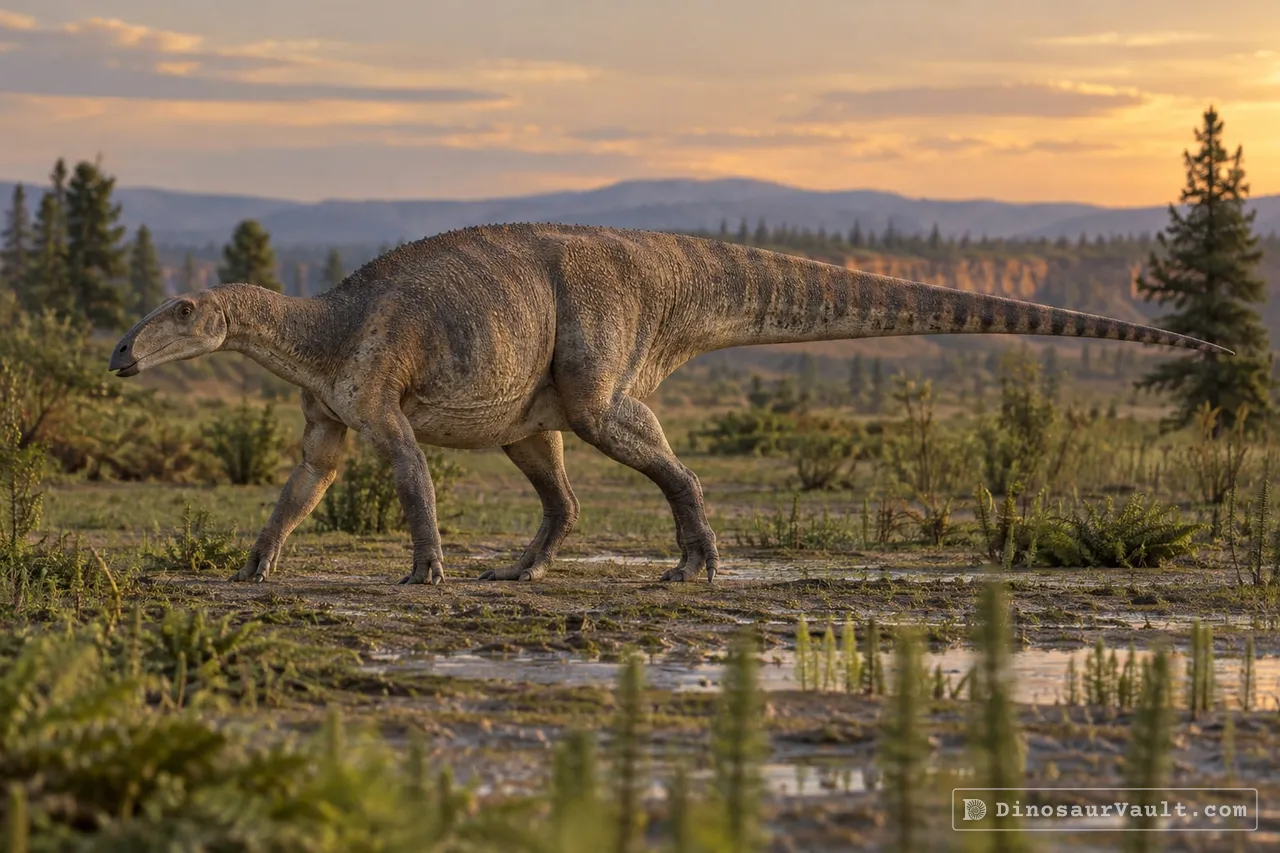
Zuoyunlong was a relative of the duckbills, a plant eater known from a hip bone.
Its world
It lived in the Late Cretaceous, in what is now China. It comes from the Zhumapu Formation, where the duckbill relative Yunganglong also lived.
How it was found
Wang and colleagues named Zuoyunlong in 2017.
Field gallery
More views of Zuoyunlong
Scenes reconstructed from the available fossil evidence.
1 of 2
Lived alongside
Found in the same rock formations

A rock formation can hold fossils laid down millions of years apart, so not every animal here met Zuoyunlong.
The evidence
The science behind Zuoyunlong
Which parts of the picture come from its own bones, and which come from its relatives.
From its own fossils
- The type specimen is a partial right ilium and the end of a right ischium, found close together and judged to be one animal.
- The blade of the ilium behind the hip socket is unusually short.
- The end of the ischium expands into a narrow, pointed tip directed downward.
Borrowed from relatives
- The missing head and limbs are restored by comparison with Probactrosaurus, which the naming study placed near Zuoyunlong.
Still unknown
- The shape of its head, the proportions of the rest of its body and its exact closest relatives.
- Its skin covering and color.
- How its young grew.
Discovery timeline
- 2002Family treeNorman
- 2013Same rocksWang et al.
- 2017Named itWang et al.
Key papers
The research behind what we know of Zuoyunlong
Family tree
Redescribed Probactrosaurus, a lightly built plant eater with an uncrested skull, long forearms and a small thumb spike.
On Asian ornithopods (Dinosauria: Ornithischia). 4. ProbactrosaurusRozhdestvensky, 1966. Zoological Journal of the Linnean Society 136: 113-144
Read the paper : On Asian ornithopods (Dinosauria: Ornithischia). 4. ProbactrosaurusRozhdestvensky, 1966 (opens in a new tab)Same rocks
Described Yunganglong, another early relative of the duckbills from the Zhumapu Formation.
A New Hadrosauroid Dinosaur from the Early Late Cretaceous of Shanxi Province, China. PLoS ONE 8: e77058
Read the paper : A New Hadrosauroid Dinosaur from the Early Late Cretaceous of Shanxi Province, China (opens in a new tab)Named it
Named Zuoyunlong from hip bones with an unusually short rear blade and linked it to Probactrosaurus.
A second hadrosauroid dinosaur from the early Late Cretaceous of Zuoyun, Shanxi Province, China. Historical Biology 29: 17-24
No link available
Close relatives
Other members of Hadrosauroidea


Sources: Wikidata