Yunganglong
"Yungang dragon"
- Lived
- 101 to 84 million years ago, Late Cretaceous
- Diet
- Herbivore
- Group
- Ornithopods
- Found in
- China
- Named by
- Wang et al. 2013
Where its fossils were found
The evidence
Today

90 million years ago
Habitat
It lived in northern China during the Late Cretaceous, where flowering plants grew. The Zhumapu Formation also contains Zuoyunlong and unnamed armored and horned dinosaurs.
Field notes
About Yunganglong
What it was like
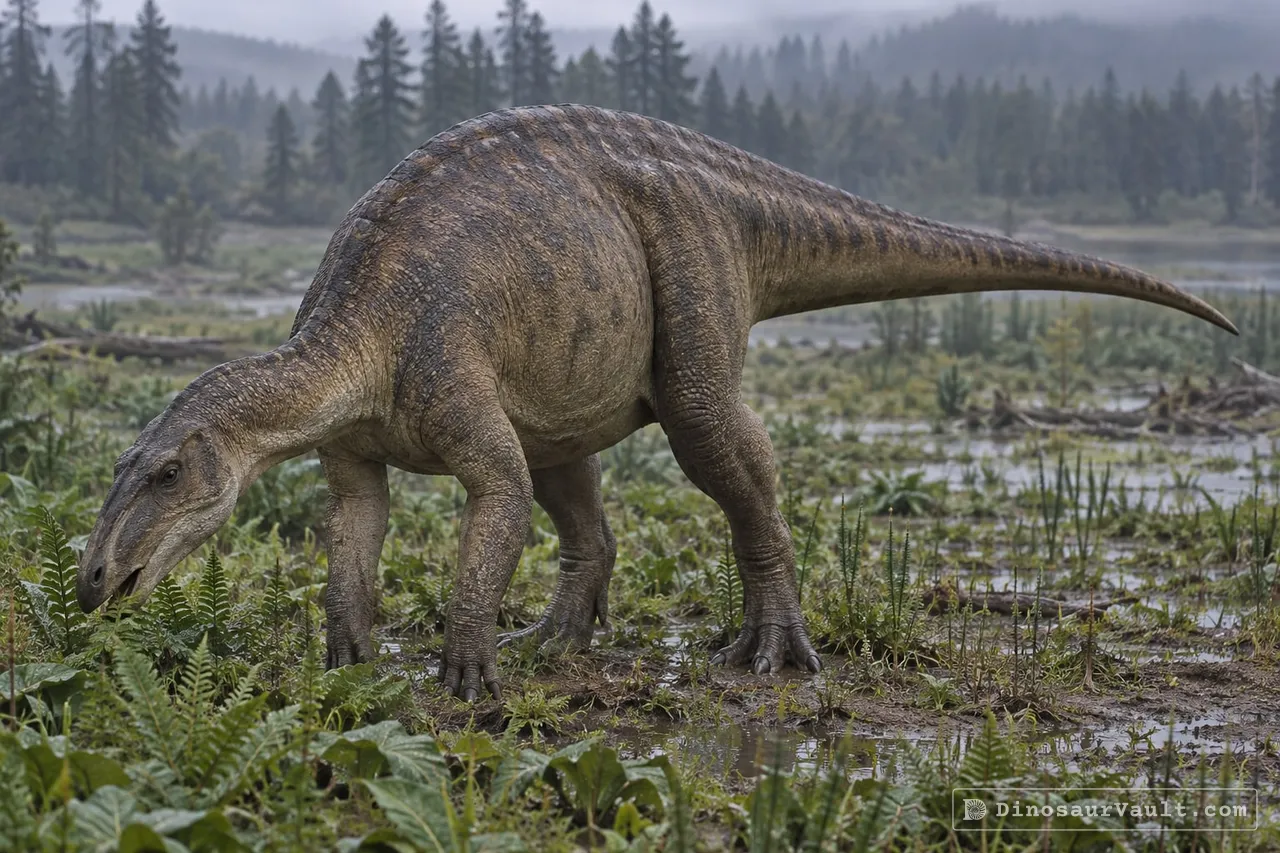
Yunganglong was a plant eater related to the duck-billed dinosaurs, known from part of the skeleton, including backbones and hip bones.
Its world
It lived in the Late Cretaceous in what is now northern China. Its bones come from the Zhumapu Formation, where it shared the land with another early hadrosaur relative, Zuoyunlong.
How it was found
Wang and colleagues named Yunganglong in 2013, from a single find. Its name refers to famous old cave temples near where it was found.
Field gallery
More views of Yunganglong
Scenes reconstructed from the available fossil evidence.
Lived alongside
Found in the same rock formations

A rock formation can hold fossils laid down millions of years apart, so not every animal here met Yunganglong.
The evidence
The science behind Yunganglong
Which parts of the picture come from its own bones, and which come from its relatives.
From its own fossils
- A single partial adult skeleton, found with its bones scattered, preserves the back of the skull, neck and tail vertebrae, hip bones, and parts of the hind legs including the shin and an ankle bone.
- The preserved back of the skull is broad and low, with a low ridge along its top.
- The thigh bone has a deep, open groove at the knee.
Borrowed from relatives
- The missing snout, jaws, arms, hands, feet and tail end are restored by comparison with Eolambia, an early duck-billed relative.
Still unknown
- The shape of its snout and jaws.
- Whether a taller crest rose at the back of its head. Only the low ridge on top of the skull is preserved.
- Its arms, hands, feet and the end of its tail.
Discovery timeline
- 2012Family treeMcDonald
- 2012Close relativeMcDonald et al.
- 2013Named itWang et al.
- 2015Same rocksWang et al.
Key papers
The research behind what we know of Yunganglong
Family tree
Compared early iguanodontians and duck-billed relatives, establishing an anatomical framework used in the later study of Yunganglong.
Phylogeny of Basal Iguanodonts (Dinosauria: Ornithischia): An Update. PLoS ONE 7: e36745
Read the paper : Phylogeny of Basal Iguanodonts (Dinosauria: Ornithischia): An Update (opens in a new tab)Close relative
Described the skeleton of Eolambia, an early duck-billed relative whose snout, jaws, arms, hands and feet are known, unlike those of Yunganglong.
Osteology of the Basal Hadrosauroid Eolambia caroljonesa (Dinosauria: Ornithopoda) from the Cedar Mountain Formation of Utah. PLoS ONE 7: e45712
Read the paper : Osteology of the Basal Hadrosauroid Eolambia caroljonesa (Dinosauria: Ornithopoda) from the Cedar Mountain Formation of Utah (opens in a new tab)Named it
Described a partial adult skeleton and identified Yunganglong as an early relative of the duck-billed dinosaurs using features of its skull and thigh bone.
A New Hadrosauroid Dinosaur from the Early Late Cretaceous of Shanxi Province, China. PLoS ONE 8: e77058
Read the paper : A New Hadrosauroid Dinosaur from the Early Late Cretaceous of Shanxi Province, China (opens in a new tab)Same rocks
Named Zuoyunlong from the same formation as Yunganglong, revealing another early duck-billed relative in the local fauna.
A second hadrosauroid dinosaur from the early Late Cretaceous of Zuoyun, Shanxi Province, China. Historical Biology 29: 17-24
Read the paper : A second hadrosauroid dinosaur from the early Late Cretaceous of Zuoyun, Shanxi Province, China (opens in a new tab)
Close relatives
Other members of Hadrosauroidea


Sources: Wikidata