Weewarrasaurus
"Weewarra lizard"
- Lived
- 101 to 94 million years ago, Late Cretaceous
- Diet
- Herbivore
- Group
- Ornithopods
- Found in
- Australia
- Named by
- Bell et al. 2018
Where its fossils were found
The evidence
Today

95 million years ago
Habitat
The Griman Creek Formation records freshwater lagoons near the coast, with conifers, ferns and horsetails. Fostoria also lived in this region.
Field notes
About Weewarrasaurus
What it was like
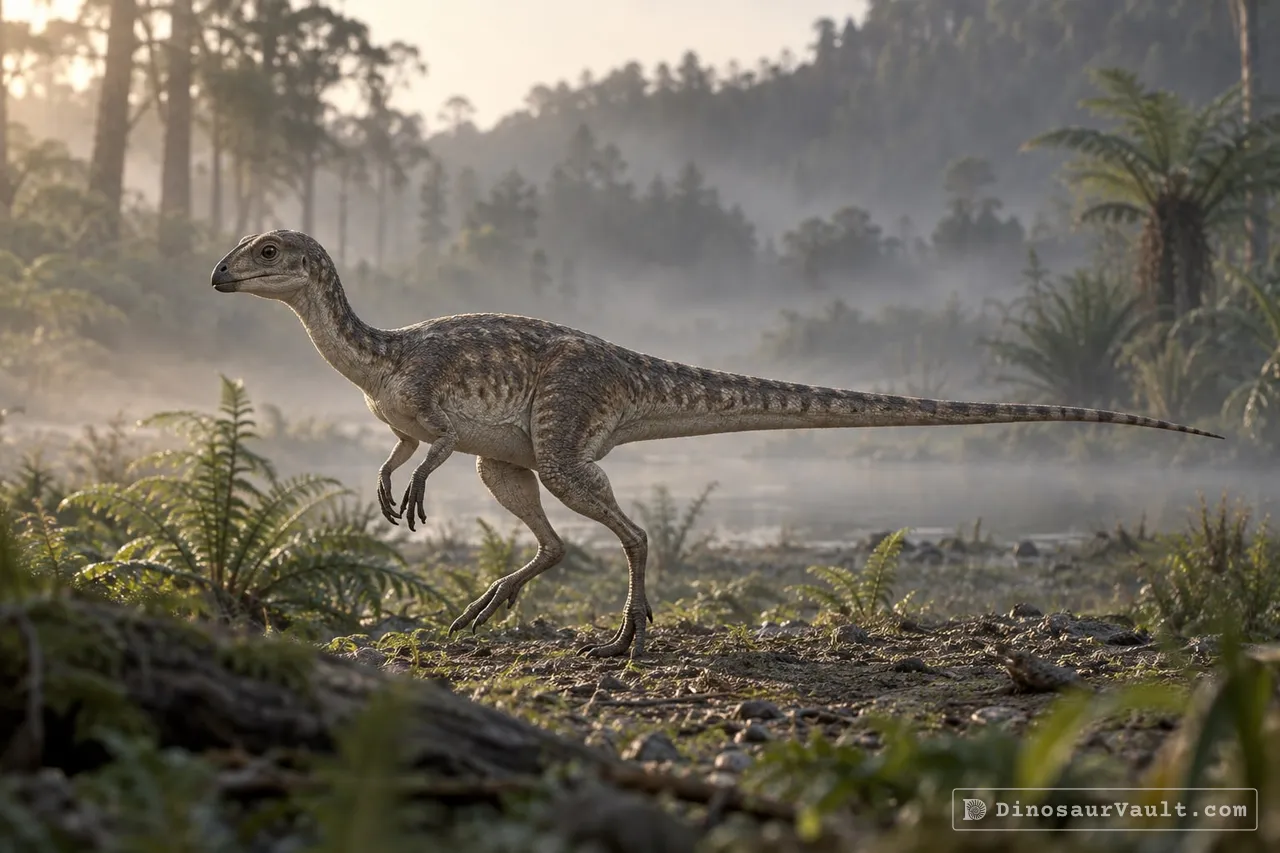
Weewarrasaurus was a small, two-legged plant eater, known only from two lower jaws. Its teeth had ridges and small bumps along the edges.
Its world
It lived in the Late Cretaceous in what is now Australia. Its bones come from the Griman Creek Formation, where it shared the land with the small plant eater Fostoria.
How it was found
Bell and colleagues named Weewarrasaurus in 2018. Its jaw bone had turned to opal, a gemstone, and was found by a miner digging for opals.
Field gallery
More views of Weewarrasaurus
Scenes reconstructed from the available fossil evidence.
1 of 3
Lived alongside
Found in the same rock formations

A rock formation can hold fossils laid down millions of years apart, so not every animal here met Weewarrasaurus.
The evidence
The science behind Weewarrasaurus
Which parts of the picture come from its own bones, and which come from its relatives.
From its own fossils
- The type specimen is a partial lower jaw preserved in separate pieces; another partial jaw with shared tooth features was referred to Weewarrasaurus.
- The opalized jaw fossils have teeth with raised ridges and small bumps along their edges.
- The type jaw is relatively shallow and long, with a slightly sinuous lower edge.
Borrowed from relatives
- Dryosaurus provides a broader comparison for the missing upper skull, body, limbs and tail.
Still unknown
- The shape of most of its skull and body, and its closest relatives.
- Its skin covering and color.
- How large it grew.
Discovery timeline
- 2018Named itBell et al.
- 2019Its worldBell et al.
- 2019Same rocksBell et al.
Key papers
The research behind what we know of Weewarrasaurus
Named it
Named Weewarrasaurus from opalized lower jaws and documented several kinds of plant-eating dinosaurs in the same formation.
Ornithopod diversity in the Griman Creek Formation (Cenomanian), New South Wales, Australia. PeerJ 6: e6008
Read the paper : Ornithopod diversity in the Griman Creek Formation (Cenomanian), New South Wales, Australia (opens in a new tab)Its world
Studied the fossil-bearing rocks and identified freshwater lagoons close to the coast as their depositional setting.
Revised geology, age, and vertebrate diversity of the dinosaur-bearing Griman Creek Formation (Cenomanian), Lightning Ridge, New South Wales, Australia. Palaeogeography, Palaeoclimatology, Palaeoecology 514: 655-671
Read the paper : Revised geology, age, and vertebrate diversity of the dinosaur-bearing Griman Creek Formation (Cenomanian), Lightning Ridge, New South Wales, Australia (opens in a new tab)Same rocks
Named Fostoria from an opalized bonebed, adding another plant-eating dinosaur to the region inhabited by Weewarrasaurus.
Fostoria dhimbangunmal , gen. et sp. nov . , a new iguanodontian (Dinosauria, Ornithopoda) from the mid-Cretaceous of Lightning Ridge, New South Wales, Australia. Journal of Vertebrate Paleontology 39: e1564757
Read the paper : Fostoria dhimbangunmal , gen. et sp. nov . , a new iguanodontian (Dinosauria, Ornithopoda) from the mid-Cretaceous of Lightning Ridge, New South Wales, Australia (opens in a new tab)
Close relatives
Other members of Elasmaria


Sources: Wikidata