Fostoria
- Lived
- 101 to 94 million years ago, Late Cretaceous
- Diet
- Herbivore
- Group
- Ornithopods
- Found in
- Australia
- Named by
- Bell et al. 2019
Where its fossils were found
The evidence
Today

95 million years ago
Habitat
Freshwater lagoons lay near the coast, with fish, turtles and crocodile relatives in the water. Weewarrasaurus lived in this part of Australia alongside sauropods and meat-eating dinosaurs.
Field notes
About Fostoria
What it was like
Fostoria was a plant eater related to Iguanodon. It is known from bones of several individuals, which had turned to opal inside the rock.
Its world
It lived in the Late Cretaceous in Australia. Its bones come from the Griman Creek Formation, where the small plant eater Weewarrasaurus also lived.
How it was found
Bell and colleagues named it in 2019. It is named after the opal miner who found the site.
Field gallery
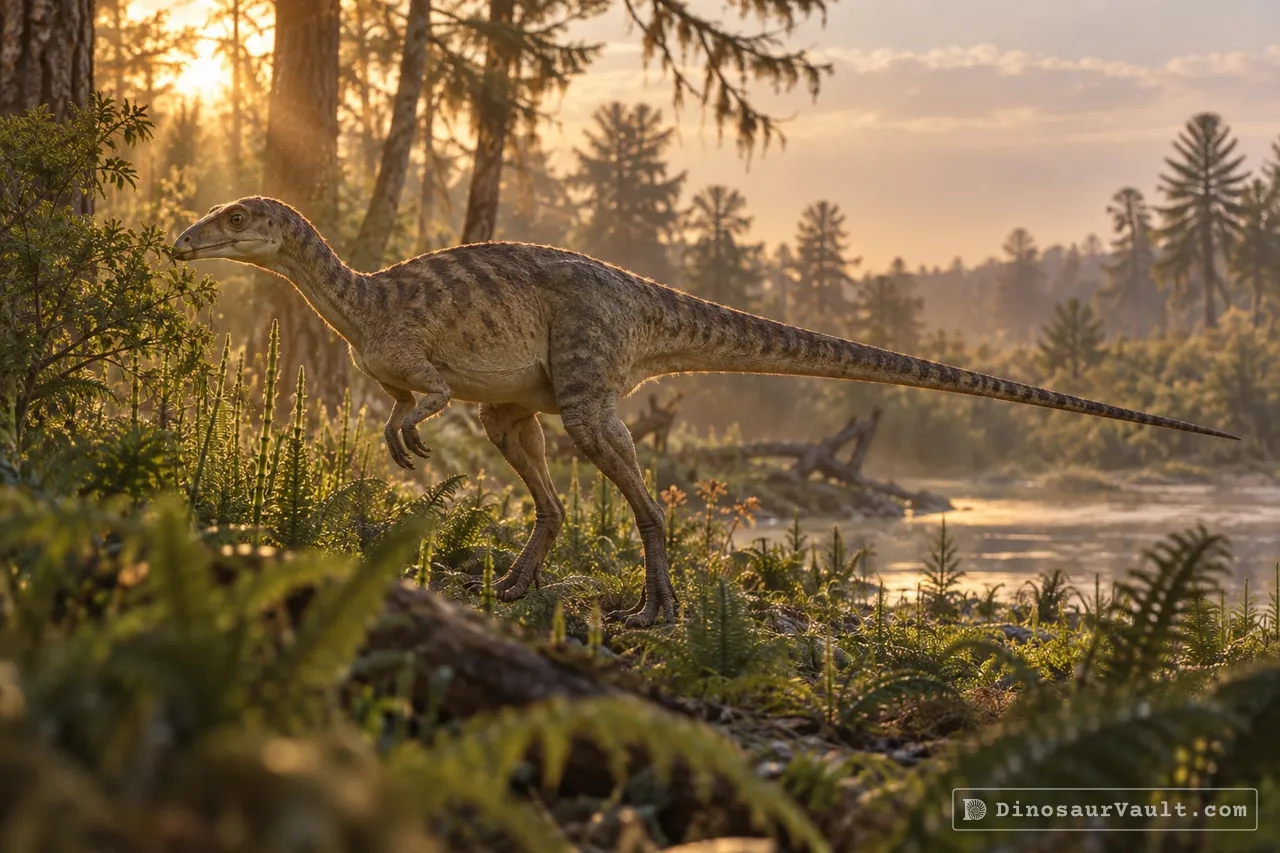
More views of Fostoria
Scenes reconstructed from the available fossil evidence.
1 of 2
Lived alongside
Found in the same rock formations

A rock formation can hold fossils laid down millions of years apart, so not every animal here met Fostoria.
The evidence
The science behind Fostoria
Which parts of the picture come from its own bones, and which come from its relatives.
From its own fossils
- Bones from several individuals were replaced by opal, preserving parts of the skull and most regions of the body.
- The skull roof has a stepped outer edge and a stout bump near its front corner.
Borrowed from relatives
- Although bones from much of the body are represented, missing parts are restored using other iguanodontians such as Muttaburrasaurus and Iguanodon.
Still unknown
- Its skin color and pattern.
- Whether the animals buried together belonged to a herd.
- How it cared for its young.
Discovery timeline
- 2018Same rocksBell et al.
- 2019Named itBell et al.
- 2019Its worldBell et al.
Key papers
The research behind what we know of Fostoria
Same rocks
Named Weewarrasaurus and documented several kinds of plant-eating dinosaurs in the rocks that also preserve Fostoria.
Ornithopod diversity in the Griman Creek Formation (Cenomanian), New South Wales, Australia. PeerJ 6: e6008
Read the paper : Ornithopod diversity in the Griman Creek Formation (Cenomanian), New South Wales, Australia (opens in a new tab)Named it
Described opalized bones from several individuals and identified distinctive skull features that establish Fostoria as a separate genus.
Fostoria dhimbangunmal , gen. et sp. nov . , a new iguanodontian (Dinosauria, Ornithopoda) from the mid-Cretaceous of Lightning Ridge, New South Wales, Australia. Journal of Vertebrate Paleontology 39: e1564757
Read the paper : Fostoria dhimbangunmal , gen. et sp. nov . , a new iguanodontian (Dinosauria, Ornithopoda) from the mid-Cretaceous of Lightning Ridge, New South Wales, Australia (opens in a new tab)Its world
Studied the fossil-bearing clay beds and interpreted them as freshwater lagoons close to the coast, home to a varied animal community.
Revised geology, age, and vertebrate diversity of the dinosaur-bearing Griman Creek Formation (Cenomanian), Lightning Ridge, New South Wales, Australia. Palaeogeography, Palaeoclimatology, Palaeoecology 514: 655-671
Read the paper : Revised geology, age, and vertebrate diversity of the dinosaur-bearing Griman Creek Formation (Cenomanian), Lightning Ridge, New South Wales, Australia (opens in a new tab)
Close relatives
Other members of Elasmaria


Sources: Wikidata