Variraptor
"Var robber"
- Lived
- 84 to 66 million years ago, Late Cretaceous
- Diet
- Carnivore
- Group
- Theropods, Dromaeosauridae
- Found in
- France
- Named by
- Le Loeuff and Buffetaut 1998
Where its fossils were found
The evidence
Today

75 million years ago
Habitat
River channels crossed southern France, with floods during wet seasons and drier intervals between them. Plant eaters in the region included Ampelosaurus and Rhabdodon.
Field notes
About Variraptor
What it was like
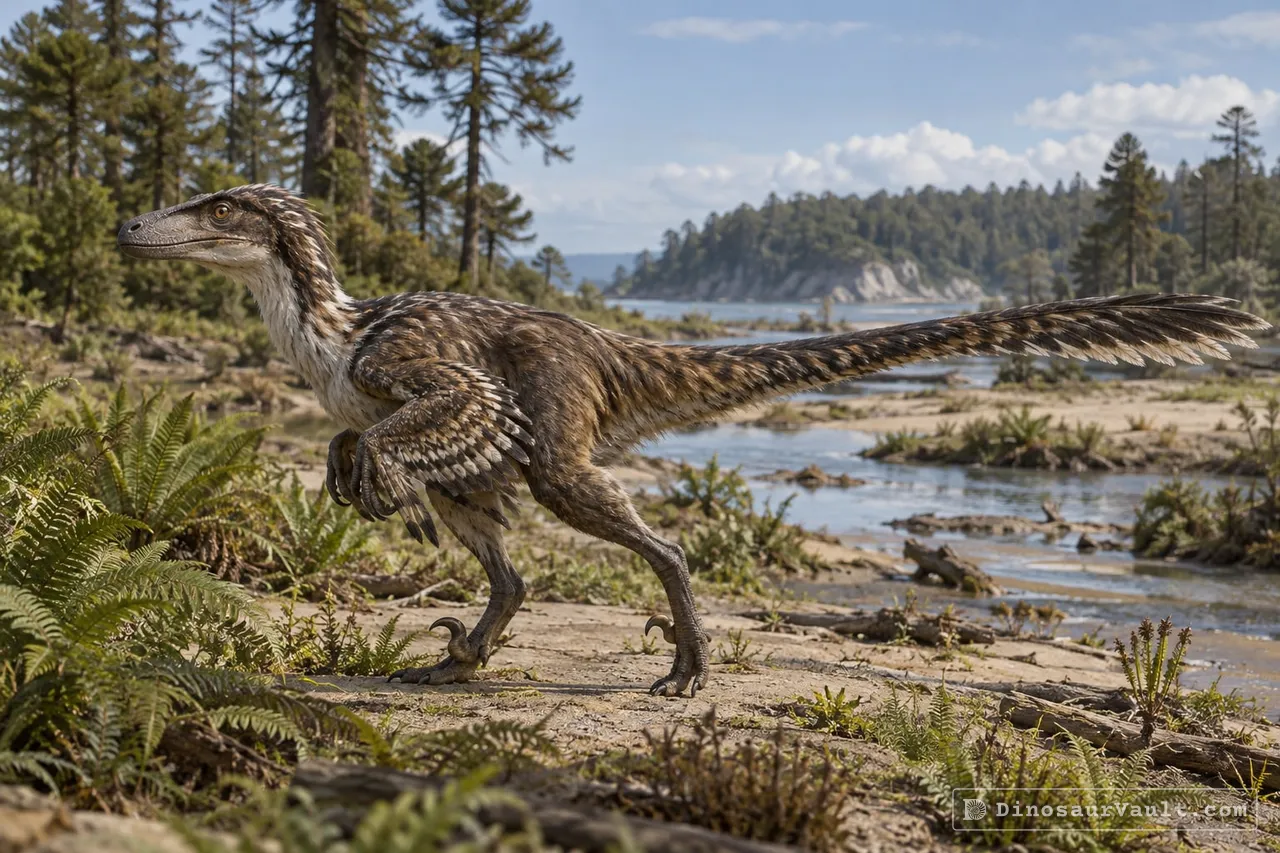
Variraptor may have been a raptor, a feathered hunter with a sickle claw on each foot. It is known only from a few bones.
Some scientists think the bones are too incomplete to name a genus, and that they may come from more than one kind of animal.
Its world
It lived in the Late Cretaceous in what is now southern France, alongside the titanosaur Ampelosaurus and the plant eater Rhabdodon.
How it was found
Le Loeuff and Buffetaut named Variraptor in 1998, from two finds.
Field gallery
More views of Variraptor
Scenes reconstructed from the available fossil evidence.
Lived alongside
Found in the same rock formations


A rock formation can hold fossils laid down millions of years apart, so not every animal here met Variraptor.
The evidence
The science behind Variraptor
Which parts of the picture come from its own bones, and which come from its relatives.
From its own fossils
- The original find includes a back vertebra and fused vertebrae from the hip region.
- A hip bone found later probably belongs to the same animal.
Borrowed from relatives
- The missing head, limbs and tail are usually restored from better-known raptors such as Deinonychus.
- A feathered coat follows relatives such as Velociraptor, whose arm bones have attachment bumps for feathers.
Still unknown
- Whether Variraptor and Pyroraptor were different animals.
- Which of the other scattered bones belong to Variraptor.
- Its full body shape and feather colors.
Discovery timeline
- 1998Named itLoeuff & Buffetaut
- 2007Close relativeTurner, Makovicky & Norell
- 2009New findChanthasit & Buffetaut
- 2014Its worldSmektala, Buffetaut & Deconinck
Key papers
The research behind what we know of Variraptor
Named it
Named Variraptor from vertebrae and an upper arm bone from southern France.
A new dromaeosaurid theropod from the Upper Cretaceous of southern France. Oryctos 1: 105-112
No link available
Close relative
Found feather attachment bumps on a Velociraptor arm bone, supporting feathered restorations of related raptors.
Feather quill knobs in the dinosaur Velociraptor. Science 317: 1721
Read the paper : Feather quill knobs in the dinosaur Velociraptor (opens in a new tab)New find
Described additional raptor bones, including a hip bone probably belonging to the original Variraptor skeleton.
New data on the Dromaeosauridae (Dinosauria: Theropoda) from the Late Cretaceous of southern France. Bulletin de la Société Géologique de France 180: 145-154
Read the paper : New data on the Dromaeosauridae (Dinosauria: Theropoda) from the Late Cretaceous of southern France (opens in a new tab)Its world
Traced a regional fossil accumulation to floods in a river system with wet and dry seasons.
Rivers as repositories for fossil vertebrates: a case study from the Upper Cretaceous of southern France. Proceedings of the Geologists' Association 125: 567-577
Read the paper : Rivers as repositories for fossil vertebrates: a case study from the Upper Cretaceous of southern France (opens in a new tab)
Close relatives
Other members of Dromaeosauridae


Sources: Wikidata