Obelignathus
- Lived
- 84 to 66 million years ago, Late Cretaceous
- Diet
- Herbivore
- Group
- Ornithopods
- Found in
- France
- Named by
- Czepiński and Madzia 2025
Where its fossils were found
The evidence
Today

75 million years ago
Habitat
It lived on land in what is now southern France during the Late Cretaceous. Dinosaurs from the same formation include Rhabdodon, Ampelosaurus and Variraptor.
Field notes
About Obelignathus
What it was like
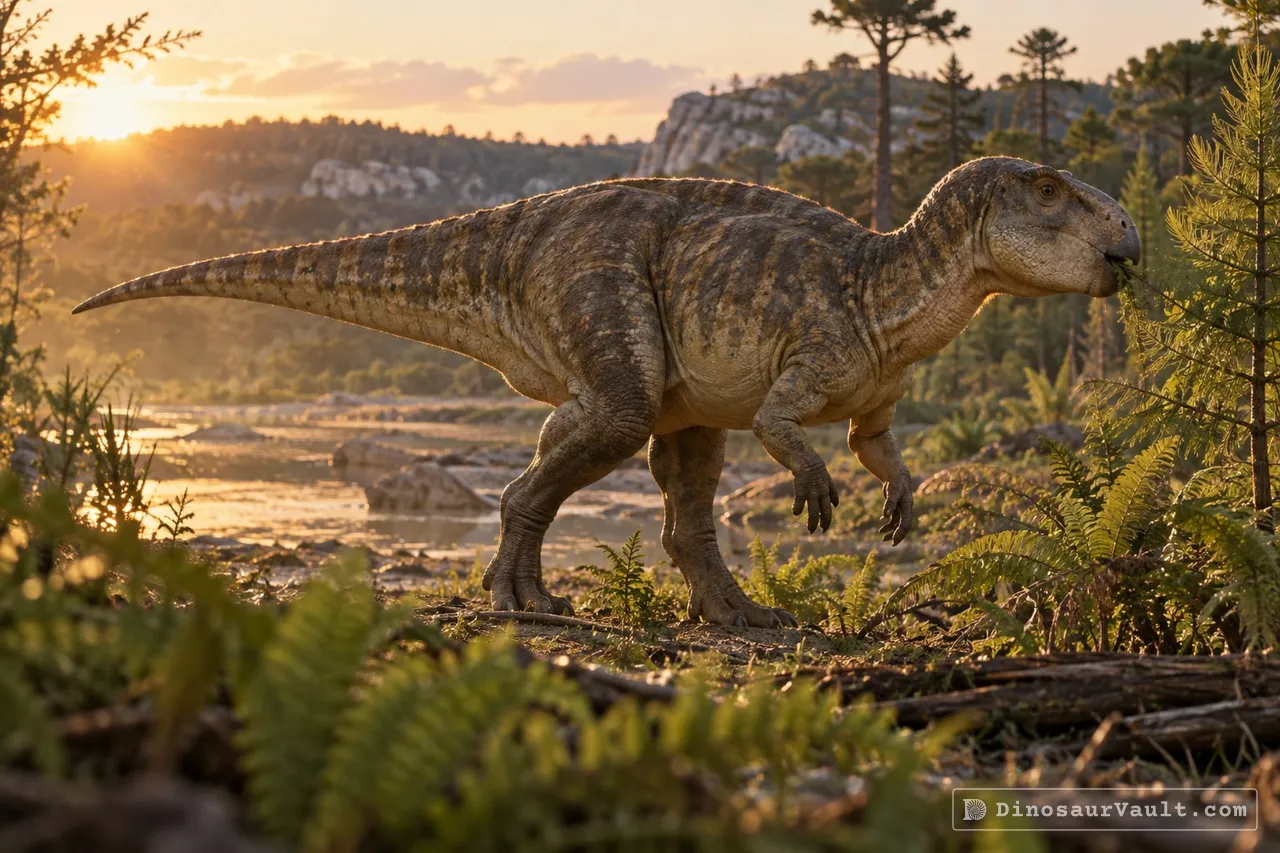
Obelignathus was a plant eater related to Rhabdodon. It is known from a strong lower jaw.
Its world
It lived in the Late Cretaceous, in what is now France. It comes from the Grès à Reptiles Formation, where it shared the land with Rhabdodon, the sauropod Ampelosaurus and the small predator Variraptor.
How it was found
Czepiński and Madzia named Obelignathus in 2025. Its name refers to a strong-jawed character in French comics.
Field gallery
More views of Obelignathus
Scenes reconstructed from the available fossil evidence.
1 of 3
Lived alongside
Found in the same rock formations


A rock formation can hold fossils laid down millions of years apart, so not every animal here met Obelignathus.
The evidence
The science behind Obelignathus
Which parts of the picture come from its own bones, and which come from its relatives.
From its own fossils
- An unusually thick right lower jaw, missing its front tip, is the basis for the name.
- The jaw curves inward along the tooth row and has a backward-twisted process where jaw muscles attached.
- The jaw lacks a bony shelf beside the tooth row.
Borrowed from relatives
- Iani provides a comparison for the missing front of the jaws, trunk and arms.
- Dryosaurus provides a broader comparison for the missing feet.
Still unknown
- Its body size and proportions.
- Its exact position among related plant eaters; different family-tree analyses place it in different branches.
- Its skin covering and color.
Discovery timeline
- 2017Close relativeGodefroit et al.
- 2023Family treeZanno et al.
- 2024Family treeFonseca et al.
- 2025Named itCzepiński & Madzia
Key papers
The research behind what we know of Obelignathus
Close relative
Described Matheronodon and showed how related plant eaters used large teeth to shear tough vegetation.
Extreme tooth enlargement in a new Late Cretaceous rhabdodontid dinosaur from Southern France. Scientific Reports 7
Read the paper : Extreme tooth enlargement in a new Late Cretaceous rhabdodontid dinosaur from Southern France (opens in a new tab)Family tree
Described the partial skeleton of Iani, an early plant eater used as a broader comparison for jaw and limb regions missing in Obelignathus.
An early-diverging iguanodontian (Dinosauria: Rhabdodontomorpha) from the Late Cretaceous of North America. PLOS ONE 18: e0286042
Read the paper : An early-diverging iguanodontian (Dinosauria: Rhabdodontomorpha) from the Late Cretaceous of North America (opens in a new tab)Family tree
Combined anatomical datasets to test relationships among early branches of bird-hipped dinosaurs, including the group containing Rhabdodon.
A comprehensive phylogenetic analysis on early ornithischian evolution. Journal of Systematic Palaeontology 22
Read the paper : A comprehensive phylogenetic analysis on early ornithischian evolution (opens in a new tab)Named it
Restudied the thick lower jaw and separated it from Rhabdodon as the new genus Obelignathus.
Exploring the diversity and disparity of rhabdodontomorph ornithopods from the Late Cretaceous European archipelago. Scientific Reports 15
Read the paper : Exploring the diversity and disparity of rhabdodontomorph ornithopods from the Late Cretaceous European archipelago (opens in a new tab)
Close relatives
Other members of Rhabdodontomorpha


Sources: Wikidata