Brasilotitan
"Brazil titan"
- Lived
- 84 to 66 million years ago, Late Cretaceous
- Diet
- Herbivore
- Group
- Sauropods
- Found in
- Brazil
- Named by
- Machado et al. 2013
Where its fossils were found
The evidence
Today

75 million years ago
Habitat
An inland landscape in what is now Brazil. Gondwanatitan and Maxakalisaurus also lived in the region represented by the Adamantina Formation.
Field notes
About Brasilotitan
What it was like
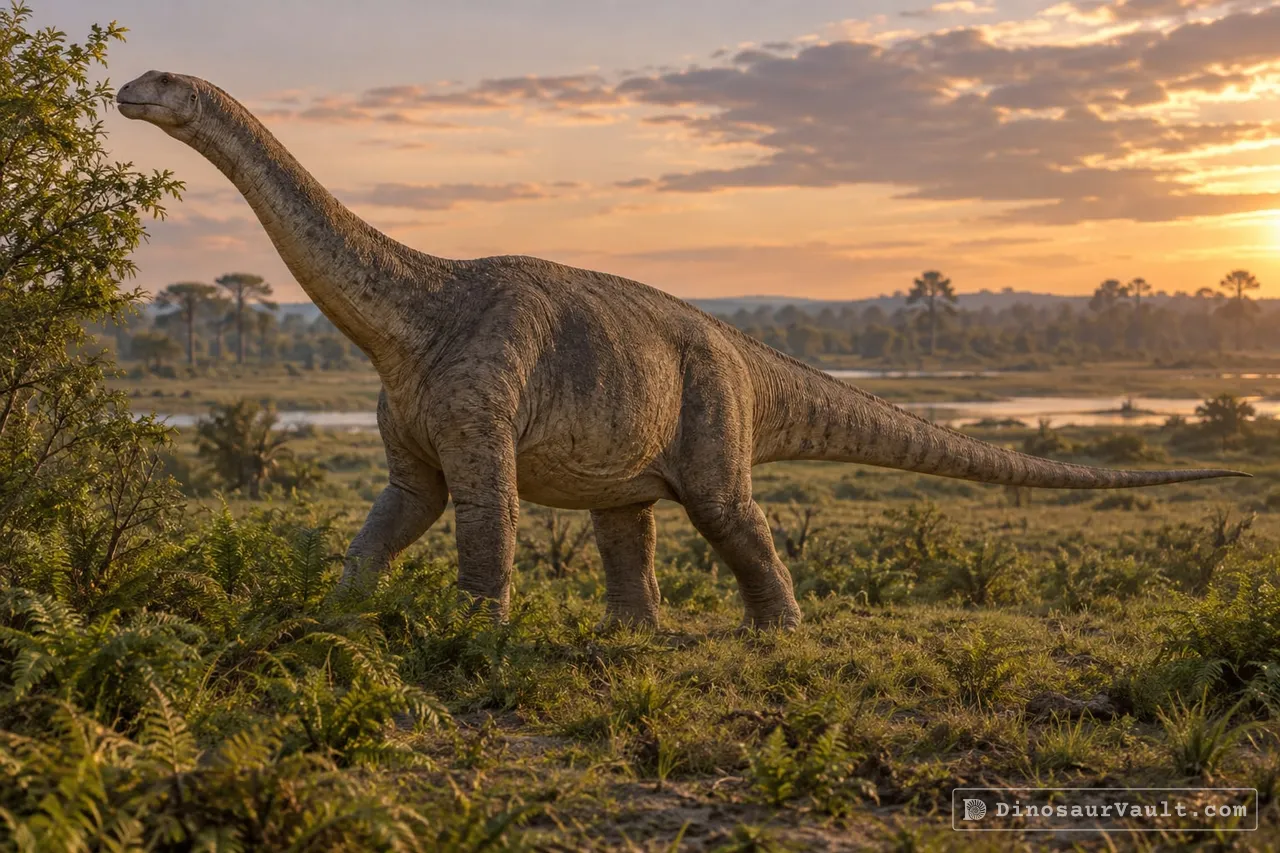
Brasilotitan was a titanosaur, a long-necked plant eater. It is known from part of the neck, hips and a lower jaw, which was squared off at the front.
Its world
It lived in the Late Cretaceous, in what is now Brazil. It comes from the Adamantina Formation, where it shared the land with the titanosaurs Gondwanatitan and Maxakalisaurus.
How it was found
Machado and colleagues named Brasilotitan in 2013.
Field gallery
More views of Brasilotitan
Scenes reconstructed from the available fossil evidence.
1 of 3
Lived alongside
Found in the same rock formations


A rock formation can hold fossils laid down millions of years apart, so not every animal here met Brasilotitan.
The evidence
The science behind Brasilotitan
Which parts of the picture come from its own bones, and which come from its relatives.
From its own fossils
- The known skeleton includes the right half of a lower jaw, neck and hip vertebrae, a claw and pieces of the pelvis.
- The lower jaw turns sharply inward at the front, giving the snout a squared-off shape, and the top of the jaw twists inward where the two halves met.
- The neck vertebrae carry low, undivided spines, and the claw is narrow and curved.
Borrowed from relatives
- The jaw is compared with the squared-off jaws of Antarctosaurus and Bonitasaura.
- The missing upper skull is restored after Tapuiasaurus, reshaped to fit its own square lower jaw.
Still unknown
- The shape of the upper part of its skull, and whether the claw came from a hand or a foot.
- Its complete body size and proportions, and its skin covering and color.
- Its closest relatives. One study grouped it with Uberabatitan but warned that the result was unstable.
Discovery timeline
- 2011Same rocksSANTUCCI & DE ARRUDA-CAMPOS
- 2013Named itMACHADO et al.
- 2016Family treeBandeira et al.
- 2018Its worldCastro et al.
Key papers
The research behind what we know of Brasilotitan
Same rocks
Described another titanosaur from the Adamantina Formation and compared the relationships of Gondwanatitan, Maxakalisaurus and other titanosaurs.
A new sauropod (Macronaria, Titanosauria) from the Adamantina Formation, Bauru Group, Upper Cretaceous of Brazil and the phylogenetic relationships of Aeolosaurini. Zootaxa 3085
Read the paper : A new sauropod (Macronaria, Titanosauria) from the Adamantina Formation, Bauru Group, Upper Cretaceous of Brazil and the phylogenetic relationships of Aeolosaurini (opens in a new tab)Named it
Described Brasilotitan from a partial lower jaw and body bones, emphasizing its unusual squared-off jaw.
<p class="HeadingRunIn"><strong>A new titanosaur sauropod from the Late Cretaceous of Brazil</strong></p>. Zootaxa 3701: 301
Read the paper : <p class="HeadingRunIn"><strong>A new titanosaur sauropod from the Late Cretaceous of Brazil</strong></p> (opens in a new tab)Family tree
Named the giant Austroposeidon. Its family tree, the first to include Brasilotitan, grouped it with Uberabatitan but cautioned that these links were unstable.
A New Giant Titanosauria (Dinosauria: Sauropoda) from the Late Cretaceous Bauru Group, Brazil. PLOS ONE 11: e0163373
Read the paper : A New Giant Titanosauria (Dinosauria: Sauropoda) from the Late Cretaceous Bauru Group, Brazil (opens in a new tab)Its world
Described a mammal tooth and used mineral dating to constrain the age of an Adamantina Formation fossil site.
A Late Cretaceous mammal from Brazil and the first radioisotopic age for the Bauru Group. Royal Society Open Science 5: 180482
Read the paper : A Late Cretaceous mammal from Brazil and the first radioisotopic age for the Bauru Group (opens in a new tab)
Close relatives
Other members of Rinconsauria


Sources: Wikidata