Maxakalisaurus
- Lived
- 84 to 66 million years ago, Late Cretaceous
- Diet
- Herbivore
- Length
- about 13 m (43 ft)
- Group
- Sauropods
- Found in
- Brazil
- Named by
- Kellner et al. 2006
Size comparison
To scale


Scale in metersOutline: typical sauropod shape
Where its fossils were found
The evidence
Today

75 million years ago
Habitat
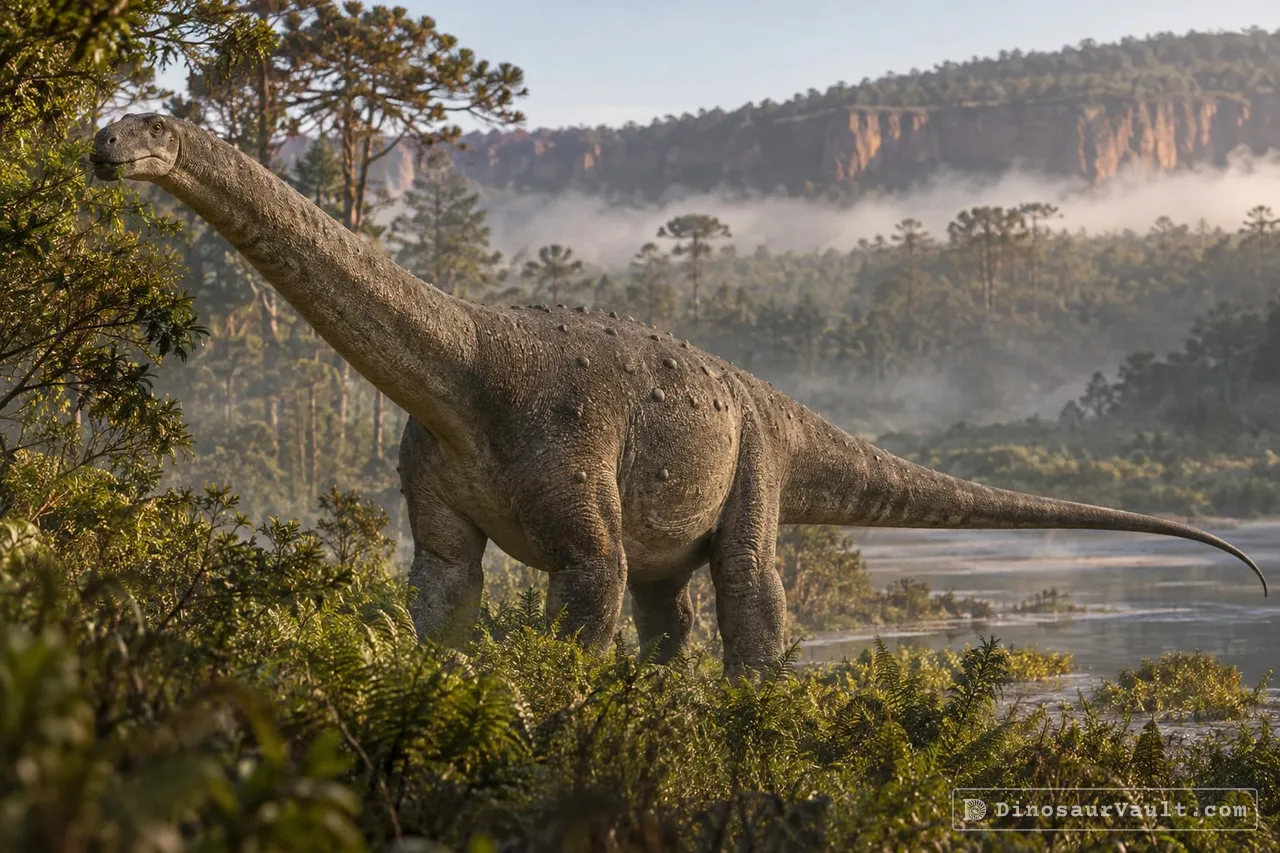
An inland landscape in Late Cretaceous Brazil. Other titanosaurs from the Adamantina Formation include Gondwanatitan and Brasilotitan.
Field notes
About Maxakalisaurus
What it was like
Maxakalisaurus was a titanosaur, a long-necked, four-legged plant eater about 13 meters (43 feet) long. Its teeth had sharp ridges, and bony plates found with it suggest it had armor in its skin.
Its world
It lived in the Late Cretaceous in what is now southeastern Brazil. Its bones come from the Adamantina Formation, where it shared the land with other titanosaurs such as Gondwanatitan and Brasilotitan.
How it was found
Kellner and colleagues named Maxakalisaurus in 2006. Its name honors a native people of the region. A skeleton of it was lost in the fire at Brazil's national museum.
Field gallery
More views of Maxakalisaurus
Scenes reconstructed from the available fossil evidence.
Lived alongside
Found in the same rock formations


A rock formation can hold fossils laid down millions of years apart, so not every animal here met Maxakalisaurus.
The evidence
The science behind Maxakalisaurus
Which parts of the picture come from its own bones, and which come from its relatives.
From its own fossils
- Disarticulated type material includes an upper jaw, neck and tail vertebrae, shoulder bones and parts of the limbs.
- Its teeth have lengthwise ridges. A bony skin plate found with the skeleton is oval, with a strongly curved outer surface and a raised midline.
- A lower jaw and teeth from the same site have been provisionally assigned to Maxakalisaurus.
Borrowed from relatives
- Mendozasaurus provides comparisons for missing parts of the neck, trunk, tail and limbs.
- Tapuiasaurus provides a comparison for missing parts of the skull roof and snout.
Still unknown
- How its skin armor was arranged.
- Its closest relatives within the titanosaurs.
- Its color and exactly which plants it ate.
Discovery timeline
- 2006Named itKellner et al.
- 2013Same rocksMACHADO et al.
- 2013SkinLindoso et al.
- 2016New findFrança et al.
Key papers
The research behind what we know of Maxakalisaurus
Named it
Described a partial titanosaur skeleton with distinctive tail vertebrae and hand bones.
On a new titanosaur sauropod from the Bauru Group, Late Cretaceous of Brazil. Boletim do Museu Nacional, Nova Série, Geologia 74: 1-31
No link available
Same rocks
Named Brasilotitan from a partial skeleton with a distinctive lower jaw, adding to the variety of titanosaurs in the same formation.
<p class="HeadingRunIn"><strong>A new titanosaur sauropod from the Late Cretaceous of Brazil</strong></p>. Zootaxa 3701: 301
Read the paper : <p class="HeadingRunIn"><strong>A new titanosaur sauropod from the Late Cretaceous of Brazil</strong></p> (opens in a new tab)Skin
Described a titanosaur armor plate from another Brazilian site and compared it with the oval plate found with Maxakalisaurus, noting its curved surface and raised midline.
A titanosaur (Dinosauria: Sauropoda) osteoderm from the Alcântara Formation (Cenomanian), São Luís Basin, Northeastern Brazil. Cretaceous Research 45: 43-48
Read the paper : A titanosaur (Dinosauria: Sauropoda) osteoderm from the Alcântara Formation (Cenomanian), São Luís Basin, Northeastern Brazil (opens in a new tab)New find
Described a lower jaw provisionally assigned to Maxakalisaurus, with replacement teeth developing inside its sockets, and tested its relationships with other titanosaurs.
New lower jaw and teeth referred toMaxakalisaurus topai(Titanosauria: Aeolosaurini) and their implications for the phylogeny of titanosaurid sauropods. PeerJ 4: e2054
Read the paper : New lower jaw and teeth referred toMaxakalisaurus topai(Titanosauria: Aeolosaurini) and their implications for the phylogeny of titanosaurid sauropods (opens in a new tab)
Close relatives
Other members of Rinconsauria


Sources: Wikidata