Muyelensaurus
- Lived
- 90 to 84 million years ago, Late Cretaceous
- Diet
- Herbivore
- Group
- Sauropods
- Found in
- Argentina
- Named by
- Calvo et al. 2007
Where its fossils were found
The evidence
Today

90 million years ago
Habitat
Rivers crossed low plains where sand and mud accumulated in the Plottier Formation. Other titanosaurs recorded from these rocks include Antarctosaurus, Petrobrasaurus and Notocolossus.
Field notes
About Muyelensaurus
What it was like
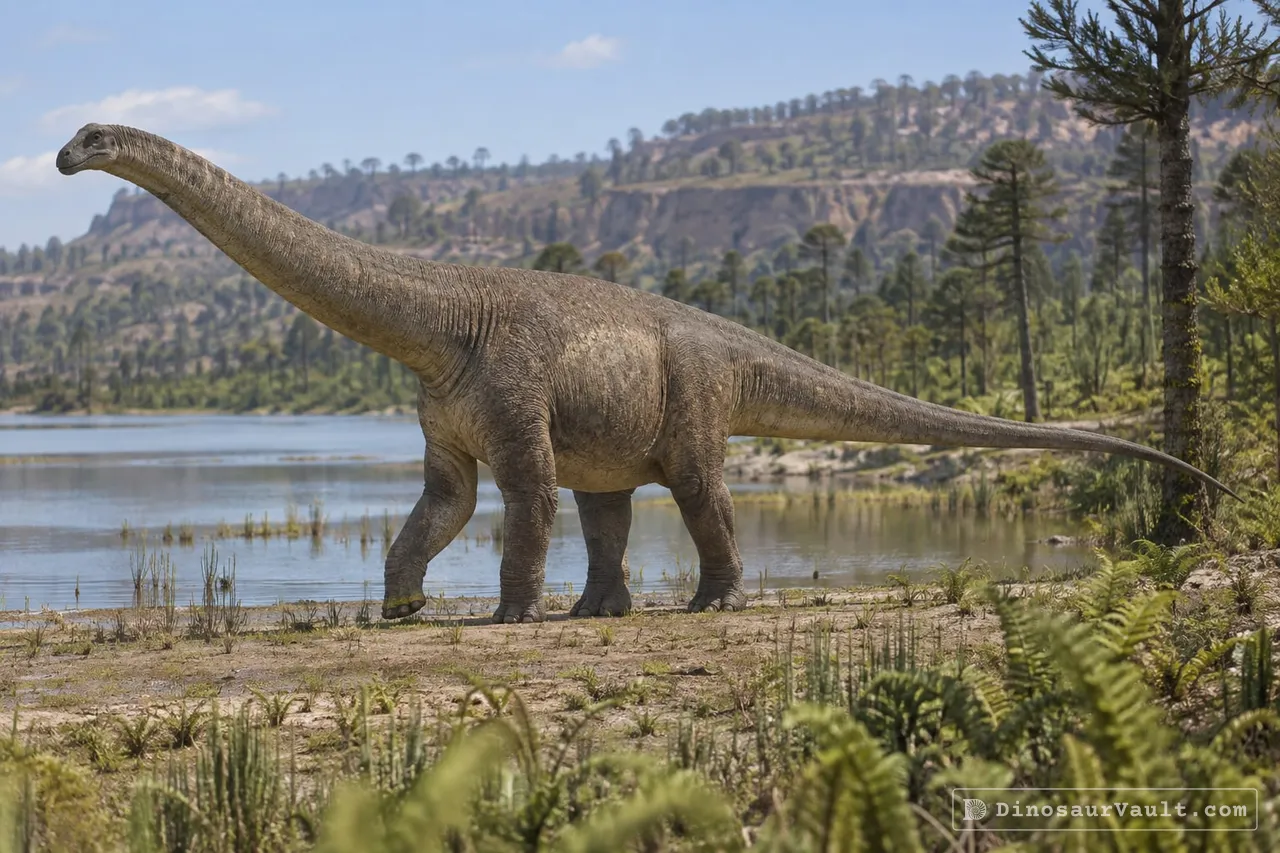
Muyelensaurus was a titanosaur, a long-necked plant eater. It was first described from bones of several animals, but a later restudy restricted the genus to its type braincase. The rest of its skeleton is uncertain, as are its closest relatives.
Its world
It lived in the Late Cretaceous, in what is now Argentina. It comes from the Plottier Formation, where the titanosaurs Antarctosaurus and Petrobrasaurus also lived.
How it was found
Calvo and colleagues named Muyelensaurus in 2007. Its name comes from a native name for a nearby river.
Field gallery
More views of Muyelensaurus
Scenes reconstructed from the available fossil evidence.
Lived alongside
Found in the same rock formations


A rock formation can hold fossils laid down millions of years apart, so not every animal here met Muyelensaurus.
The evidence
The science behind Muyelensaurus
Which parts of the picture come from its own bones, and which come from its relatives.
From its own fossils
- The type specimen is an incomplete braincase, with part of the bone above the eye socket and a robust, long parietal at the back of the skull roof.
- It was first described with snout bones, teeth, vertebrae, shoulder and hip bones and limbs from several animals. One later study restricts the name to the type braincase and sets those other bones apart.
- Limb bones once referred to it are slender, and microscopic sections of them show extensive rebuilding of older bone tissue.
Borrowed from relatives
- Its face, jaws and eyes are restored after Euhelopus, a more distant relative with a well known skull.
- Its neck, body, shoulders and the upper parts of its limbs are restored after Mnyamawamtuka, another titanosaur.
Still unknown
- The complete shape of its skull.
- Which of the bones first described with it, including those of a young animal, belonged to it.
- Its closest relatives. It was first grouped with Rinconsaurus, but one later study found its position changed from one analysis to another.
Discovery timeline
- 2007Named itCalvo, Riga & Porfiri
- 2018Same rocksBellardini et al.
- 2024Growing upGonzález et al.
- 2026RedescriptionMoreno et al.
Key papers
The research behind what we know of Muyelensaurus
Named it
Named a slender titanosaur from skull and skeleton bones of several animals and grouped it with Rinconsaurus.
A new titanosaur sauropod from the Late Cretaceous of Neuquén, Patagonia, Argentina. Arquivos do Museu Nacional, Rio de Janeiro 65: 485-504
No link available
Same rocks
Described large titanosaur limb bones from river deposits and compared them with Muyelensaurus and other titanosaurs from the same formation.
New Titanosauria (Dinosauria, Sauropoda) remains from the Upper Cretaceous (Plottier Fm) of the southern Neuquén Basin (Patagonia, Argentina). Journal of Iberian Geology 44: 75-84
Read the paper : New Titanosauria (Dinosauria, Sauropoda) remains from the Upper Cretaceous (Plottier Fm) of the southern Neuquén Basin (Patagonia, Argentina) (opens in a new tab)Growing up
Studied microscopic bone structure in limb bones referred to Muyelensaurus and Rinconsaurus, finding extensive tissue rebuilding and body size poorly matching growth stage.
Paleobiology of Rinconsaurus caudamirus and Muyelensaurus pecheni (Sauropoda, Titanosauria) from the Neuquén Group, Upper Cretaceous of Argentina: inferences from long bone histology. Cretaceous Research 153: 105682
Read the paper : Paleobiology of Rinconsaurus caudamirus and Muyelensaurus pecheni (Sauropoda, Titanosauria) from the Neuquén Group, Upper Cretaceous of Argentina: inferences from long bone histology (opens in a new tab)Redescription
Restudied the bones, kept Muyelensaurus as a valid name for its type braincase alone, and found its place among titanosaurs unstable between analyses.
Osteological reassessment of Muyelensaurus pecheni (Dinosauria: Sauropoda): Systematics and its phylogenetic implications for the clade Rinconsauria. Historical Biology 38: 2689-2747
Read the paper : Osteological reassessment of Muyelensaurus pecheni (Dinosauria: Sauropoda): Systematics and its phylogenetic implications for the clade Rinconsauria (opens in a new tab)
Close relatives
Other members of Rinconsauria


Sources: Wikidata