Arrudatitan
"Arruda's titan"
- Lived
- 84 to 66 million years ago, Late Cretaceous
- Diet
- Herbivore
- Group
- Sauropods
- Found in
- Brazil
- Named by
- Silva Junior et al. 2022
Where its fossils were found
The evidence
Today

75 million years ago
Habitat
Rivers and lakes crossed a landscape with a dry climate, recorded in the Adamantina Formation of Brazil. Other titanosaurs in the region included Gondwanatitan, Maxakalisaurus and Brasilotitan.
Field notes
About Arrudatitan
What it was like
Arrudatitan was a titanosaur, a long-necked plant eater related to Aeolosaurus. It is known from bones of the tail, shoulder and front legs.
Its world
It lived in the Late Cretaceous in what is now Brazil. Its bones come from the Adamantina Formation, where the titanosaurs Gondwanatitan and Maxakalisaurus also lived.
How it was found
It was first named as a species of Aeolosaurus. Silva Junior and colleagues gave it its own genus in 2022.
Field gallery
More views of Arrudatitan
Scenes reconstructed from the available fossil evidence.
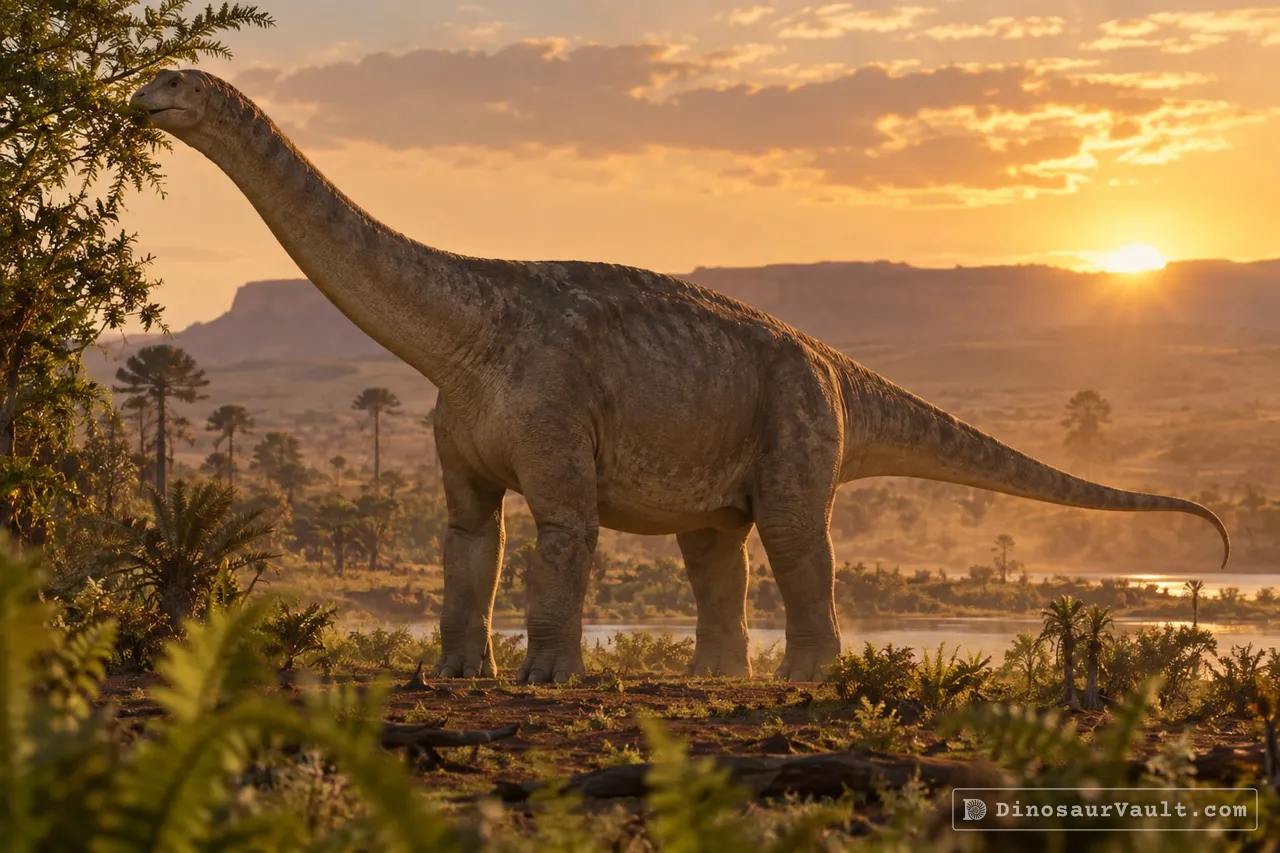
1 of 3
Lived alongside
Found in the same rock formations


A rock formation can hold fossils laid down millions of years apart, so not every animal here met Arrudatitan.
The evidence
The science behind Arrudatitan
Which parts of the picture come from its own bones, and which come from its relatives.
From its own fossils
- One partly articulated skeleton, found in a small area with no bone repeated, preserves bones from the back of the neck, ribs, pieces of the back, front tail vertebrae with their chevrons, a probable piece of shoulder blade, incomplete upper arm, forearm and thigh bones, and one hip bone.
- Thin plates of bone on its neck and back vertebrae form a combination not seen in other titanosaurs, including an extra plate that splits a hollow in the rear back vertebrae. Its mid-body ribs are flat on one side and rounded on the other in cross-section.
- The bones beneath the tail have distinctive bumps around their joint surfaces.
Borrowed from relatives
- The missing head is restored after the skull of Tapuiasaurus, a titanosaur known from a well-preserved head.
- The chest, shoulder and elbow are filled out by comparison with Mnyamawamtuka, another titanosaur.
Still unknown
- The shape of its head and teeth, and its hands and feet.
- Its skin covering and color.
- Its closest relatives. The study that named it could not settle its place among related titanosaurs, and a later analysis dropped it from one of its family trees as unstable but kept it in another.
Discovery timeline
- 2011Full descriptionSANTUCCI & DE ARRUDA-CAMPOS
- 2020Family treeHechenleitner et al.
- 2022Named itSilva Junior et al.
Key papers
The research behind what we know of Arrudatitan
Full description
Described the partial skeleton under its original name, Aeolosaurus maximus, emphasizing distinctive tail bones and comparing it with other titanosaurs.
A new sauropod (Macronaria, Titanosauria) from the Adamantina Formation, Bauru Group, Upper Cretaceous of Brazil and the phylogenetic relationships of Aeolosaurini. Zootaxa 3085
Read the paper : A new sauropod (Macronaria, Titanosauria) from the Adamantina Formation, Bauru Group, Upper Cretaceous of Brazil and the phylogenetic relationships of Aeolosaurini (opens in a new tab)Family tree
A family tree including the species then called Aeolosaurus maximus helped clarify relationships among titanosaurs across South America.
Two Late Cretaceous sauropods reveal titanosaurian dispersal across South America. Communications Biology 3
Read the paper : Two Late Cretaceous sauropods reveal titanosaurian dispersal across South America (opens in a new tab)Named it
Restudied the skeleton once called Aeolosaurus maximus, found features of its vertebrae and ribs unlike other titanosaurs, and gave it its own genus.
Reassessment of Aeolosaurus maximus, a titanosaur dinosaur from the Late Cretaceous of Southeastern Brazil. Historical Biology 34: 403-411
Read the paper : Reassessment of Aeolosaurus maximus, a titanosaur dinosaur from the Late Cretaceous of Southeastern Brazil (opens in a new tab)
Close relatives
Other members of Rinconsauria


Sources: Wikidata