Harpymimus
"harpy mimic"
- Lived
- 110 to 101 million years ago, Early Cretaceous
- Diet
- Omnivore
- Length
- about 2 m (7 ft)
- Group
- Theropods, Deinocheiridae
- Found in
- Mongolia
- Named by
- Barsbold and Perle 1984
Size comparison
To scale

Scale in metersOutline: typical theropod shape
Where its fossils were found
The evidence
Today

105 million years ago
Habitat
It lived inland in what is now Mongolia. The Khuren Dukh Formation also contains Psittacosaurus, Altirhinus and Zavacephale.
Field notes
About Harpymimus
What it was like
Harpymimus was an early ostrich-like dinosaur about 2 meters (7 feet) long, with long legs, a long neck and a small head. Unlike its later relatives, which had toothless beaks, it still had a few small teeth at the front of its lower jaw.
It probably ate plants, insects and small animals.
Its world
It lived in the Early Cretaceous in what is now Mongolia. Its bones come from the Khuren Dukh Formation, where it shared the land with Psittacosaurus, the iguanodont Altirhinus and the dome-headed Zavacephale.
How it was found
Barsbold and Perle named Harpymimus in 1984, from a single partial skeleton with a skull.
Field gallery
More views of Harpymimus
Scenes reconstructed from the available fossil evidence.
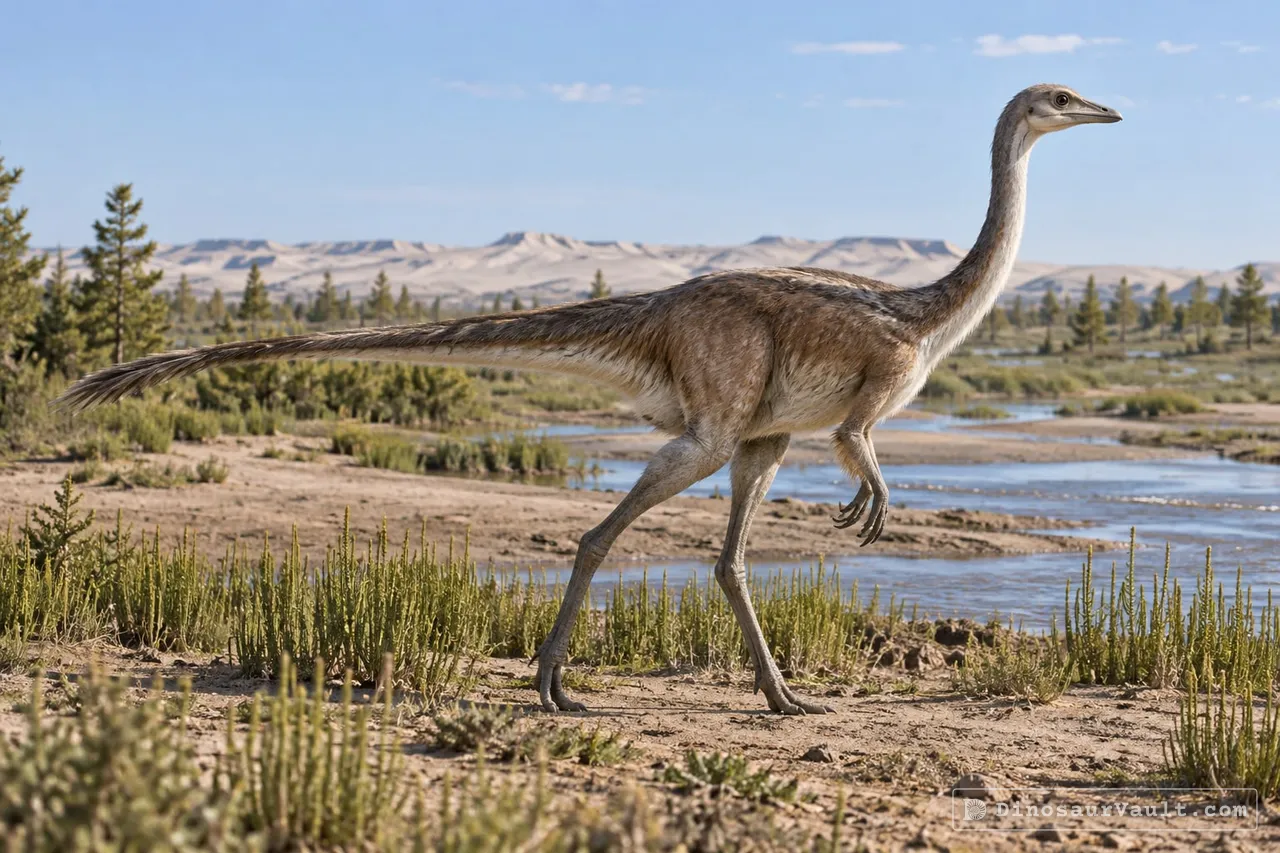
Lived alongside
Found in the same rock formations


A rock formation can hold fossils laid down millions of years apart, so not every animal here met Harpymimus.
The evidence
The science behind Harpymimus
Which parts of the picture come from its own bones, and which come from its relatives.
From its own fossils
- A partial skeleton with a skull preserves the small-headed build of an early ostrich-like dinosaur. Small teeth sat in separate sockets at the front of the lower jaw, while the upper jaw had none and probably carried a horny beak.
- The upper arm bone is robust and the first hand bone is short. The first finger's claw is more curved than the others, and the third claw is low and long with a flat underside.
- The central foot bone remains exposed at its upper end, unlike the tightly pinched arrangement in later ostrich-like dinosaurs.
Borrowed from relatives
- The neck, shoulders, hips and legs are restored by comparison with Sinornithomimus, keeping its own toothed jaw, short first hand bone and unpinched foot.
- The tail follows Gallimimus, one of whose skeletons has a complete tail.
Still unknown
- Its color and the extent of any feather covering.
- Exactly what it ate.
- How its proportions changed during growth.
Discovery timeline
- 1984Named itBarsbold & Perle
- 2005Close relativeKobayashi & Barsbold
- 2009Family treeMakovicky et al.
- 2025Close relativeTheda et al.
Key papers
The research behind what we know of Harpymimus
Named it
Named an early ostrich-like dinosaur from a partial skeleton with a skull found in Mongolia.
The first record of a primitive ornithomimosaur from the Cretaceous of Mongolia. Paleontological Journal 1984: 118-120
No link available
Close relative
Compared Garudimimus with Harpymimus, documenting changes in the jaws and central foot bone during the evolution of ostrich-like dinosaurs.
Reexamination of a primitive ornithomimosaur, Garudimimus brevipes Barsbold, 1981 (Dinosauria: Theropoda), from the Late Cretaceous of Mongolia. Canadian Journal of Earth Sciences 42: 1501-1521
Read the paper : Reexamination of a primitive ornithomimosaur, Garudimimus brevipes Barsbold, 1981 (Dinosauria: Theropoda), from the Late Cretaceous of Mongolia (opens in a new tab)Family tree
Named Beishanlong and compared it with Harpymimus, finding close similarities in their skeletons and discussing adult and possible juvenile Harpymimus remains.
A giant ornithomimosaur from the Early Cretaceous of China. Proceedings of the Royal Society B: Biological Sciences 277: 191-198
Read the paper : A giant ornithomimosaur from the Early Cretaceous of China (opens in a new tab)Close relative
Described a hand claw and foot bone of an ostrich-like dinosaur from Germany and reviewed hand claws across the group, including Harpymimus, whose first claw is the most curved.
The first ornithomimosaur remains from Germany. Acta Palaeontologica Polonica 70: 543-555
Read the paper : The first ornithomimosaur remains from Germany (opens in a new tab)
Close relatives
Other members of Deinocheiridae


Sources: Wikidata