Teihivenator
Type species Teihivenator macropus
- Lived
- 72 to 66 million years ago, Late Cretaceous
- Diet
- Carnivore
- Group
- Theropods
- Found in
- United States
- Named by
- Yun 2017
Where its fossils were found
The evidence
Today

70 million years ago
Habitat
The bones come from shallow-sea deposits of the Navesink Formation in New Jersey. Nearby land supported dinosaurs such as Hadrosaurus and Dryptosaurus.
Field notes
About Teihivenator
What it was like
Teihivenator was a meat eater named from part of a shin bone, foot bones and toe bones. Its shin bone has been identified as belonging to a tyrannosaur relative, but a later study could not identify it more closely.
Because the bones are so few, some scientists doubt it is a separate genus.
Its world
It lived about 72 to 66 million years ago, at the end of the Late Cretaceous, in what is now New Jersey, in the United States. Its bones come from the Navesink Formation, rocks laid down in a shallow sea. Nearby land supported dinosaurs such as Hadrosaurus.
How it was found
The bones were first described in the nineteenth century under another name. Yun gave them the new name Teihivenator in 2017.
Field gallery
More views of Teihivenator
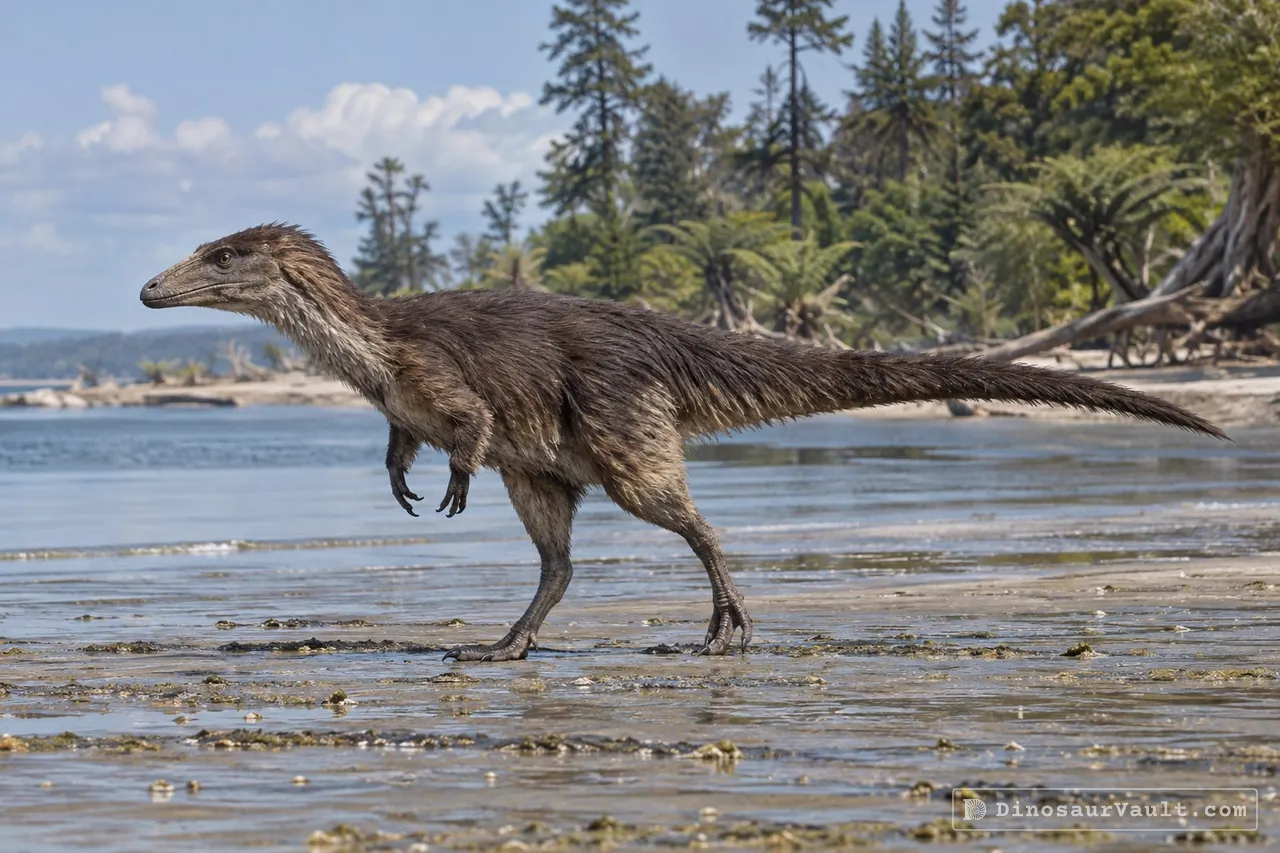
Scenes reconstructed from the available fossil evidence.
Lived alongside
Found in the same rock formations

A rock formation can hold fossils laid down millions of years apart, so not every animal here met Teihivenator.
The evidence
The science behind Teihivenator
Which parts of the picture come from its own bones, and which come from its relatives.
From its own fossils
- The bones named Teihivenator are part of a shin bone, foot bones and toe bones, which the naming paper treated as one animal.
- The naming paper describes a triangular inner knob and a deep notch at the top of the shin bone, part of the combination of features it used to set the genus apart.
- A later study assigned the shin bone to a tyrannosauroid that cannot be identified more closely.
Borrowed from relatives
- A later comparison found that its shin bone differs from those of Dryptosaurus and Appalachiosaurus at the lower end.
Still unknown
- Whether Teihivenator is a distinct genus. The naming paper saw a distinctive set of features, while a later study treated the shin bone as an unnamed tyrannosauroid.
- Whether the foot and toe bones came from the same animal as the shin bone.
- The size and appearance of the whole animal.
Discovery timeline
- 2017Named itYun
- 2018RedescriptionBrownstein
- 2018Its worldBrownstein
Key papers
The research behind what we know of Teihivenator
Named it
Proposed Teihivenator as a new name for hindlimb bones previously assigned to Dryptosaurus macropus, and listed the shin features that set it apart.
Teihivenator gen. nov., a new generic name for the tyrannosauroid dinosaur "Laelaps" macropus (Cope, 1868; preoccupied by Koch, 1836). Journal of Zoological and Bioscience Research 4: 7-13
No link available
Redescription
Reexamined the shin bone and assigned it to a tyrannosauroid that cannot be named more closely, and discussed what it means for eastern tyrannosauroids.
A tyrannosauroid tibia from the Navesink Formation of New Jersey and its biogeographic and evolutionary implications for North American tyrannosauroids. Cretaceous Research 85: 309-318
Read the paper : A tyrannosauroid tibia from the Navesink Formation of New Jersey and its biogeographic and evolutionary implications for North American tyrannosauroids (opens in a new tab)Its world
Reviewed the dinosaurs of eastern North America and how an inland sea separated their communities from those farther west.
The biogeography and ecology of the Cretaceous non-avian dinosaurs of Appalachia. Palaeontologia Electronica: 1-56
Read the paper : The biogeography and ecology of the Cretaceous non-avian dinosaurs of Appalachia (opens in a new tab)
Close relatives
Other members of Tyrannosauroidea


Sources: Wikidata