Taleta
"three"
Type species Taleta taleta
- Lived
- 72 to 66 million years ago, Late Cretaceous
- Diet
- Herbivore
- Group
- Ornithopods, Hadrosauridae
- Found in
- Morocco
- Named by
- Longrich et al. 2025
Where its fossils were found
The evidence
Today

70 million years ago
Habitat
It probably lived on coastal land in what is now Morocco. Its bones were buried in marine phosphate deposits that also preserve Ajnabia, Minqaria and Chenanisaurus.
Field notes
About Taleta
What it was like
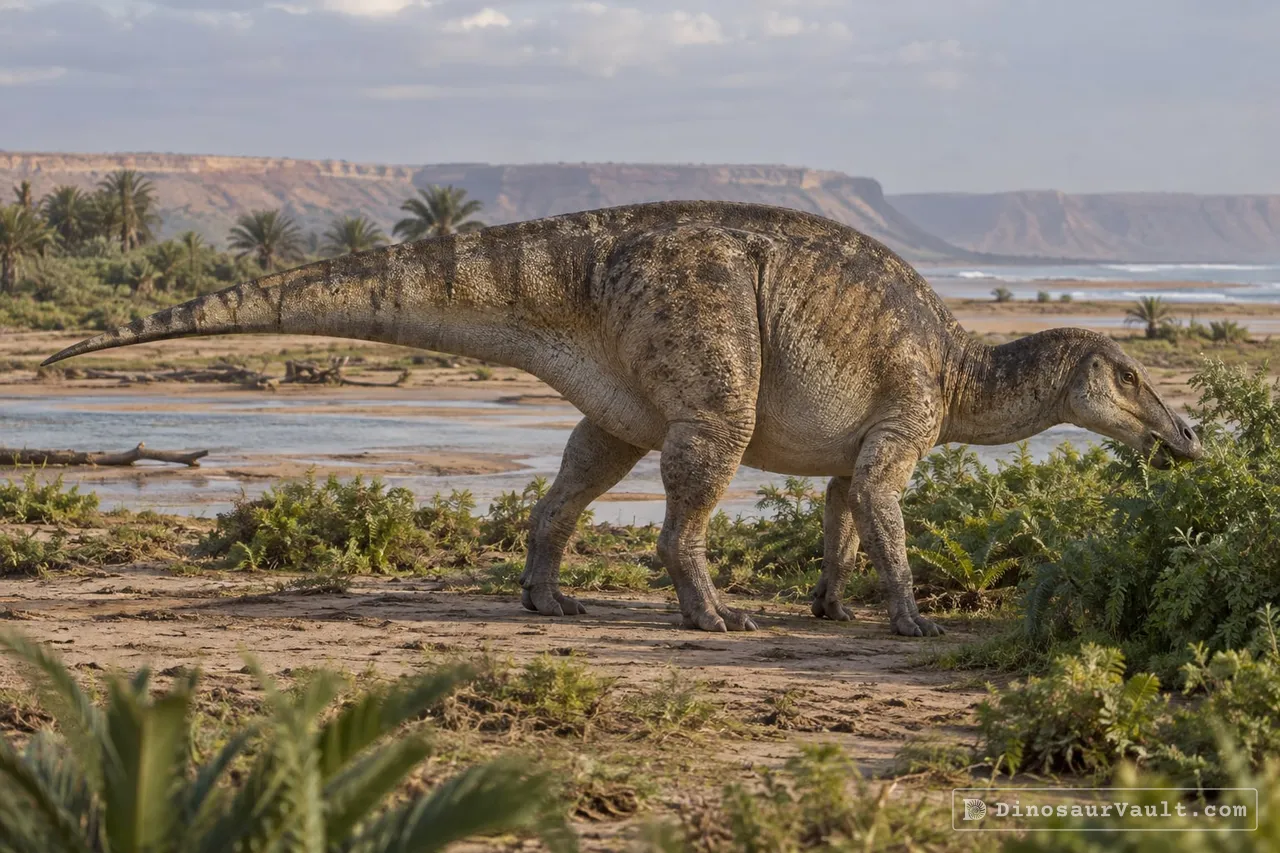
Taleta was a duck-billed dinosaur from the branch of hadrosaurs with crests. It is known only from two upper jaw bones.
Its world
It lived about 72 to 66 million years ago, at the end of the Late Cretaceous, in what is now Morocco. Its bones come from marine phosphate rocks, which have also produced two other hadrosaurs, Ajnabia and Minqaria.
How it was found
Longrich and colleagues named Taleta in 2025. It is the third hadrosaur found at the site, which is why it was named "three".
Field gallery
More views of Taleta
Scenes reconstructed from the available fossil evidence.
Lived alongside
Found in the same rock formations


A rock formation can hold fossils laid down millions of years apart, so not every animal here met Taleta.
The evidence
The science behind Taleta
Which parts of the picture come from its own bones, and which come from its relatives.
From its own fossils
- A pair of upper jaw bones has a straight tooth row.
- The large tooth crowns sit at an angle and carry a strong ridge along their surface.
Borrowed from relatives
- Its jaws link it to the crested duck-billed dinosaurs, including Ajnabia and Minqaria.
- The missing body is restored using more complete crested relatives such as Corythosaurus.
Still unknown
- The shape of any crest on its head.
- Its full body size and proportions.
- Its skin color and which plants it ate.
Discovery timeline
- 2021Same rocksLongrich et al.
- 2024Same rocksLongrich et al.
- 2025Named itLongrich et al.
Key papers
The research behind what we know of Taleta
Same rocks
Named Ajnabia and argued that duck-billed dinosaurs reached Africa by crossing the sea.
The first duckbill dinosaur (Hadrosauridae: Lambeosaurinae) from Africa and the role of oceanic dispersal in dinosaur biogeography. Cretaceous Research 120: 104678
Read the paper : The first duckbill dinosaur (Hadrosauridae: Lambeosaurinae) from Africa and the role of oceanic dispersal in dinosaur biogeography (opens in a new tab)Same rocks
Named Minqaria and described other hadrosaur bones, revealing a wider variety of duck-billed dinosaurs in Morocco.
A new small duckbilled dinosaur (Hadrosauridae: Lambeosaurinae) from Morocco and dinosaur diversity in the late Maastrichtian of North Africa. Scientific Reports 14
Read the paper : A new small duckbilled dinosaur (Hadrosauridae: Lambeosaurinae) from Morocco and dinosaur diversity in the late Maastrichtian of North Africa (opens in a new tab)Named it
Named Taleta from upper jaws whose teeth and shape distinguish it from the other duck-billed dinosaurs found in Morocco.
A new hadrosaurid dinosaur from the late Maastrichtian Phosphates of Morocco provides evidence for an African radiation of lambeosaurines. Gondwana Research 145: 142-151
Read the paper : A new hadrosaurid dinosaur from the late Maastrichtian Phosphates of Morocco provides evidence for an African radiation of lambeosaurines (opens in a new tab)
Close relatives
Other members of Hadrosauridae


Sources: Wikidata