Chenanisaurus
Type species Chenanisaurus barbaricus
- Lived
- 72 to 66 million years ago, Late Cretaceous
- Diet
- Carnivore
- Group
- Theropods
- Found in
- Morocco
- Named by
- Longrich et al. 2017
Where its fossils were found
The evidence
Today

70 million years ago
Habitat
It lived on land beside a shallow sea in Morocco, where its bones were buried in marine phosphate deposits. Other dinosaurs from these deposits include Ajnabia, Minqaria and Phosphatotitan.
Field notes
About Chenanisaurus
What it was like
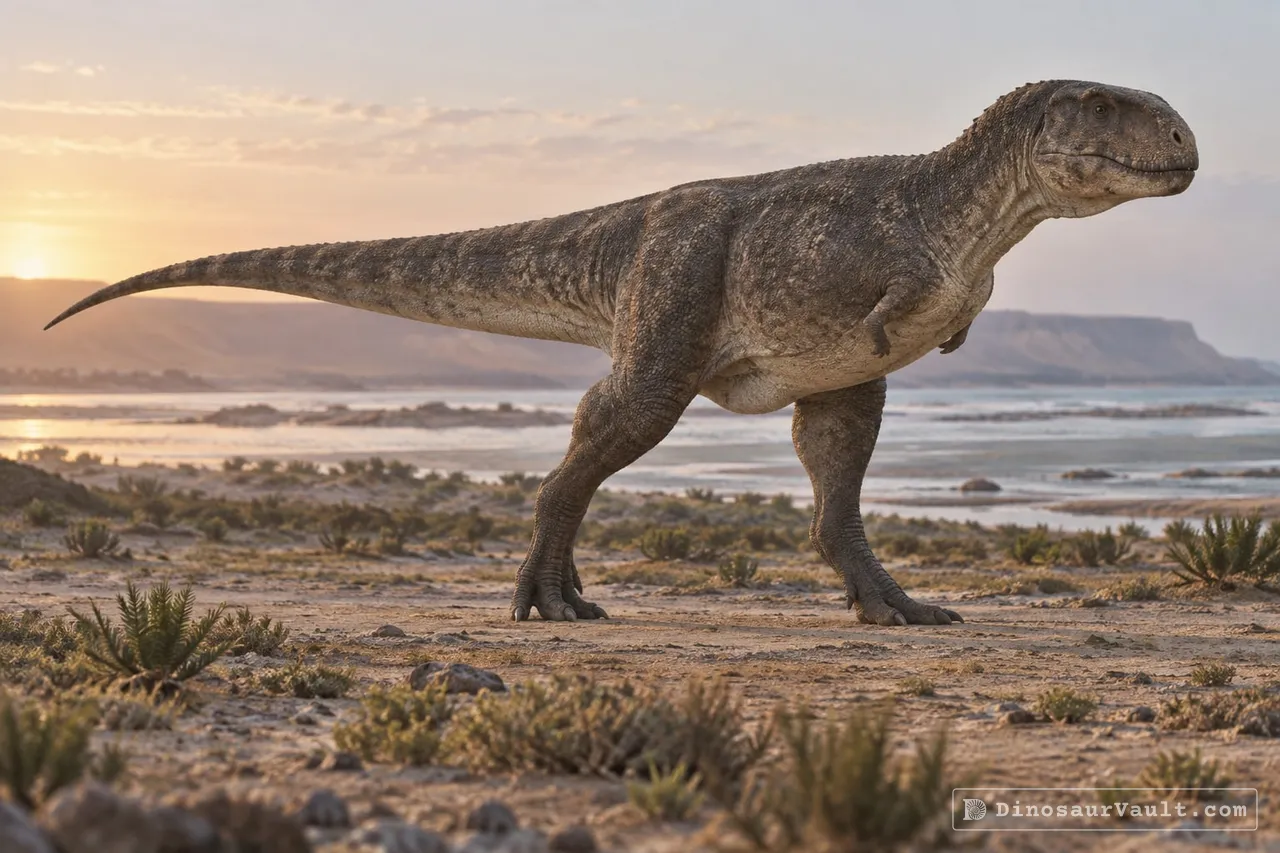
Chenanisaurus was a large abelisaur, a predator with a short, deep snout and tiny arms. It is known only from part of a lower jaw and some teeth, which show a heavy, powerful bite.
Its world
It lived about 72 to 66 million years ago, at the very end of the Cretaceous, in what is now Morocco. Its fossils come from phosphate rocks laid down in a shallow sea, where bones of land animals sometimes washed out from the coast. It shared that coast with the small abelisaur Minqaria and the titanosaur Phosphatotitan.
How it was found
Longrich and colleagues named Chenanisaurus in 2017. The type species is Chenanisaurus barbaricus. It was one of the last large predators in Africa before the dinosaurs died out.
Field gallery
More views of Chenanisaurus
Scenes reconstructed from the available fossil evidence.
1 of 2
Lived alongside
Found in the same rock formations


A rock formation can hold fossils laid down millions of years apart, so not every animal here met Chenanisaurus.
The evidence
The science behind Chenanisaurus
Which parts of the picture come from its own bones, and which come from its relatives.
From its own fossils
- Part of a lower jaw and isolated teeth are the main known remains.
- The lower jaw is unusually short, deep and strongly curved.
Borrowed from relatives
- The legs, tail and tiny arms in a restoration follow better-known abelisaurs such as Carnotaurus.
Still unknown
- The shape of the complete skull and any ornaments above the eyes.
- Its full body proportions and adult size.
- Its skin texture and color.
Discovery timeline
- 2017Named itLongrich et al.
- 2021Same rocksLongrich et al.
- 2023Same rocksLongrich et al.
Key papers
The research behind what we know of Chenanisaurus
Named it
Described a large abelisaur from a short, deep lower jaw and teeth found in marine deposits in Morocco.
An abelisaurid from the latest Cretaceous (late Maastrichtian) of Morocco, North Africa. Cretaceous Research 76: 40-52
Read the paper : An abelisaurid from the latest Cretaceous (late Maastrichtian) of Morocco, North Africa (opens in a new tab)Same rocks
Named Ajnabia from the same marine deposits and proposed that its ancestors crossed the sea to reach Africa.
The first duckbill dinosaur (Hadrosauridae: Lambeosaurinae) from Africa and the role of oceanic dispersal in dinosaur biogeography. Cretaceous Research 120: 104678
Read the paper : The first duckbill dinosaur (Hadrosauridae: Lambeosaurinae) from Africa and the role of oceanic dispersal in dinosaur biogeography (opens in a new tab)Same rocks
Described smaller abelisaurs from the same deposits, showing that Chenanisaurus belonged to a more varied predator community.
New fossils of Abelisauridae (Dinosauria: Theropoda) from the upper Maastrichtian of Morocco, North Africa. Cretaceous Research 152: 105677
Read the paper : New fossils of Abelisauridae (Dinosauria: Theropoda) from the upper Maastrichtian of Morocco, North Africa (opens in a new tab)
Sources: Wikidata