Phosphatotitan
"phosphate titan"
Type species Phosphatotitan khouribgaensis
- Lived
- 72 to 66 million years ago, Late Cretaceous
- Diet
- Herbivore
- Group
- Sauropods, Argentinosauridae
- Found in
- Morocco
- Named by
- Longrich et al. 2026
Where its fossils were found
The evidence
Today

70 million years ago
Habitat
It probably lived on land near a shallow sea in Morocco. Chenanisaurus, Ajnabia and Minqaria are also known from these phosphate beds.
Field notes
About Phosphatotitan
What it was like
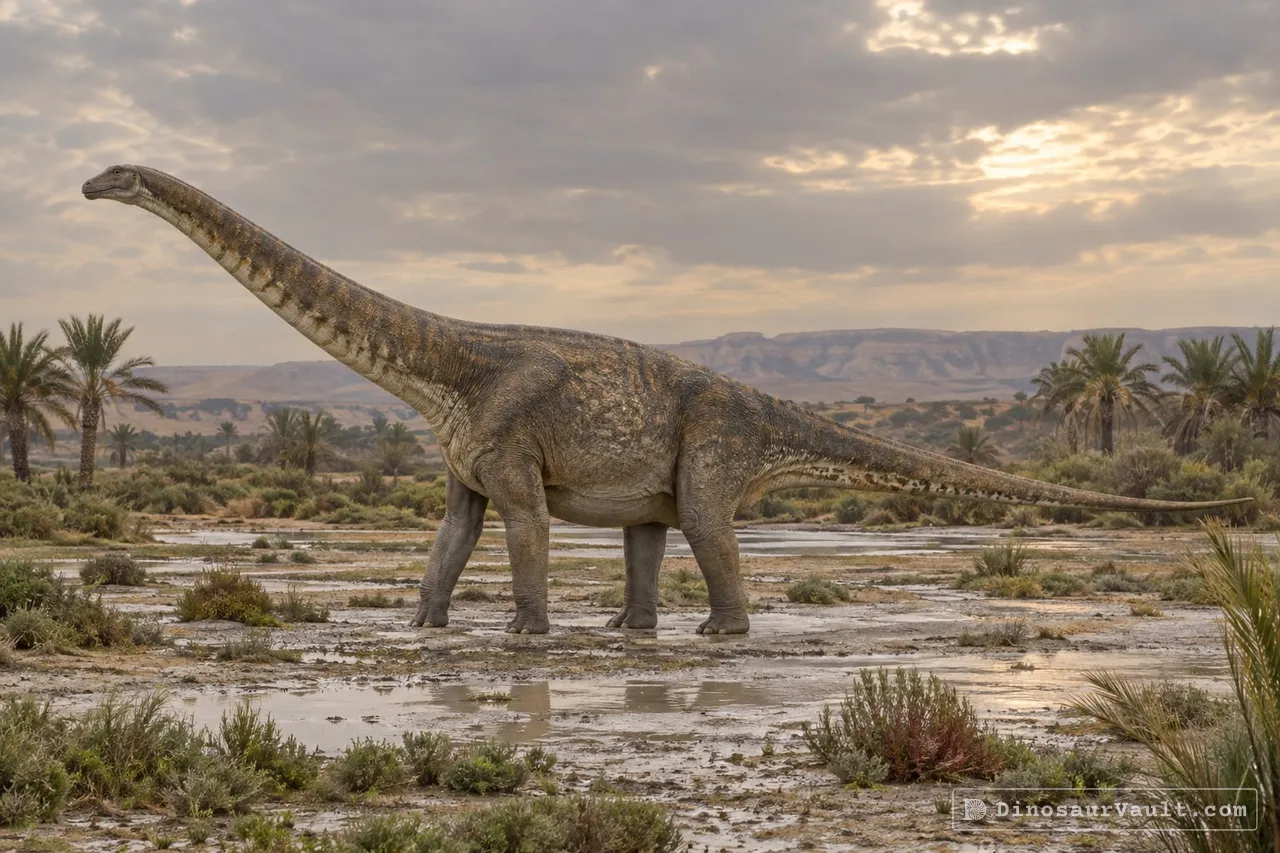
Phosphatotitan was a titanosaur, a long-necked plant eater, known from a partial skeleton.
Its world
It lived about 72 to 66 million years ago, at the very end of the Late Cretaceous, in what is now Morocco. Its bones come from phosphate beds that formed in a shallow sea, which suggests its body washed out from land. Other dinosaurs from these rocks include the predator Chenanisaurus and the small duckbill Ajnabia.
How it was found
Longrich and colleagues named it in 2026. The type species is Phosphatotitan khouribgaensis.
Field gallery
More views of Phosphatotitan
Scenes reconstructed from the available fossil evidence.
Lived alongside
Found in the same rock formations


A rock formation can hold fossils laid down millions of years apart, so not every animal here met Phosphatotitan.
The evidence
The science behind Phosphatotitan
Which parts of the picture come from its own bones, and which come from its relatives.
From its own fossils
- A partial skeleton preserves back, hip and tail vertebrae, along with pieces of the pelvis.
- Broad bony projections on the vertebrae and a wide pelvis link it to the lognkosaur titanosaurs.
Borrowed from relatives
- Mendozasaurus helps restore the missing limbs and the supporting shape of the body.
- Tapuiasaurus provides a comparison for a slender head at the end of the long neck.
Still unknown
- The shape of its head and the proportions of its complete body.
- Its adult size and how old the known animal was.
- Its skin covering and color.
Often drawn wrong
- The broad projections on its backbone belonged inside the body, rather than forming exposed wings or spikes.
- It was a land animal, even though its bones were buried in marine sediment.
Discovery timeline
- 2016SkullWilson et al.
- 2026Named itLongrich et al.
Key papers
The research behind what we know of Phosphatotitan
Skull
Described the nearly complete skull of Tapuiasaurus, a useful comparison for restoring the missing head of Phosphatotitan.
The skull of the titanosaurTapuiasaurus macedoi(Dinosauria: Sauropoda), a basal titanosaur from the Lower Cretaceous of Brazil. Zoological Journal of the Linnean Society 178: 611-662
Read the paper : The skull of the titanosaurTapuiasaurus macedoi(Dinosauria: Sauropoda), a basal titanosaur from the Lower Cretaceous of Brazil (opens in a new tab)Named it
Named a titanosaur from a partial skeleton in Morocco and linked its broad vertebrae to the lognkosaurs.
A Titanosaurian Sauropod with South American Affinities (Lognkosauria: Argentinosauridae) from the Late Maastrichtian of Morocco and Evidence for Dinosaur Endemism in Africa. Diversity 18: 241
Read the paper : A Titanosaurian Sauropod with South American Affinities (Lognkosauria: Argentinosauridae) from the Late Maastrichtian of Morocco and Evidence for Dinosaur Endemism in Africa (opens in a new tab)
Sources: Wikidata