Shuangmiaosaurus
- Lived
- 106 to 101 million years ago, Early Cretaceous
- Diet
- Herbivore
- Group
- Ornithopods
- Found in
- China
- Named by
- You et al. 2003
Where its fossils were found
The evidence
Today

105 million years ago
Habitat
It lived in China, where the Sunjiawan Formation also preserves Crichtonpelta and Borealosaurus.
Field notes
About Shuangmiaosaurus
What it was like
Shuangmiaosaurus was a large relative of the duckbills, a plant eater known from part of an upper and lower jaw.
Its world
It lived in the Cretaceous, in what is now China. It comes from the Sunjiawan Formation, where it shared the land with the ankylosaur Crichtonpelta and the sauropod Borealosaurus.
How it was found
You and colleagues named Shuangmiaosaurus in 2003.
Field gallery
More views of Shuangmiaosaurus
Scenes reconstructed from the available fossil evidence.
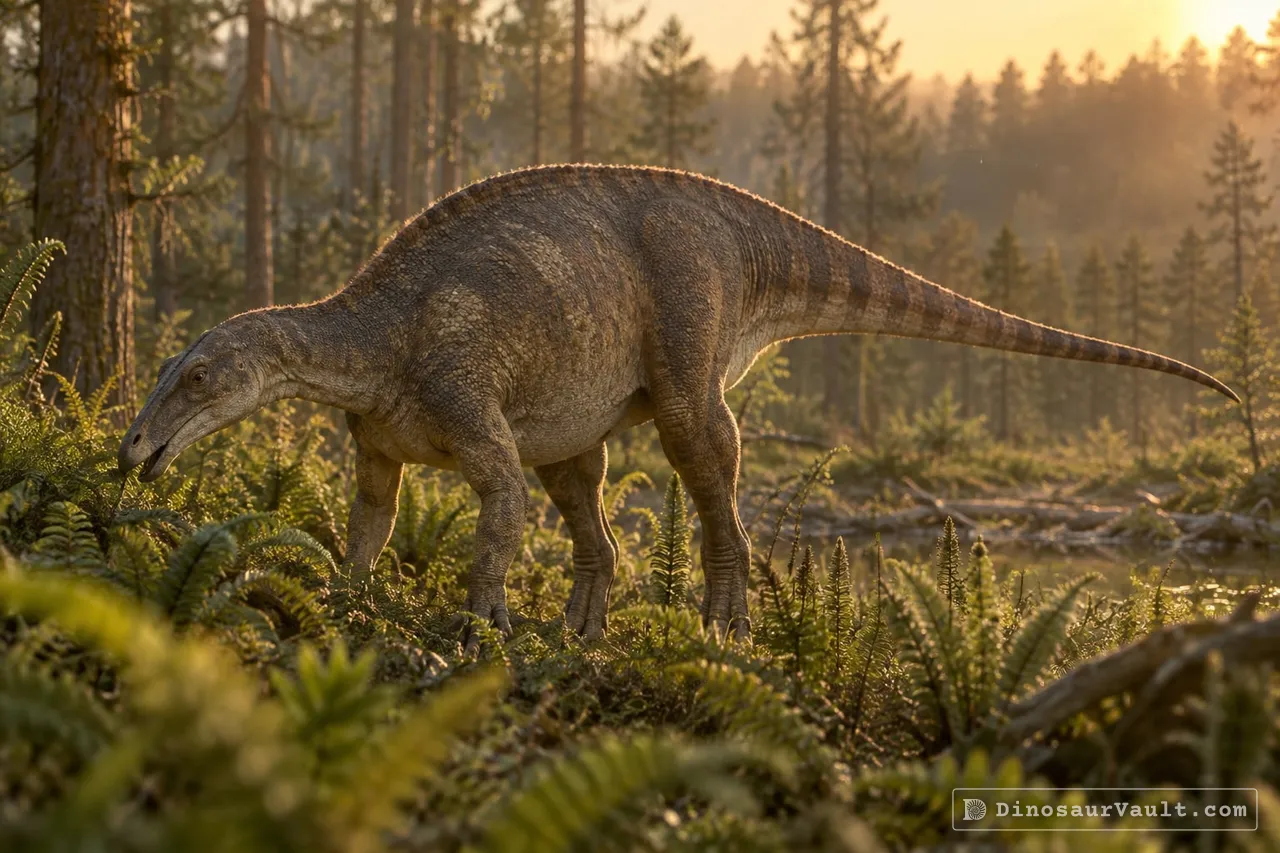
1 of 2
Lived alongside
Found in the same rock formations


A rock formation can hold fossils laid down millions of years apart, so not every animal here met Shuangmiaosaurus.
The evidence
The science behind Shuangmiaosaurus
Which parts of the picture come from its own bones, and which come from its relatives.
From its own fossils
- The known remains include an upper jaw, a lower jaw and fragments from the front of the snout and the eye region.
- The tall process on the lower jaw, where chewing muscles attached, leaned backward.
Borrowed from relatives
- The missing trunk, limbs and tail are restored by comparison with better-known duckbill relatives such as Bactrosaurus and Gilmoreosaurus.
Still unknown
- Its full body size and proportions.
- Its exact position among the early relatives of duckbilled dinosaurs.
- Its skin color.
Discovery timeline
- 2003Named itYou et al.
- 2012Family treeMcDonald
- 2013Family treeWang et al.
Key papers
The research behind what we know of Shuangmiaosaurus
Named it
Named Shuangmiaosaurus from jaw bones and placed it close to duckbilled dinosaurs.
A new hadrosauroid dinosaur from the mid-Cretaceous of Liaoning, China. Acta Geologica Sinica 77: 148-154
No link available
Family tree
Included Shuangmiaosaurus in a broad comparison of early duckbill relatives and highlighted gaps in the dating of several Asian genera.
Phylogeny of Basal Iguanodonts (Dinosauria: Ornithischia): An Update. PLoS ONE 7: e36745
Read the paper : Phylogeny of Basal Iguanodonts (Dinosauria: Ornithischia): An Update (opens in a new tab)Family tree
Compared Shuangmiaosaurus with other duckbill relatives and included its backward-leaning jaw process in the analysis.
A New Hadrosauroid Dinosaur from the Early Late Cretaceous of Shanxi Province, China. PLoS ONE 8: e77058
Read the paper : A New Hadrosauroid Dinosaur from the Early Late Cretaceous of Shanxi Province, China (opens in a new tab)
Close relatives
Other members of Hadrosauroidea


Sources: Wikidata