Borealosaurus
"northern lizard"
- Lived
- 106 to 101 million years ago, Early Cretaceous
- Diet
- Herbivore
- Group
- Sauropods
- Found in
- China
- Named by
- You et al. 2004
Where its fossils were found
The evidence
Today

105 million years ago
Habitat
The Sunjiawan Formation preserves sand, gravel and mud from an inland landscape in China. Ferns, ginkgo-like plants and conifers grew in the region, alongside Crichtonpelta and Shuangmiaosaurus.
Field notes
About Borealosaurus
What it was like
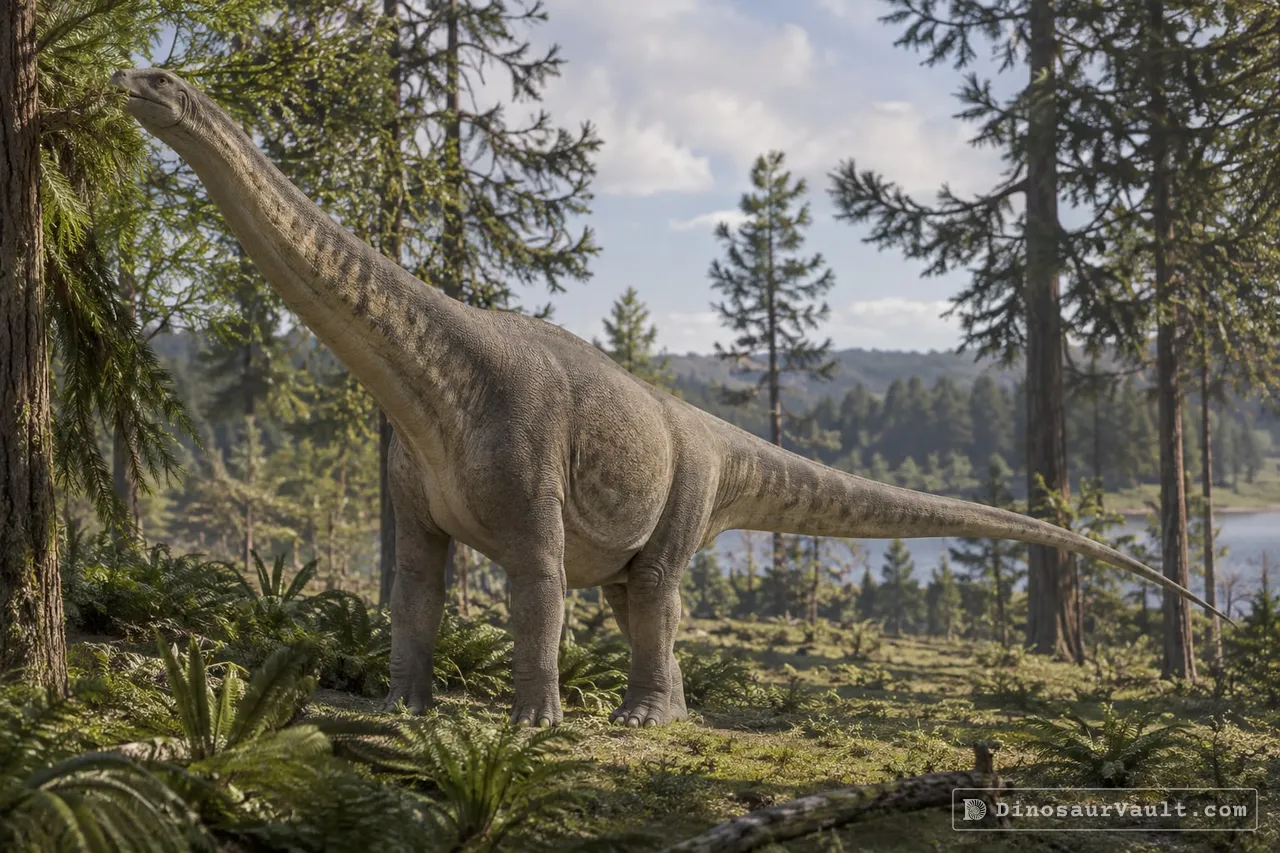
Borealosaurus was a titanosaur, a long-necked plant eater. It is known from a few bones, including tail bones and a tooth.
Its world
It lived in the Cretaceous, in what is now China. It comes from the Sunjiawan Formation, where it shared the land with the ankylosaur Crichtonpelta and the plant eater Shuangmiaosaurus.
How it was found
You and colleagues named Borealosaurus in 2004.
Field gallery
More views of Borealosaurus
Scenes reconstructed from the available fossil evidence.
1 of 3
Lived alongside
Found in the same rock formations


A rock formation can hold fossils laid down millions of years apart, so not every animal here met Borealosaurus.
The evidence
The science behind Borealosaurus
Which parts of the picture come from its own bones, and which come from its relatives.
From its own fossils
- The defining fossil is a vertebra from the middle-to-rear part of the tail.
- Its tail vertebra has a rounded front end and a hollow back end.
- A tooth, a second tail vertebra and an upper arm bone were only provisionally assigned to it, and a tooth found later in the same rocks was also tentatively linked to it.
Borrowed from relatives
- The long neck and small head are restored by comparison with better-known Asian sauropods such as Euhelopus.
- The shoulder, upper arm and feet follow other titanosaurs such as Mnyamawamtuka.
Still unknown
- Its complete body shape and size.
- Whether the extra bones belong to it. A later study found the upper arm bone too small to come from the same animal as the defining vertebra, and how it was found with the other bones is unclear.
- Its exact place among titanosaurs. Its tail joints are shaped like those of Opisthocoelicaudia, but they sit farther down the tail, so the likeness may not show close kinship.
Discovery timeline
- 2004Named itYou et al.
- 2013Close relativeD'Emic et al.
- 2013Close relativePoropat & Kear
- 2017Family treeAverianov & Sues
Key papers
The research behind what we know of Borealosaurus
Named it
Named Borealosaurus from an unusual tail vertebra and provisionally assigned a tooth, another tail bone and an upper arm bone to it.
A titanosaurian sauropod dinosaur with opsithocoelous caudal vertebrae from the early Late Cretaceous of Liaoning province, China. Acta Geologica Sinica 78: 907-911
No link available
Close relative
Redescribed Huabeisaurus and compared Asian sauropods, arguing that the upper arm bone once assigned to Borealosaurus cannot be shown to belong to it.
Osteology of Huabeisaurus allocotus (Sauropoda: Titanosauriformes) from the Upper Cretaceous of China. PLoS ONE 8: e69375
Read the paper : Osteology of Huabeisaurus allocotus (Sauropoda: Titanosauriformes) from the Upper Cretaceous of China (opens in a new tab)Close relative
Photographed in detail and rebuilt in three dimensions the type skull of Euhelopus, and described further skull bones.
Photographic Atlas and Three-Dimensional Reconstruction of the Holotype Skull of Euhelopus zdanskyi with Description of Additional Cranial Elements. PLoS ONE 8: e79932
Read the paper : Photographic Atlas and Three-Dimensional Reconstruction of the Holotype Skull of Euhelopus zdanskyi with Description of Additional Cranial Elements (opens in a new tab)Family tree
Compared Asian sauropod remains and placed Borealosaurus among titanosaurs outside the more specialized branch with deeply cupped front faces on tail vertebrae.
Review of Cretaceous sauropod dinosaurs from Central Asia. Cretaceous Research 69: 184-197
Read the paper : Review of Cretaceous sauropod dinosaurs from Central Asia (opens in a new tab)
Close relatives
Other members of Titanosauria


Sources: Wikidata