Xiyunykus
"western claw"
- Lived
- 137 to 133 million years ago, Early Cretaceous
- Diet
- Carnivore
- Group
- Theropods
- Found in
- China
- Named by
- Xu et al. 2018
Where its fossils were found
The evidence
Today

135 million years ago
Habitat
It lived in a landscape with lakes in what is now northwestern China. Other dinosaurs from these lake deposits include Wuerhosaurus and Psittacosaurus.
Field notes
About Xiyunykus
What it was like
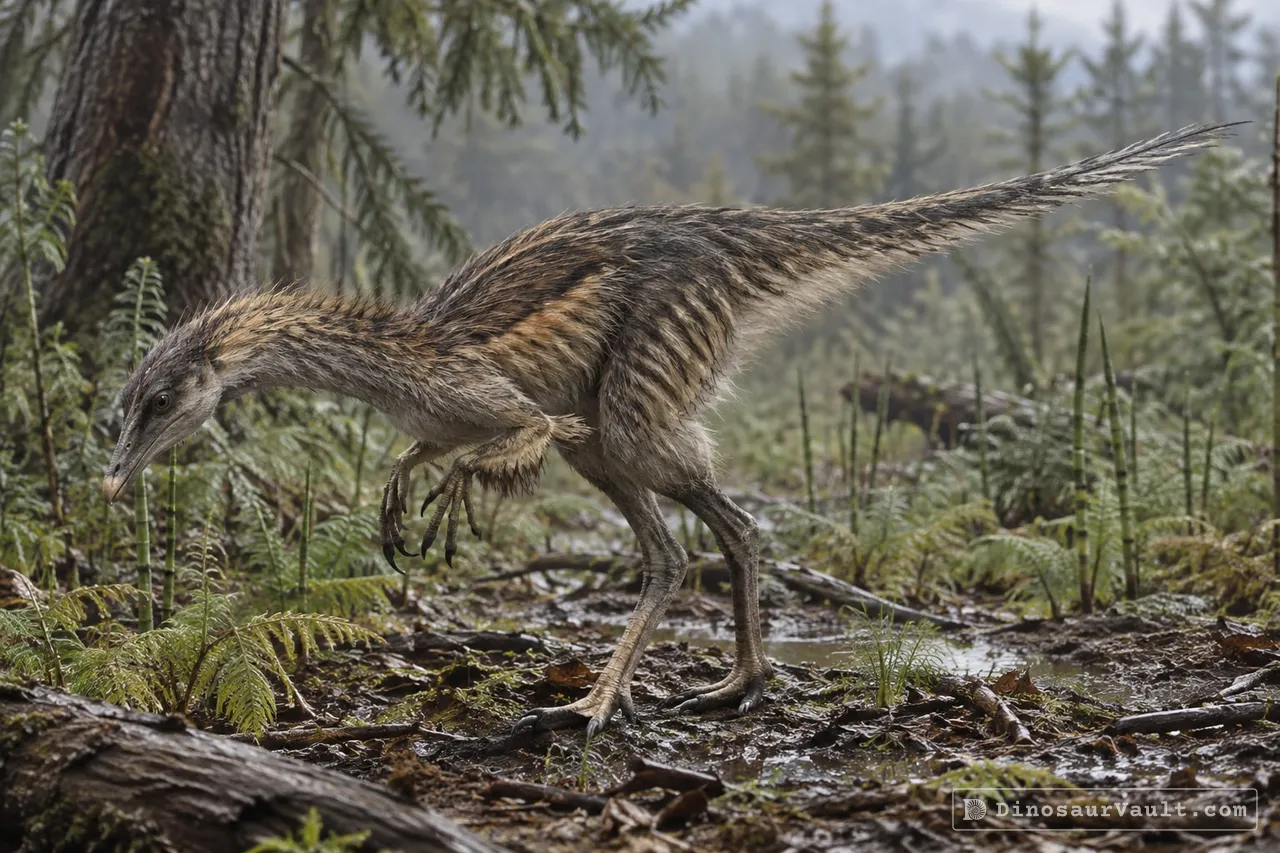
Xiyunykus was an early alvarezsaur, a small, bird-like theropod. It is known from parts of the skull and skeleton. Its features are halfway between early members of the group and later ones with one big claw on each short arm.
Its world
It lived about 137 to 133 million years ago, in the Early Cretaceous, in what is now northwestern China. Its bones come from the Shengjinkou Formation.
How it was found
Xu and colleagues named it in 2018, at the same time as Bannykus.
Field gallery
More views of Xiyunykus
Scenes reconstructed from the available fossil evidence.
1 of 3
Lived alongside
Found in the same rock formations


A rock formation can hold fossils laid down millions of years apart, so not every animal here met Xiyunykus.
The evidence
The science behind Xiyunykus
Which parts of the picture come from its own bones, and which come from its relatives.
From its own fossils
- A single partial skeleton includes the skull roof, part of the braincase, bones of the lower jaw, vertebrae from the neck to the tail, the shoulder, the upper arm bone and an ulna, parts of the thigh and shin bones, and part of a foot bone.
- Its shoulder blade is long and its upper arm bone relatively slender, so its arms retained much more of their length than those of later short-armed alvarezsaurs.
- Its skull combines features of Haplocheirus with features seen in more specialized relatives such as Shuvuuia.
Borrowed from relatives
- The missing snout and the area around the eyes are restored by comparison with Haplocheirus.
- The body, hips and knees follow Bannykus, whose hind legs are generally similar to those of Xiyunykus.
Still unknown
- The front of its skull and its snout.
- What its hands looked like, and how it used its arms.
- Exactly what it ate.
Discovery timeline
- 2014Close relativeChoiniere et al.
- 2018Named itXu et al.
- 2021Growing upQin et al.
- 2024Family treeMeso et al.
Key papers
The research behind what we know of Xiyunykus
Close relative
Described the skull of Haplocheirus, an early alvarezsaur, bone by bone, including the snout bones that are missing in Xiyunykus.
Cranial Osteology ofHaplocheirus sollersChoiniere et al., 2010 (Theropoda: Alvarezsauroidea). American Museum Novitates 3816: 1-44
Read the paper : Cranial Osteology ofHaplocheirus sollersChoiniere et al., 2010 (Theropoda: Alvarezsauroidea) (opens in a new tab)Named it
Named Xiyunykus and Bannykus, showing intermediate stages between earlier alvarezsaurs and later relatives with very short arms.
Two Early Cretaceous Fossils Document Transitional Stages in Alvarezsaurian Dinosaur Evolution. Current Biology 28: 2853-2860.e3
Read the paper : Two Early Cretaceous Fossils Document Transitional Stages in Alvarezsaurian Dinosaur Evolution (opens in a new tab)Growing up
Compared microscopic bone growth across alvarezsaurs, including Xiyunykus, and found differing growth strategies within the group.
Growth and miniaturization among alvarezsauroid dinosaurs. Current Biology 31: 3687-3693.e5
Read the paper : Growth and miniaturization among alvarezsauroid dinosaurs (opens in a new tab)Family tree
Traced body size and rates of change across alvarezsaurs. Its family tree grouped Xiyunykus with Bannykus and Tugulusaurus.
Body size and evolutionary rate analyses reveal complex evolutionary history of Alvarezsauria. Cladistics 41: 135-155
Read the paper : Body size and evolutionary rate analyses reveal complex evolutionary history of Alvarezsauria (opens in a new tab)
Close relatives
Other members of Alvarezsauroidea


Sources: Wikidata