Galleonosaurus
"galleon lizard"
- Lived
- 126 to 120 million years ago, Early Cretaceous
- Diet
- Herbivore
- Group
- Ornithopods
- Found in
- Australia
- Named by
- Herne et al. 2019
Where its fossils were found
The evidence
Today

125 million years ago
Habitat
A river floodplain at high southern latitudes, between Australia and Antarctica. Qantassaurus and an ornithopod tentatively identified as Atlascopcosaurus also occur in these rocks.
Field notes
About Galleonosaurus
What it was like
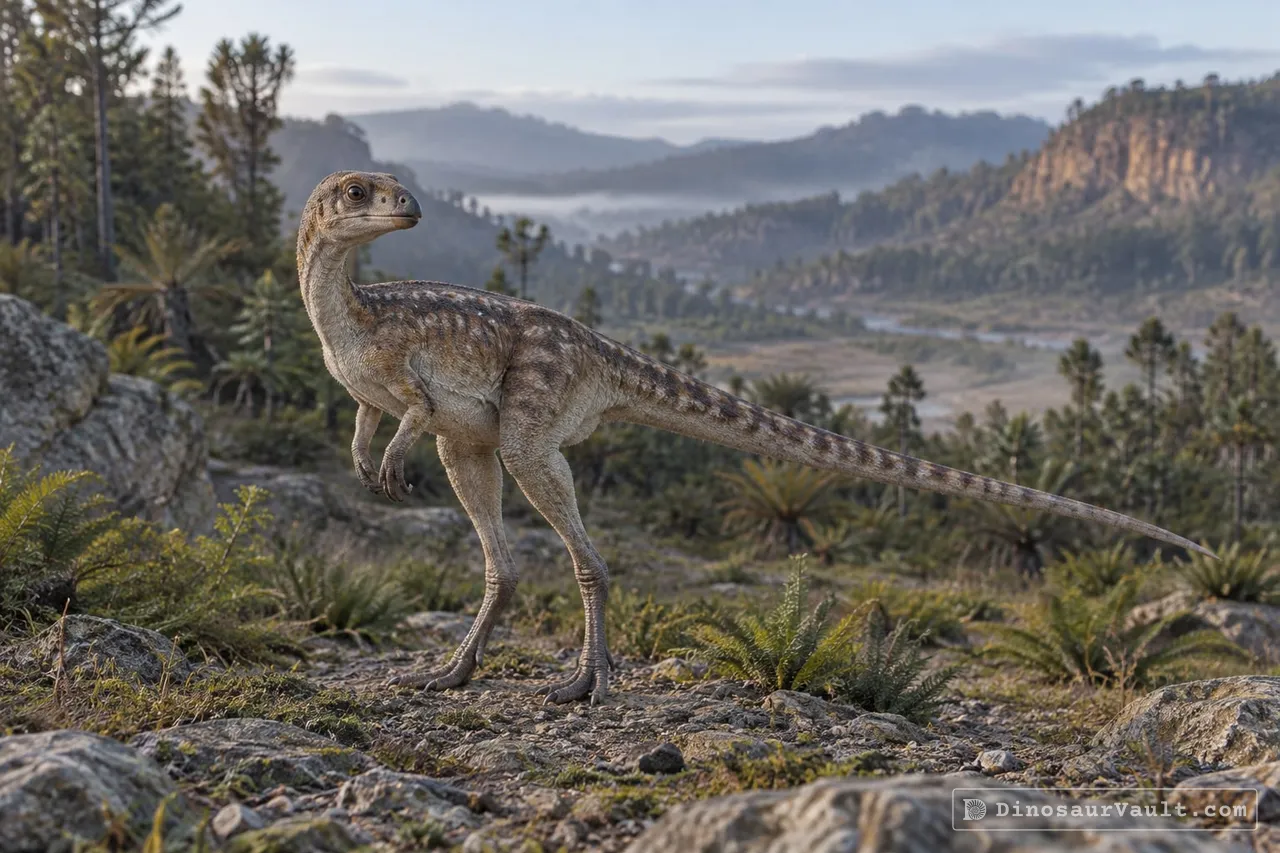
Galleonosaurus was a small plant eater that ran on two legs. It is known from upper jaws, shaped a bit like an upturned ship's hull, which gave it its name.
Its world
It lived in the Early Cretaceous, in what is now Australia. The area was then far to the south, with cold, dark winters. It shared that land with the small plant eater Qantassaurus.
How it was found
Herne and colleagues named Galleonosaurus in 2019.
Field gallery
More views of Galleonosaurus
Scenes reconstructed from the available fossil evidence.
Lived alongside
Found in the same rock formations


A rock formation can hold fossils laid down millions of years apart, so not every animal here met Galleonosaurus.
The evidence
The science behind Galleonosaurus
Which parts of the picture come from its own bones, and which come from its relatives.
From its own fossils
- The type specimen is an isolated upper jaw. Other material assigned to Galleonosaurus includes separate upper jaws and an associated palate bone and partial bone beside the eye.
- Its upper jaw has a tall, ship-like outline and a row of ridged teeth.
- Scans reveal branching channels for nerves and blood vessels inside the jaw.
Borrowed from relatives
- Leaellynasaura supplies a comparison for jaw features used to distinguish these genera.
Still unknown
- Its skin covering and color.
- The shape and proportions of its limbs and tail, and whether Diluvicursor represents the same animal.
- Whether it cared for its young.
Discovery timeline
- 2019Named itHerne et al.
- 2021New findDuncan et al.
- 2023Fossil sitesPoropat et al.
Key papers
The research behind what we know of Galleonosaurus
Named it
Named Galleonosaurus from upper jaws, traced their internal channels and compared jaw growth across specimens.
New small-bodied ornithopods (Dinosauria, Neornithischia) from the Early Cretaceous Wonthaggi Formation (Strzelecki Group) of the Australian-Antarctic rift system, with revision of Qantassaurus intrepidus Rich and Vickers-Rich, 1999. Journal of Paleontology 93: 543-584
Read the paper : New small-bodied ornithopods (Dinosauria, Neornithischia) from the Early Cretaceous Wonthaggi Formation (Strzelecki Group) of the Australian-Antarctic rift system, with revision of Qantassaurus intrepidus Rich and Vickers-Rich, 1999 (opens in a new tab)New find
Described jaws from the Eumeralla Formation tentatively assigned to Galleonosaurus and raised a possible overlap between Diluvicursor and a genus named from jaws.
Ornithopod jaws from the Lower Cretaceous Eumeralla Formation, Victoria, Australia, and their implications for polar neornithischian dinosaur diversity. Journal of Vertebrate Paleontology 41
Read the paper : Ornithopod jaws from the Lower Cretaceous Eumeralla Formation, Victoria, Australia, and their implications for polar neornithischian dinosaur diversity (opens in a new tab)Fossil sites
Reviewed Australian fossil animals, including the known remains and fossil locality of Galleonosaurus.
An annotated checklist of Australian Mesozoic tetrapods. Alcheringa: An Australasian Journal of Palaeontology 47: 129-205
Read the paper : An annotated checklist of Australian Mesozoic tetrapods (opens in a new tab)
Close relatives
Other members of Elasmaria


Sources: Wikidata