Protohadros
"first hadrosaur"
Type species Protohadros byrdi
- Lived
- 101 to 94 million years ago, Late Cretaceous
- Diet
- Herbivore
- Length
- about 6 m (20 ft)
- Group
- Ornithopods
- Found in
- United States
- Named by
- Head 1998
Size comparison
To scale

Scale in metersOutline: typical ornithopod shape
Where its fossils were found
The evidence
Today

95 million years ago
Habitat
A low coastal landscape crossed by rivers, with swamps and lakes. The smaller plant eater Ampelognathus lived here too.
Field notes
About Protohadros
What it was like
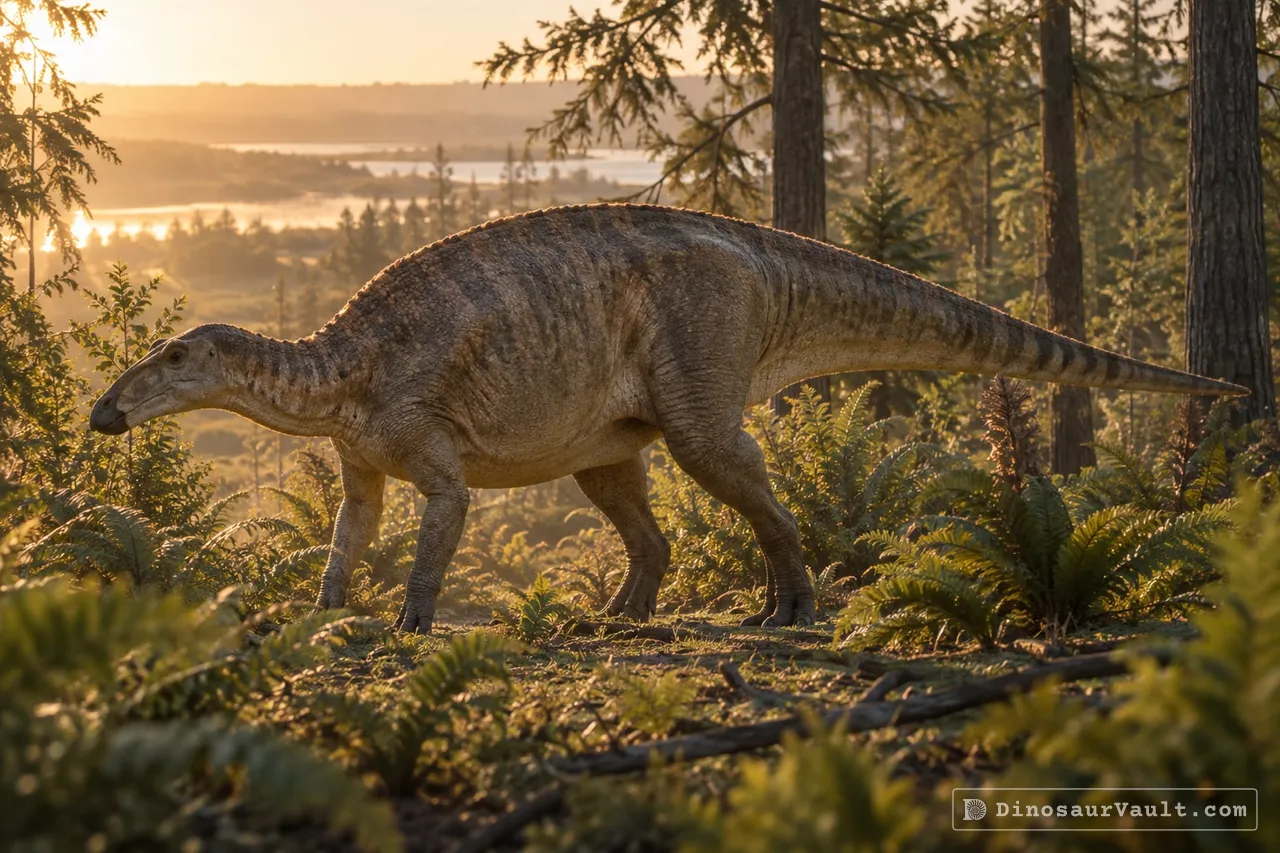
Protohadros was a plant eater about 6 meters (20 feet) long, an early relative of the duck-billed dinosaurs. Its lower jaw curved down sharply at the front, which may mean it fed on plants close to the ground.
Its world
It lived in the Late Cretaceous in what is now Texas, in the United States. Its bones come from the Lewisville Formation, rocks laid down near the coast.
How it was found
Head named Protohadros in 1998. Three finds are known. Despite its name, later studies found it was not the first hadrosaur, but a relative just outside the family.
Field gallery
More views of Protohadros
Scenes reconstructed from the available fossil evidence.
1 of 3
Lived alongside
Found in the same rock formations

A rock formation can hold fossils laid down millions of years apart, so not every animal here met Protohadros.
The evidence
The science behind Protohadros
Which parts of the picture come from its own bones, and which come from its relatives.
From its own fossils
- A skull preserved as separate bones and scattered bones from the body were used to describe Protohadros. The bone around its eye socket is thick and rough.
- Both the upper and lower jaws turn sharply downward at the front, and the lower jaw grows deeper toward its tip. This may have helped it crop plants close to the ground.
- Remains from another site in Texas are assigned to it because their lower jaws share a shelf of bone below the tooth row. They come from at least five animals of different sizes.
Borrowed from relatives
- The skull roof, neck, limbs, hands and feet are restored by comparison with Eolambia, an early duck-bill relative known from many individuals.
Still unknown
- How tall its upper jaw bone was. Experts who studied the skull disagree on whether it was high or fairly low.
- Its skin texture and color.
- Which plants made up most of its diet.
Discovery timeline
- 1998Named itHead
- 2012Close relativeMcDonald et al.
- 2013Family treeWang et al.
- 2023Same rocksTykoski, Contreras & Noto
Key papers
The research behind what we know of Protohadros
Named it
Described the skull and scattered body bones, interpreting the downturned muzzle as an adaptation for feeding on low plants.
A new species of basal hadrosaurid (Dinosauria, Ornithischia) from the Cenomanian of Texas. Journal of Vertebrate Paleontology 18: 718-738
Read the paper : A new species of basal hadrosaurid (Dinosauria, Ornithischia) from the Cenomanian of Texas (opens in a new tab)Close relative
Described the skeleton of Eolambia bone by bone, comparing its jaws, cheek and eye socket with those of Protohadros.
Osteology of the Basal Hadrosauroid Eolambia caroljonesa (Dinosauria: Ornithopoda) from the Cedar Mountain Formation of Utah. PLoS ONE 7: e45712
Read the paper : Osteology of the Basal Hadrosauroid Eolambia caroljonesa (Dinosauria: Ornithopoda) from the Cedar Mountain Formation of Utah (opens in a new tab)Family tree
Compared early duck-bill relatives and placed Protohadros outside the true duck-billed dinosaur family.
A New Hadrosauroid Dinosaur from the Early Late Cretaceous of Shanxi Province, China. PLoS ONE 8: e77058
Read the paper : A New Hadrosauroid Dinosaur from the Early Late Cretaceous of Shanxi Province, China (opens in a new tab)Same rocks
Named Ampelognathus from the same formation and reported that Protohadros remains include young and partly grown animals.
The first small-bodied ornithopod dinosaur from the Lewisville Formation (middle Cenomanian) of Texas. Journal of Vertebrate Paleontology 43
Read the paper : The first small-bodied ornithopod dinosaur from the Lewisville Formation (middle Cenomanian) of Texas (opens in a new tab)
Close relatives
Other members of Hadrosauroidea


Sources: Wikidata