Ampelognathus
"grapevine jaw"
Type species Ampelognathus coheni
- Lived
- 101 to 94 million years ago, Late Cretaceous
- Diet
- Herbivore
- Group
- Ornithopods
- Found in
- United States
- Named by
- Tykoski et al. 2023
Where its fossils were found
The evidence
Today

95 million years ago
Habitat
Coastal lowlands in Texas, with rivers, lakes, swamps and tidal lagoons. Protohadros lived in the same region, along with armored plant eaters and small meat eaters.
Field notes
About Ampelognathus
What it was like
Ampelognathus was a small plant eater known from a lower jaw. It may be related to Rhabdodon and its kin.
Its world
It lived in the Late Cretaceous, in what is now Texas. It comes from the Lewisville Formation, where the early duckbill relative Protohadros also lived.
How it was found
Tykoski and colleagues named Ampelognathus in 2023. The type species is Ampelognathus coheni. Its name comes from the town near where it was found.
Field gallery
More views of Ampelognathus
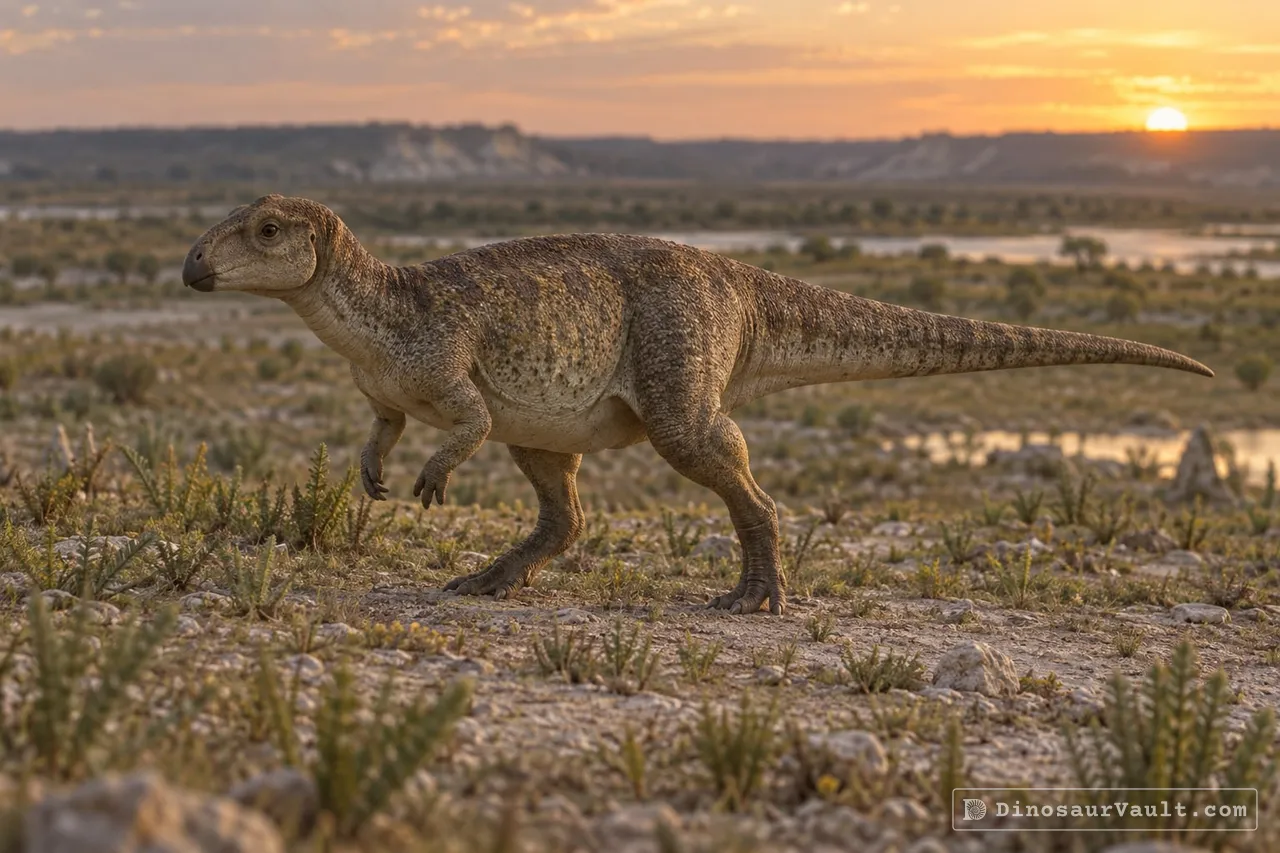
Scenes reconstructed from the available fossil evidence.
Lived alongside
Found in the same rock formations

A rock formation can hold fossils laid down millions of years apart, so not every animal here met Ampelognathus.
The evidence
The science behind Ampelognathus
Which parts of the picture come from its own bones, and which come from its relatives.
From its own fossils
- An almost complete left lower jaw, with a tooth root and sockets along the tooth row.
- The jaw twists along its length and has a low projection where chewing muscles attached.
Borrowed from relatives
- The missing body may have resembled small ornithopods such as Convolosaurus and Hypsilophodon, whose jaws were used for comparison.
Still unknown
- Its adult size and body proportions.
- Whether the known jaw belonged to a young animal.
- Its exact place in the ornithopod family tree.
Discovery timeline
- 1998Same rocksHead
- 2019Close relativeAndrzejewski, Winkler & Jacobs
- 2023Named itTykoski, Contreras & Noto
Key papers
The research behind what we know of Ampelognathus
Same rocks
Described Protohadros, a larger plant eater from the same regional rocks, with a downturned snout suited to feeding near the ground.
A new species of basal hadrosaurid (Dinosauria, Ornithischia) from the Cenomanian of Texas. Journal of Vertebrate Paleontology 18: 718-738
Read the paper : A new species of basal hadrosaurid (Dinosauria, Ornithischia) from the Cenomanian of Texas (opens in a new tab)Close relative
Described Convolosaurus from skeletons at different growth stages, providing a comparison for the jaw of Ampelognathus.
A new basal ornithopod (Dinosauria: Ornithischia) from the Early Cretaceous of Texas. PLOS ONE 14: e0207935
Read the paper : A new basal ornithopod (Dinosauria: Ornithischia) from the Early Cretaceous of Texas (opens in a new tab)Named it
Named a small ornithopod from a nearly complete lower jaw with an unusual twist and a low muscle attachment.
The first small-bodied ornithopod dinosaur from the Lewisville Formation (middle Cenomanian) of Texas. Journal of Vertebrate Paleontology 43
Read the paper : The first small-bodied ornithopod dinosaur from the Lewisville Formation (middle Cenomanian) of Texas (opens in a new tab)
Close relatives
Other members of Rhabdodontomorpha


Sources: Wikidata