Pilmatueia
Type species Pilmatueia faundezi
- Lived
- 137 to 133 million years ago, Early Cretaceous
- Diet
- Herbivore
- Group
- Sauropods, Dicraeosauridae
- Found in
- Argentina
- Named by
- Coria et al. 2019
Where its fossils were found
The evidence
Today

135 million years ago
Habitat
It lived around rivers in the Mulichinco Formation landscape of Argentina. Lajasvenator and Emiliasaura also come from these rocks.
Field notes
About Pilmatueia
What it was like
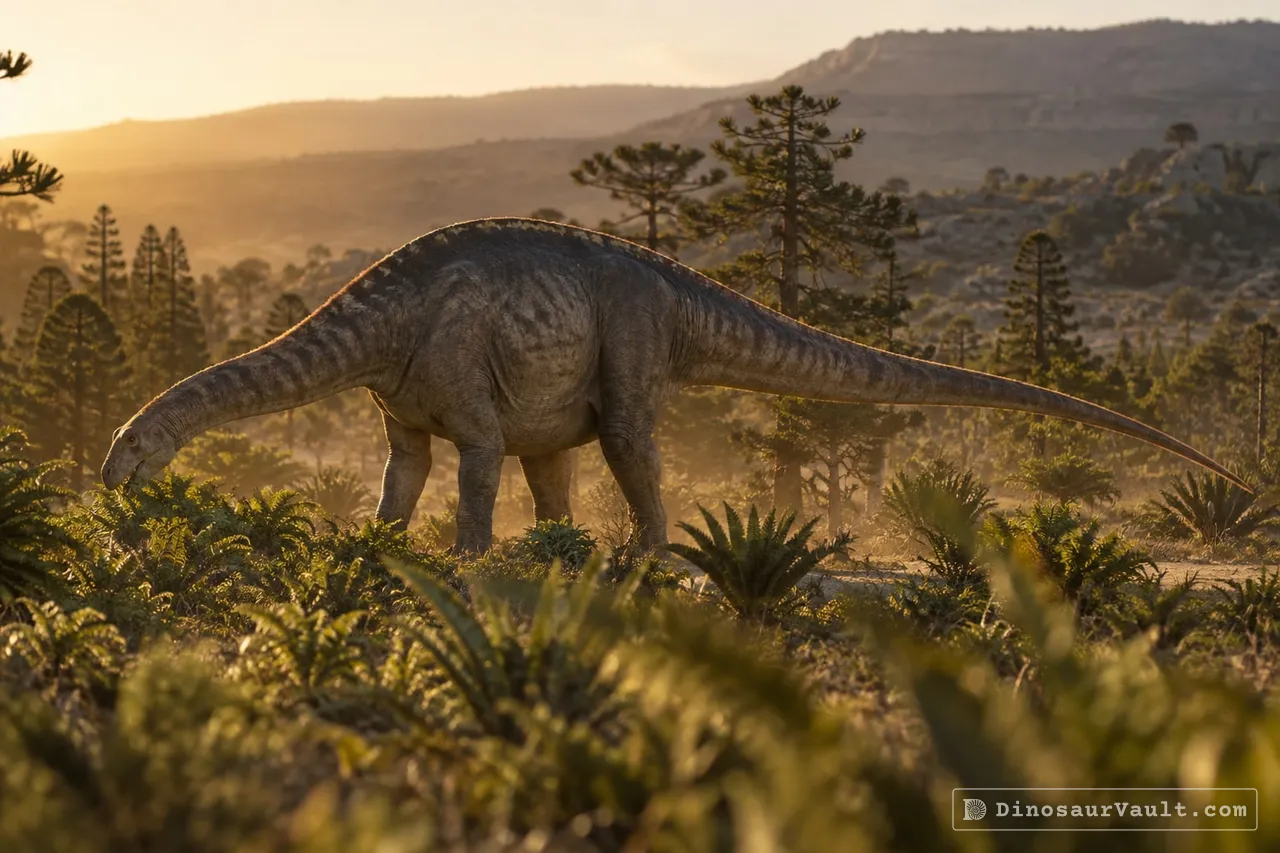
Pilmatueia was a dicraeosaurid, a short-necked sauropod related to Amargasaurus. It had tall, forked spines on its neck and back.
Its world
It lived in the Early Cretaceous, in what is now Argentina. It comes from the Mulichinco Formation, where it shared the land with the predator Lajasvenator and the small plant eater Emiliasaura.
How it was found
Coria and colleagues named Pilmatueia in 2019. The type species is Pilmatueia faundezi.
Field gallery
More views of Pilmatueia
Scenes reconstructed from the available fossil evidence.
Lived alongside
Found in the same rock formations


A rock formation can hold fossils laid down millions of years apart, so not every animal here met Pilmatueia.
The evidence
The science behind Pilmatueia
Which parts of the picture come from its own bones, and which come from its relatives.
From its own fossils
- Neck, back and tail vertebrae, ribs and shoulder blades preserve parts of its skeleton.
- The spines above its neck and back vertebrae split into paired branches.
- Large air chambers hollow out a neck vertebra, and smaller chambers occur in a back vertebra.
Borrowed from relatives
- The missing skull and limbs are restored by comparison with dicraeosaurids such as Dicraeosaurus and Amargasaurus.
- Its relatively short neck follows the proportions of other dicraeosaurids.
Still unknown
- The full shape of its skull and the length of its complete neck.
- What soft tissue covered its paired vertebral spines.
- Its color.
Discovery timeline
- 2019Named itCoria et al.
- 2020Full descriptionWindholz, Coria & Zurriaguz
- 2022New findWINDHOLZ et al.
Key papers
The research behind what we know of Pilmatueia
Named it
Named a dicraeosaurid from isolated bones with distinctive neck and back vertebrae.
A new dicraeosaurid sauropod from the Lower Cretaceous (Mulichinco Formation, Valanginian, Neuquén Basin) of Argentina. Cretaceous Research 93: 33-48
Read the paper : A new dicraeosaurid sauropod from the Lower Cretaceous (Mulichinco Formation, Valanginian, Neuquén Basin) of Argentina (opens in a new tab)Full description
Found large air chambers inside a neck vertebra, showing greater variation in dicraeosaurid air spaces than previously recognized.
Vertebral pneumatic structures in the Early Cretaceous sauropod dinosaur Pilmatueia faundezi from northwestern Patagonia, Argentina. Lethaia 53: 369-381
Read the paper : Vertebral pneumatic structures in the Early Cretaceous sauropod dinosaur Pilmatueia faundezi from northwestern Patagonia, Argentina (opens in a new tab)New find
Described a partial skeleton with neck and back vertebrae, ribs and shoulder blades, expanding the known anatomy of Pilmatueia.
On a dicraeosaurid specimen from the Mulichinco Formation (Valanginian, Neuquén Basin) of Argentina and phylogenetic relationships of the South American dicraeosaurids (Sauropoda, Diplodocoidea). Comptes Rendus Palevol
Read the paper : On a dicraeosaurid specimen from the Mulichinco Formation (Valanginian, Neuquén Basin) of Argentina and phylogenetic relationships of the South American dicraeosaurids (Sauropoda, Diplodocoidea) (opens in a new tab)
Close relatives
Other members of Dicraeosauridae


Sources: Wikidata