Emiliasaura
"Emilia's lizard"
Type species Emiliasaura alessandrii
- Lived
- 137 to 133 million years ago, Early Cretaceous
- Diet
- Herbivore
- Group
- Ornithopods
- Found in
- Argentina
- Named by
- Coria et al. 2024
Where its fossils were found
The evidence
Today

135 million years ago
Habitat
Rivers crossed a muddy and sandy floodplain with podocarp conifers. The hunter Lajasvenator and the long-necked plant eater Pilmatueia lived in the same region.
Field notes
About Emiliasaura
What it was like
Emiliasaura was a small, two-legged plant eater, known from three partial skeletons. It was an early iguanodont, first described as a relative of Rhabdodon and Zalmoxes.
Its world
It lived in the Early Cretaceous in what is now Argentina. Its bones come from the Mulichinco Formation, where it shared the land with the hunter Lajasvenator and the long-necked Pilmatueia.
How it was found
Coria and colleagues named Emiliasaura in 2024.
Field gallery
More views of Emiliasaura
Scenes reconstructed from the available fossil evidence.
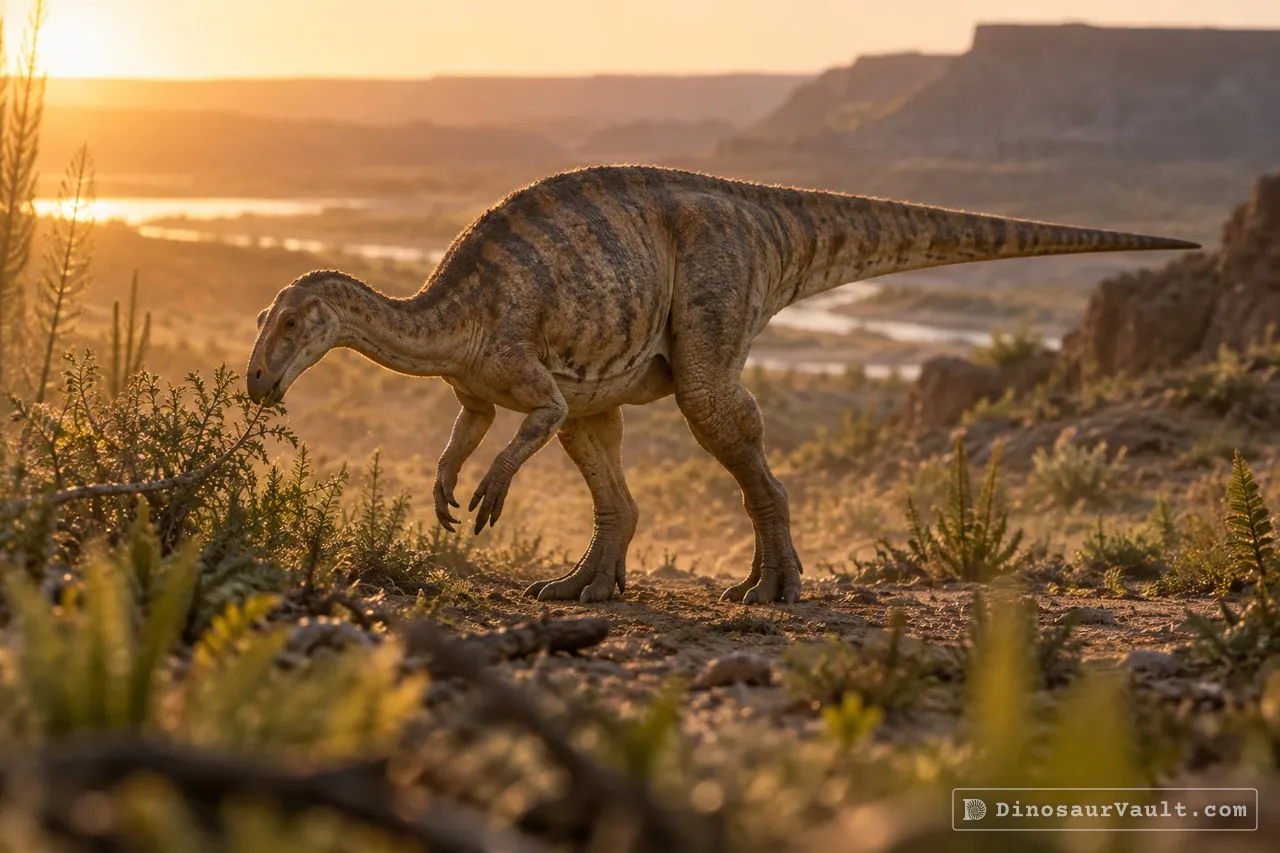
1 of 3
Lived alongside
Found in the same rock formations


A rock formation can hold fossils laid down millions of years apart, so not every animal here met Emiliasaura.
The evidence
The science behind Emiliasaura
Which parts of the picture come from its own bones, and which come from its relatives.
From its own fossils
- Partial skeletons preserve forearm bones and a complete hind leg.
- Other remains include pieces of the backbone, hips and hind limbs.
Borrowed from relatives
- The missing head is restored by comparison with other iguanodonts, such as Rhabdodon and Iguanodon.
Still unknown
- Its exact place in the iguanodont family tree: different studies place it on different branches.
- The shape of its skull and teeth.
- Its skin covering and color.
Discovery timeline
- 2020Same rocksCoria et al.
- 2024Named itCoria et al.
- 2025Family treeCzepiński & Madzia
Key papers
The research behind what we know of Emiliasaura
Same rocks
Described Lajasvenator, a meat eater from the same formation as Emiliasaura.
An Early Cretaceous, medium-sized carcharodontosaurid theropod (Dinosauria, Saurischia) from the Mulichinco Formation (upper Valanginian), Neuquén Province, Patagonia, Argentina. Cretaceous Research 111: 104319
Read the paper : An Early Cretaceous, medium-sized carcharodontosaurid theropod (Dinosauria, Saurischia) from the Mulichinco Formation (upper Valanginian), Neuquén Province, Patagonia, Argentina (opens in a new tab)Named it
Described Emiliasaura from partial skeletons and initially placed it among the relatives of Rhabdodon.
First Valanginian (Early Cretaceous) ornithopod (Dinosauria, Ornithischia) from Patagonia. Cretaceous Research.
No link available
Family tree
Placed Emiliasaura outside the group containing Rhabdodon in a new analysis of ornithopod relationships.
Exploring the diversity and disparity of rhabdodontomorph ornithopods from the Late Cretaceous European archipelago. Scientific Reports 15
Read the paper : Exploring the diversity and disparity of rhabdodontomorph ornithopods from the Late Cretaceous European archipelago (opens in a new tab)
Close relatives
Other members of Rhabdodontomorpha


Sources: Wikidata