Lajasvenator
"Las Lajas hunter"
- Lived
- 137 to 133 million years ago, Early Cretaceous
- Diet
- Carnivore
- Group
- Theropods, Carcharodontosauridae
- Found in
- Argentina
- Named by
- Coria et al. 2020
Where its fossils were found
The evidence
Today

135 million years ago
Habitat
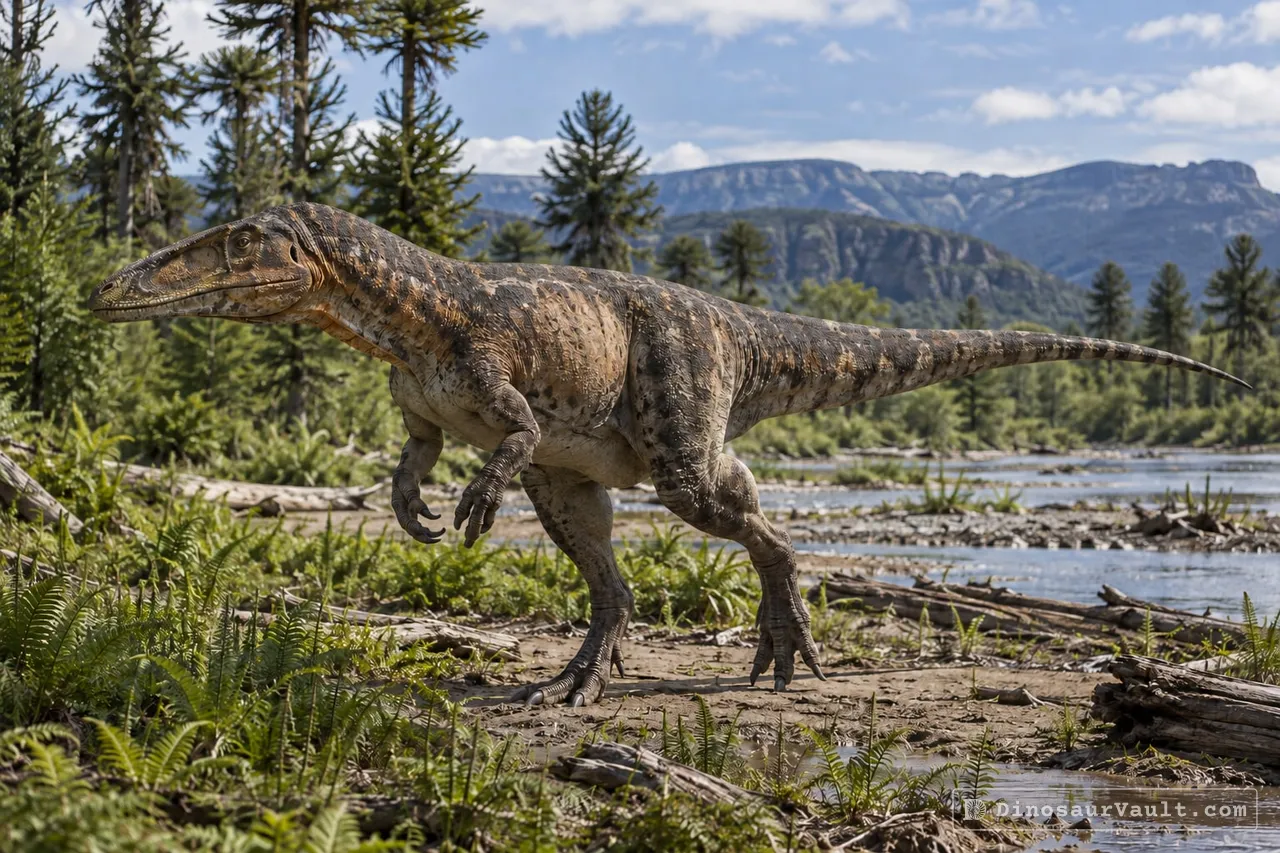
Sandy river channels split and rejoined across a floodplain in what is now Argentina. The Mulichinco Formation also preserves Pilmatueia and Emiliasaura.
Field notes
About Lajasvenator
What it was like
Lajasvenator was a carcharodontosaurid, a member of the family of "shark-toothed" predators that later included Giganotosaurus. It was small for its family and is known from parts of the skull, backbone and hips.
Its world
It lived about 137 to 133 million years ago, in the Early Cretaceous, in what is now Argentina. Its bones come from the Mulichinco Formation, where it lived alongside the plant eater Emiliasaura and the sauropod Pilmatueia.
How it was found
Coria and colleagues named it in 2020. It is one of the oldest carcharodontosaurids known from South America.
Field gallery
More views of Lajasvenator
Scenes reconstructed from the available fossil evidence.
1 of 3
Lived alongside
Found in the same rock formations


A rock formation can hold fossils laid down millions of years apart, so not every animal here met Lajasvenator.
The evidence
The science behind Lajasvenator
Which parts of the picture come from its own bones, and which come from its relatives.
From its own fossils
- Two partial skeletons preserve pieces of the snout and lower jaws, neck and back vertebrae, tail bones and hips. The main one has most of the front snout bone and a row of rear neck vertebrae.
- Its neck vertebrae carry projecting joint surfaces and lip-like ridges, and the neck ribs have forked front ends. Fused joints in the backbone show the main skeleton was an adult.
- The second skeleton keeps the front ends of both lower jaws, which are squared off with a small chin-like bump underneath.
Borrowed from relatives
- Missing limbs and skull regions are restored by comparison with carcharodontosaurids such as Concavenator and Eocarcharia.
- A recent study's family trees place it as an early member of the carcharodontosaurid family, closest to Lusovenator.
Still unknown
- Its complete body length and limb proportions.
- Its skin covering and color.
- Which animals it hunted.
Discovery timeline
- 2019Same rocksCoria et al.
- 2020Named itCoria et al.
- 2021Its worldPino et al.
- 2025Family treeKellermann, Cuesta & Rauhut
Key papers
The research behind what we know of Lajasvenator
Same rocks
Named Pilmatueia, a sauropod from the same formation as Lajasvenator.
A new dicraeosaurid sauropod from the Lower Cretaceous (Mulichinco Formation, Valanginian, Neuquén Basin) of Argentina. Cretaceous Research 93: 33-48
Read the paper : A new dicraeosaurid sauropod from the Lower Cretaceous (Mulichinco Formation, Valanginian, Neuquén Basin) of Argentina (opens in a new tab)Named it
Named a relatively small carcharodontosaurid from partial skeletons with distinctive neck vertebrae and ribs.
An Early Cretaceous, medium-sized carcharodontosaurid theropod (Dinosauria, Saurischia) from the Mulichinco Formation (upper Valanginian), Neuquén Province, Patagonia, Argentina. Cretaceous Research 111: 104319
Read the paper : An Early Cretaceous, medium-sized carcharodontosaurid theropod (Dinosauria, Saurischia) from the Mulichinco Formation (upper Valanginian), Neuquén Province, Patagonia, Argentina (opens in a new tab)Its world
Reconstructed branching river channels and showed that some dinosaur bones traveled farther before burial than others.
An accumulation of dinosaur remains in fluvial deposits of Mulichinco Formation (lower Valanginian, Neuquén Basin), Patagonia, Argentina: Taphonomic and paleoenvironmental inferences. Journal of South American Earth Sciences 105: 102979
Read the paper : An accumulation of dinosaur remains in fluvial deposits of Mulichinco Formation (lower Valanginian, Neuquén Basin), Patagonia, Argentina: Taphonomic and paleoenvironmental inferences (opens in a new tab)Family tree
Restudied a large carcharodontosaurid from Egypt and, in a wider family tree, found Lajasvenator to be an early member of the family, paired with Lusovenator.
Re-evaluation of the Bahariya Formation carcharodontosaurid (Dinosauria: Theropoda) and its implications for allosauroid phylogeny. PLOS ONE 20: e0311096
Read the paper : Re-evaluation of the Bahariya Formation carcharodontosaurid (Dinosauria: Theropoda) and its implications for allosauroid phylogeny (opens in a new tab)
Close relatives
Other members of Carcharodontosauridae


Sources: Wikidata