Magnamanus
"big hand"
- Lived
- 133 to 121 million years ago, Early Cretaceous
- Diet
- Herbivore
- Group
- Ornithopods
- Found in
- Spain
- Named by
- Fuentes Vidarte et al. 2016
Where its fossils were found
The evidence
Today

125 million years ago
Habitat
Rivers crossed a subtropical landscape with conifer trees in what is now Spain. Polacanthus and Soriatitan also lived in the Golmayo Formation.
Field notes
About Magnamanus
What it was like
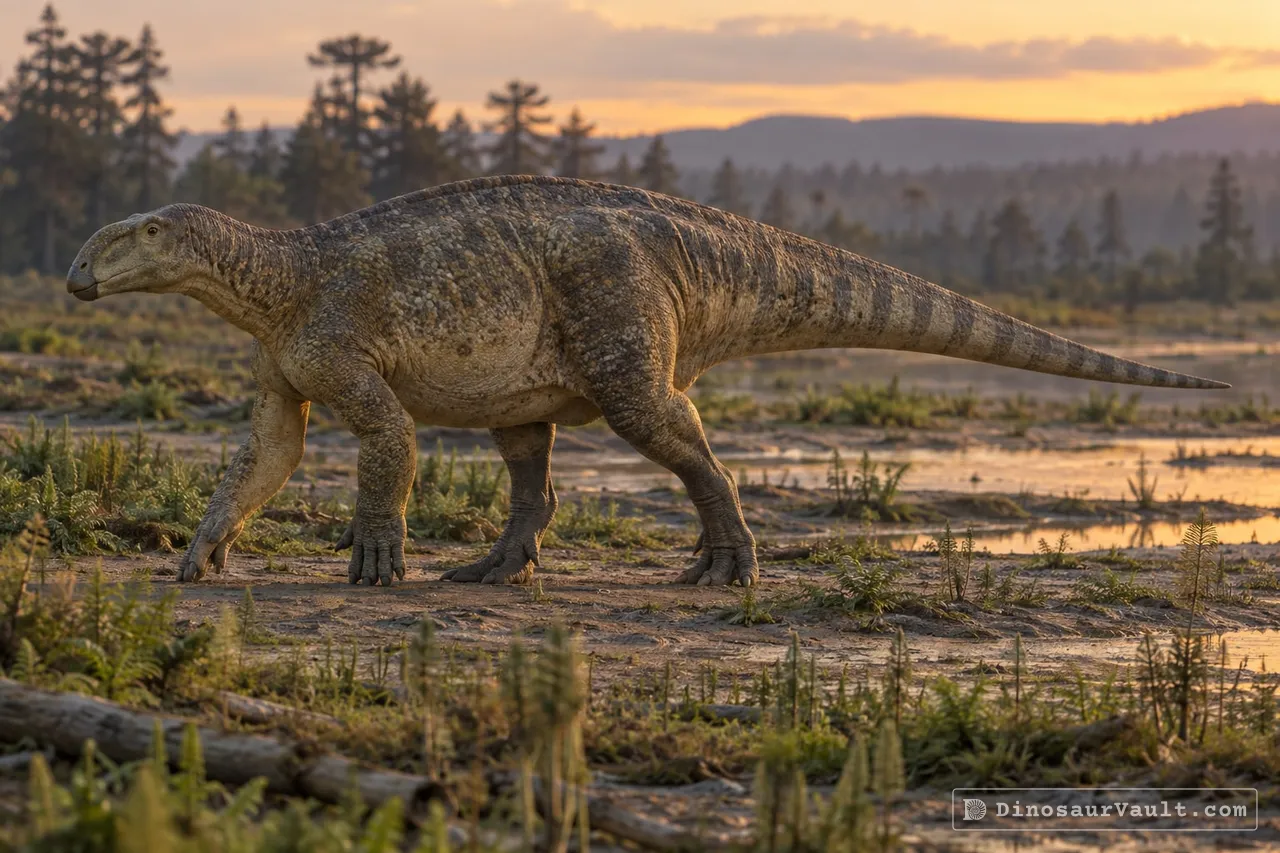
Magnamanus was a large plant eater related to Iguanodon. It is known from part of the skeleton, and its hands were large, which gave it its name.
Its world
It lived in the Early Cretaceous in what is now northern Spain. Its bones come from the Golmayo Formation, where it shared the land with the armored Polacanthus and the long-necked Soriatitan.
How it was found
Fuentes Vidarte and colleagues named Magnamanus in 2016, from a single find.
Field gallery
More views of Magnamanus
Scenes reconstructed from the available fossil evidence.
1 of 3
Lived alongside
Found in the same rock formations


A rock formation can hold fossils laid down millions of years apart, so not every animal here met Magnamanus.
The evidence
The science behind Magnamanus
Which parts of the picture come from its own bones, and which come from its relatives.
From its own fossils
- The type skeleton, which its describers credit to a single animal, includes pieces of the upper and lower jaws, vertebrae from neck to tail, shoulder bones, both upper arms, the right forearm and hand, and parts of the hips and right leg.
- Its broad wrist and large hand gave Magnamanus its name. One of its forearm bones is straight and compact with strongly widened ends, sturdier than in Iguanodon or Ouranosaurus.
- The beak bone at the front of the lower jaw has a rounded upper edge without bony points. Farther back, the lower jaw has a low, backward-tilting projection where jaw muscles attached.
Borrowed from relatives
- Missing parts of the head are restored using better-preserved iguanodontians such as Iguanodon.
- The neck and body are filled in by comparison with other iguanodontians such as Eolambia.
Still unknown
- The complete outline of its skull.
- Whether a second partial skeleton found later in Spain belongs to Magnamanus. Its describers compared it with Magnamanus but did not firmly refer it.
- Whether it lived in herds.
Discovery timeline
- 2016Named itVidarte et al.
- 2017Same rocksRoyo-Torres et al.
- 2021Close relativeSantos-Cubedo et al.
- 2026New findFuentes-Vidarte et al.
Key papers
The research behind what we know of Magnamanus
Named it
Described Magnamanus from a partial skeleton, distinguishing it by the shape of its jaw, shoulder, arms, wrist and hips.
Un nuevo dinosaurio estiracosterno (Ornithopoda: Ankylopollexia) del Cretácico Inferior de España [A new styracosternan dinosaur (Ornithopoda: Ankylopollexia) from the Lower Cretaceous of Spain]. Spanish Journal of Palaeontology 31(2):407-446.
No link available
Same rocks
Named Soriatitan, a long-necked plant eater from the Golmayo Formation that helps flesh out the dinosaur community around Magnamanus.
A new Brachiosauridae Sauropod dinosaur from the lower Cretaceous of Europe (Soria Province, Spain). Cretaceous Research 80: 38-55
Read the paper : A new Brachiosauridae Sauropod dinosaur from the lower Cretaceous of Europe (Soria Province, Spain) (opens in a new tab)Close relative
Compared the jaw of Portellsaurus with Magnamanus and other related plant eaters, describing differences in their tooth rows and jaw-muscle attachments.
A new styracosternan hadrosauroid (Dinosauria: Ornithischia) from the Early Cretaceous of Portell, Spain. PLOS ONE 16: e0253599
Read the paper : A new styracosternan hadrosauroid (Dinosauria: Ornithischia) from the Early Cretaceous of Portell, Spain (opens in a new tab)New find
Reported a second partial skeleton with skull pieces, teeth, vertebrae, ribs and hip bones, compared with Magnamanus but kept as only a possible match.
Restos de un dinosaurio (Ornithopoda: Styracosterna) cf. Magnamanus soriaensis del Cretácico Inferior de Soria, España. Estudios Geológicos 82: 1153
Read the paper : Restos de un dinosaurio (Ornithopoda: Styracosterna) cf. Magnamanus soriaensis del Cretácico Inferior de Soria, España (opens in a new tab)
Close relatives
Other members of Styracosterna


Sources: Wikidata