Dakotadon
"Dakota tooth"
- Lived
- 137 to 133 million years ago, Early Cretaceous
- Diet
- Herbivore
- Group
- Ornithopods
- Found in
- United States
- Named by
- Paul 2008
Where its fossils were found
The evidence
Today

135 million years ago
Habitat
Rivers and wet lowlands formed the deposits of the Lakota Formation. Hoplitosaurus and Osmakasaurus also lived in the region.
Field notes
About Dakotadon
What it was like
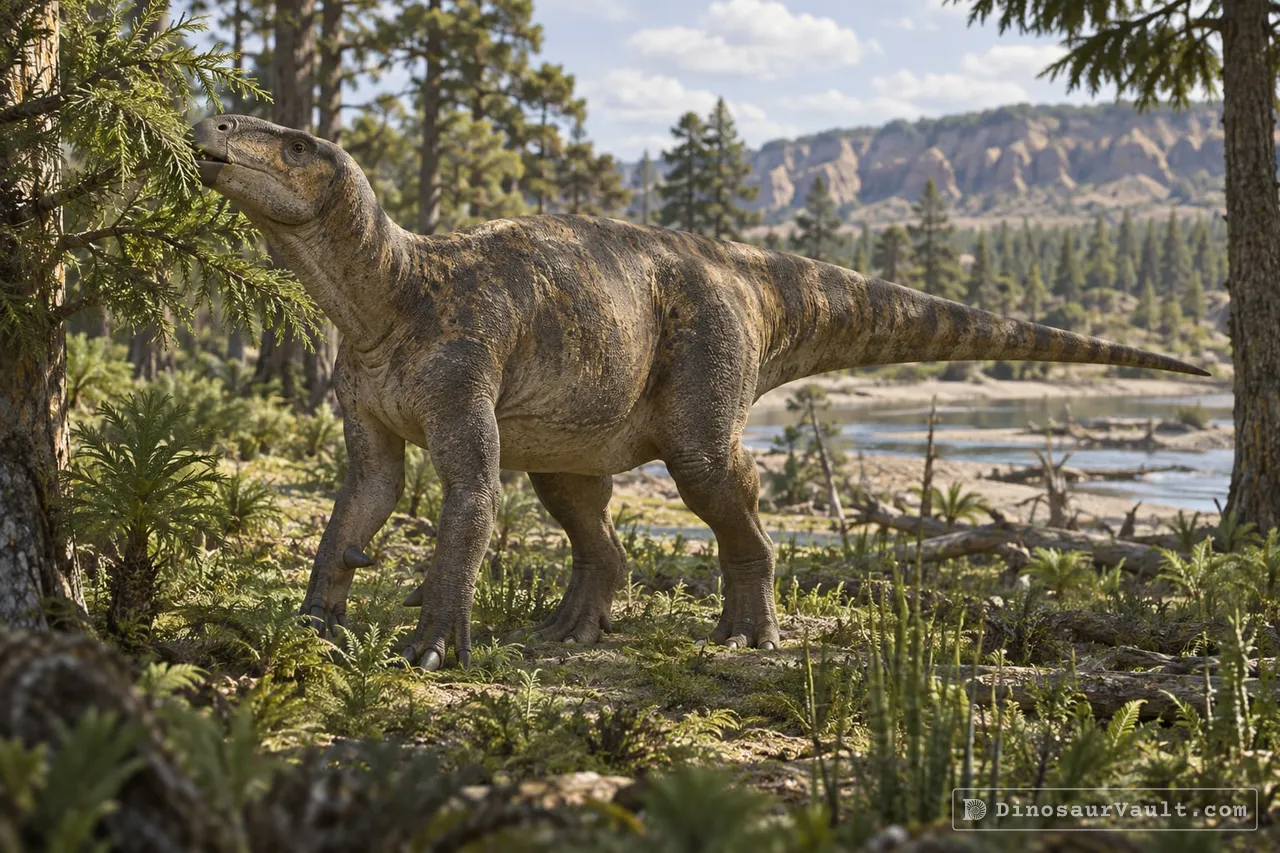
Dakotadon was a large plant eater related to Iguanodon, known from a partial skull with teeth. Like its relatives, it had a toothless beak at the front and grinding teeth behind.
Its world
It lived in the Early Cretaceous in what is now South Dakota, in the United States. Its fossil comes from the Lakota Formation, where it shared the land with the armored Hoplitosaurus.
How it was found
Its skull was first described as a species of Iguanodon. Paul gave it its own genus in 2008, but scientists still debate where it belongs.
Field gallery
More views of Dakotadon
Scenes reconstructed from the available fossil evidence.
1 of 3
The evidence
The science behind Dakotadon
Which parts of the picture come from its own bones, and which come from its relatives.
From its own fossils
- A partial skull and lower jaws are preserved with back and tail vertebrae.
- The toothless front of its upper jaw has a rough surface where a beak covered the bone.
- The undersides of its tail vertebrae carry prominent lengthwise ridges.
Borrowed from relatives
- The missing limbs and most of the body are restored using related plant eaters such as Hippodraco and Iguanacolossus.
Still unknown
- The proportions of its limbs and the full length of its body.
- Its skin texture and color.
- Its exact relationship to other early iguanodonts.
Often drawn wrong
- Older skull reconstructions followed some shapes distorted during burial and misidentified several face bones.
Discovery timeline
- 1989SkullWeishampel & Bjork
- 2008Named itPaul
- 2015RedescriptionBoyd & Pagnac
Key papers
The research behind what we know of Dakotadon
Skull
First described the skull and associated vertebrae, assigning the animal to Iguanodon.
The first indisputable remains ofIguanodon(Ornithischia: Ornithopoda) from North America:Iguanodon lakotaensis, sp. nov. Journal of Vertebrate Paleontology 9: 56-66
Read the paper : The first indisputable remains ofIguanodon(Ornithischia: Ornithopoda) from North America:Iguanodon lakotaensis, sp. nov. (opens in a new tab)Named it
Separated this animal from Iguanodon and gave it the genus name Dakotadon.
A revised taxonomy of the iguanodont dinosaur genera and species. Cretaceous Research 29: 192-216
Read the paper : A revised taxonomy of the iguanodont dinosaur genera and species (opens in a new tab)Redescription
Corrected earlier skull interpretations, identified distinctive features and relocated the fossil site to refine the animal's age.
Insight on the anatomy, systematic relationships, and age of the Early Cretaceous ankylopollexian dinosaur Dakotadon lakotaensis. PeerJ 3: e1263
Read the paper : Insight on the anatomy, systematic relationships, and age of the Early Cretaceous ankylopollexian dinosaur Dakotadon lakotaensis (opens in a new tab)
Close relatives
Other members of Styracosterna


Sources: Wikidata