Lanzhousaurus
"Lanzhou lizard"
- Lived
- 126 to 113 million years ago, Early Cretaceous
- Diet
- Herbivore
- Group
- Ornithopods
- Found in
- China
- Named by
- You et al. 2005
Where its fossils were found
The evidence
Today

120 million years ago
Habitat
A landscape of rivers and lakes in what is now northwestern China. The sauropods Huanghetitan, Daxiatitan and Yongjinglong are known from the same regional rock group.
Field notes
About Lanzhousaurus
What it was like
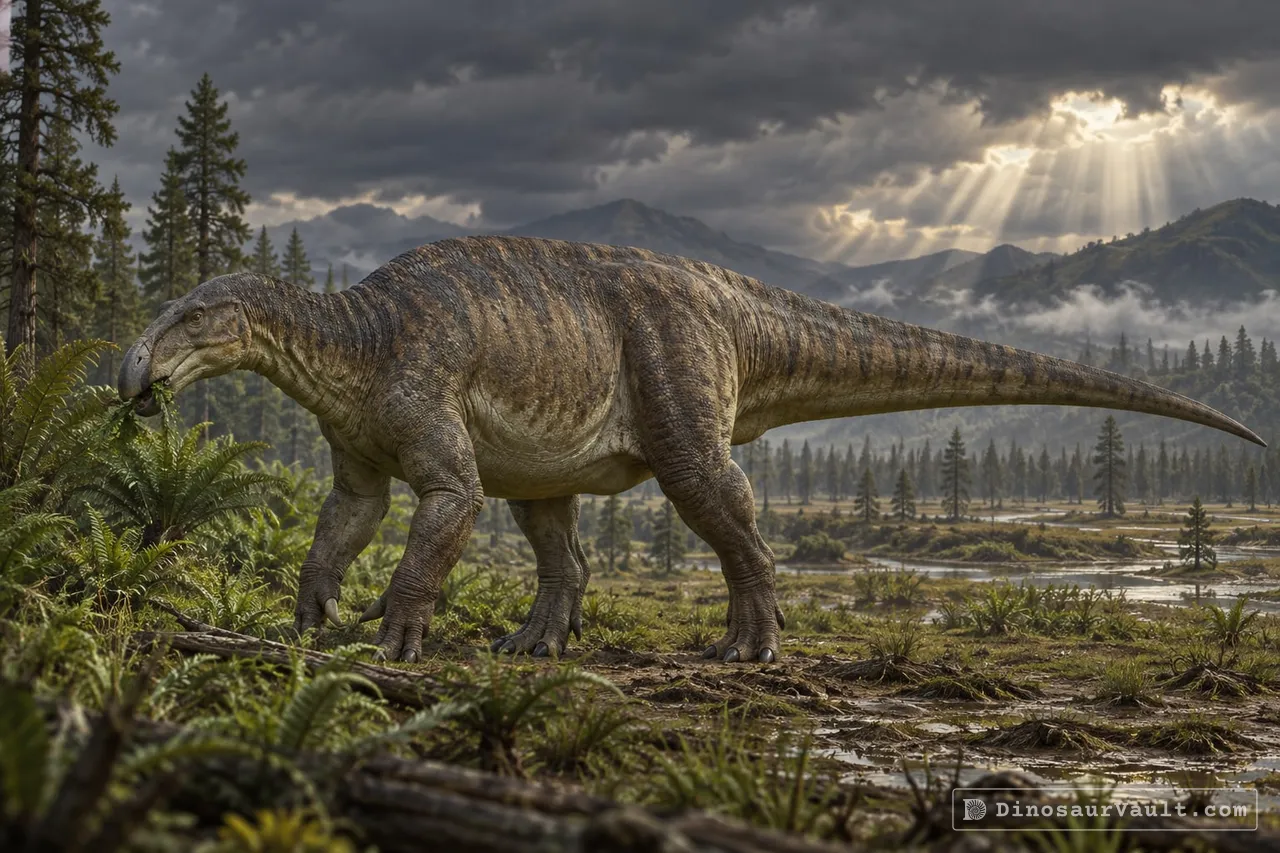
Lanzhousaurus was a very large plant eater related to Iguanodon, known from a partial skeleton with a lower jaw. It had some of the largest teeth of any plant-eating dinosaur.
It had far fewer teeth than its relatives, but each tooth was huge.
Its world
It lived in the Early Cretaceous in what is now northwestern China.
How it was found
You and colleagues named Lanzhousaurus in 2005, from a single find.
Field gallery
More views of Lanzhousaurus
Scenes reconstructed from the available fossil evidence.
1 of 3
The evidence
The science behind Lanzhousaurus
Which parts of the picture come from its own bones, and which come from its relatives.
From its own fossils
- An incomplete skeleton preserves the lower jaws, teeth, neck and back vertebrae, ribs, breastbones and part of the hips.
- A small number of huge teeth formed a broad, continuous chewing surface.
- Chemical patterns and growth lines in its teeth suggest that tooth enamel grew rapidly.
Borrowed from relatives
- Its missing limbs are restored by comparison with other large iguanodontians such as Lurdusaurus and Iguanodon.
- Like Lurdusaurus, it probably had a heavy body supported on all fours.
Still unknown
- The proportions of its arms, legs and tail.
- Which plants it ate.
- Its skin texture and color.
Discovery timeline
- 2005Named itYou, Ji & Li
- 2014Same rocksLi et al.
- 2017How it fedSuarez et al.
Key papers
The research behind what we know of Lanzhousaurus
Named it
Described Lanzhousaurus from a partial skeleton with enormous teeth and compared it with the heavily built Lurdusaurus.
Lanzhousaurus magnidens gen. et sp. nov. from Gansu Province, China: the largest-toothed herbivorous dinosaur in the world. Geological Bulletin of China 24: 785-794
No link available
Same rocks
Named Yongjinglong from the same regional rock group, adding another large plant eater to the fauna that included Lanzhousaurus.
A New Titanosaurian Sauropod from the Hekou Group (Lower Cretaceous) of the Lanzhou-Minhe Basin, Gansu Province, China. PLoS ONE 9: e85979
Read the paper : A New Titanosaurian Sauropod from the Hekou Group (Lower Cretaceous) of the Lanzhou-Minhe Basin, Gansu Province, China (opens in a new tab)How it fed
Chemical measurements and scans of its giant teeth suggest rapid enamel growth, a feeding adaptation that appeared before duck-billed dinosaurs.
Stable Isotopes Reveal Rapid Enamel Elongation (Amelogenesis) Rates for the Early Cretaceous Iguanodontian Dinosaur Lanzhousaurus magnidens. Scientific Reports 7
Read the paper : Stable Isotopes Reveal Rapid Enamel Elongation (Amelogenesis) Rates for the Early Cretaceous Iguanodontian Dinosaur Lanzhousaurus magnidens (opens in a new tab)
Close relatives
Other members of Styracosterna


Sources: Wikidata